Broiler Mortality in a Philippine Summer: What Is Normal, and What It Costs
The short answer
No Philippine source publishes a measured mortality rate for a backyard broiler flock. The nearest published figure is a target: 48 commercial contract growers told a 2022 survey what they aim at, and the 16 of them in open-sided housing named 94 to 95% livability for big birds and 93 to 96% for lechon manok. Target iyon, hindi resulta, at hindi bakuran. On 50 manok that is two or three deaths, and a third of the growers in the same survey said they hit their targets only sometimes or not at all. Ang mas masasagot na tanong ay hindi kung ilan ang namatay kundi kung kailan sila namatay.
Source Datuin et al. (2022), Production System of Selected Commercial Broiler Chicken Farms in the Philippines, PJVAS 48(1):57-69 (read on August 13, 2026)
94 to 95%. Know what that number is before you measure a batch against it. It is a livability target, and it belongs to sixteen commercial contract growers in open-sided housing who were asked what they were aiming at (Datuin et al., PJVAS 48(1):57-69). Walang sinukat doon. Nobody audited it, nobody recorded an outcome against it, and not one of those farms was a bakuran.
Repeat it as a result and the arithmetic gets strange fast. Applied to 50 manok, 95% livability is 2.5 dead birds and 94% is 3. Kalahating manok ang isinasagot sa iyo ng porsyento, which is what happens when a figure built for a house of ten thousand is pointed at a flock of fifty.
The deeper problem is not the half bird. A percentage says nothing about gastos. It treats every dead bird as the same dead bird, and they are not the same. A sisiw that dies on the fourth night has eaten almost nothing. A bird that dies in the fifth week has eaten a third of a sack and was carrying the whole point of the batch. Pareho silang isang manok sa mortality chart.
If you are still at the beginning of this, read the broiler pillar first and come back once ang mga sisiw are on the ground at nasa kulungan na sila.
Saan ba galing ang 94 hanggang 95 na porsyento?
From one paper, and the scope of that paper decides everything you may do with the number afterwards.
Datuin et al. (2022) surveyed 55 commercial broiler operations: 48 contract growers and 7 integrators. The housing split covers the growers alone. Of those 48, 46 are classified by housing type, 16 open-sided and 30 climate-controlled, and the 7 integrators appear in neither column (PJVAS 48(1):57-69). So the open-sided figures are sixteen farms’ answers, not fifty-five.
Table 5 on page 66 carries the word that matters in its own title: Broiler production performance targets of growers based on type of housing. Its open-sided column gives 94 to 95% livability for big birds over 1.7 kg, and 93 to 96% for lechon manok at 1.6 kg and under. Climate-controlled housing runs 92 to 98% and 85 to 98% for the same two market classes.
Before using any of it, read Table 6 on the same page. It records 31% of the growers meeting their targets only sometimes and a further 2% not at all, read out in the prose on page 65 as 33% (Datuin et al. 2022). Same growers, same survey. A third of the people who named those livability figures also said they do not always reach them.
Two things travel with the number every time it is quoted. The paper publishes a range and no mean, kaya walang midpoint na mahihila mula rito. Both ends or neither. And every one of the 55 was commercial, contract grower or integrator, so nobody in that survey was keeping 30 manok sa bakuran on whatever feed the dealer had that week. There is no Philippine equivalent for backyard flocks, and there never has been one. Hiram ang numero, at hindi mo kilala ang nagpahiram.
Ano ba talaga ang halaga ng isang patay na manok?
Here is where this page parts company with the rest of the search results for the question. What percentage is normal can only be answered with somebody else’s target. What did that death cost me can be answered today, out of tables that are already published, and nobody puts that answer in front of Filipino keepers.
The cost of a death is set by the day it happens, not by the rate.
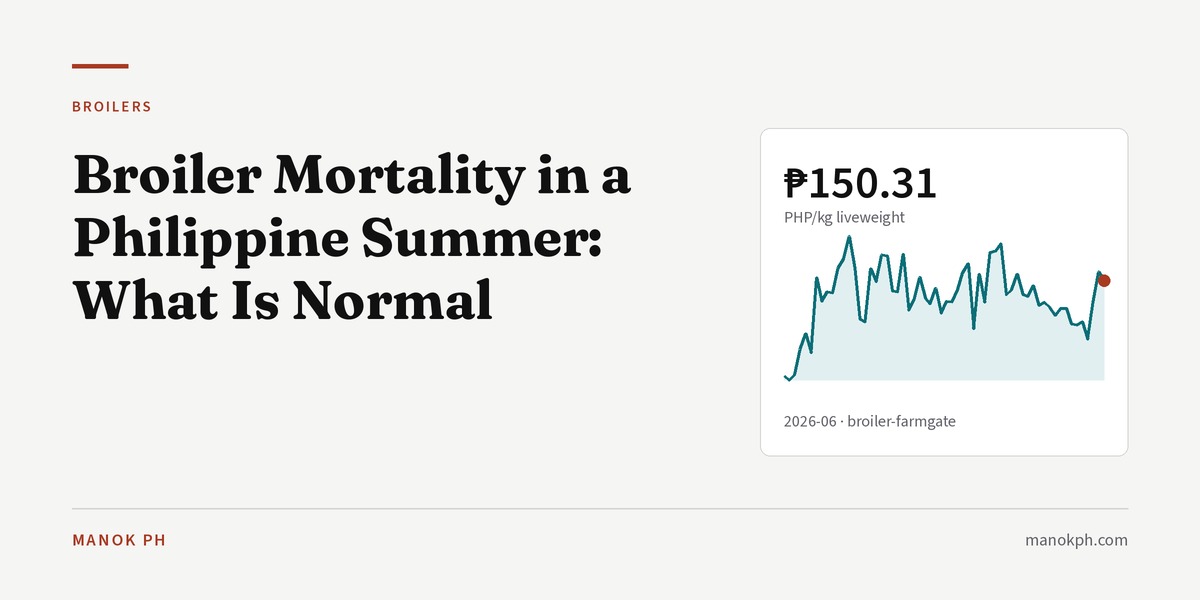
Two published columns give you the ladder. Aviagen prints Ross 308 AP body weight and cumulative feed intake day by day (Ross 308 AP Broiler: Performance Objectives, 2022), and PSA prints ₱150.31 per kilo liveweight for what household sellers received in June 2026. Put one against the other and a dead manok stops being a percentage. Nagiging halaga ito, at magkaiba ang halagang iyon kada linggo.
| The day it dies | Ross 308 AP body weight | Feed already eaten | That liveweight at the June 2026 household farmgate |
|---|---|---|---|
| Placement | day-old chick | 0 g | none; ₱33.50 of stock |
| Day 7 | 214 g | 165 g | ₱32.17 |
| Day 14 | 540 g | 537 g | ₱81.17 |
| Day 21 | 1,033 g | 1,167 g | ₱155.27 |
| Day 28 | 1,657 g | 2,083 g | ₱249.06 |
| Day 35 | 2,360 g | 3,268 g | ₱354.73 |
Weight and cumulative intake are as-hatched metric rows transcribed from Aviagen (2022), which are performance objectives for controlled housing rather than Philippine measurements. The peso column is that weight multiplied by ₱150.31 per kilo liveweight, PSA household broiler farmgate, June 2026. The chick is ₱33.50 per head for the week of 13 July 2026, which is BAI integrator and wholesale farmgate and not what a dealer charges a backyard keeper over the counter.
Read the fourth column honestly. Nobody buys a 540 g bird at farmgate, and the figure does not pretend they would. It is the liveweight the batch has already put on, priced at the only Philippine farmgate series there is. What a death takes away is that weight, plus the feed that bought it. Iyon ang totoong gastos, hindi ang porsyento sa itaas nito.
The two ends of the ladder are not close. A bird lost on day 35 removes 10.6 times what the chick cost, before you count a single gram of the 3,268 g it ate getting there. Isang manok, dalawang linggo ang pagitan, at halos sampung beses ang agwat.
Week one is the cheap end in pesos, and that is not a reason to relax about it. It is the one week where you set the temperature instead of the weather, and the decisions that settle it are made before the sisiw arrive: heat source, litter, ring size. Bago pa dumating ang sisiw, tapos na ang pinakamahalagang desisyon sa buong batch. The evidence for those sits in the coop guide and is not repeated here.
Work it out for your own flock
How warm should the brooder be this week? Open the calculator
The one week of the batch where the temperature is your decision rather than the weather's, worked against Philippine ambient rather than a European schedule. Week-one deaths are the cheapest on the ladder above and the easiest to prevent.
Bakit mas pangit ang totoong feed conversion mo kaysa sa nakalimbag?
Because the breed table does not count dead birds, and it says so in its own footnote.
Aviagen states that its cumulative FCR column includes the chick’s weight at placement and does not account for mortality (Ross 308 AP Performance Objectives, 2022). So 1.386 at day 35 is not sacks fed divided by kilos sold. Your own figure at the end of a batch carries the feed eaten by every manok that never reached the palengke, and none of that feed is in the table.
Your real number is therefore always worse than the printed one, and the gap is exactly that: the feed of the dead. A batch that loses 8% and loses it late has bought most of a full grow-out for birds that sold for nothing. Puhunan iyon na walang kapalit.
That is one reason the Philippine survey band sits so far above the brochure. The open-sided target FCR in Datuin et al. is 1.50 to 1.83 for big birds and 1.50 to 2.00 for lechon manok, against a Ross day-28 cumulative figure of 1.257 in the row that lands inside the 1.6 to 1.7 kg Philippine harvest weight (PJVAS 48(1):57-69). Mortality is not the whole of that gap. It is one line of it, and it is the line no costing sheet carries, so it shows up first in the break-even price.
The full week-by-week table, Ross and Cobb side by side, is in the growth-by-week piece. Do not average the two strains. Pumili ka ng isa at iyon ang gamitin sa buong batch.
Init ba ang pumapatay, o ang mabagal na paglaki?
The published evidence describes the second one and not the first, and the two get quietly swapped.
Kpomasse et al. (2021) report that at 32 °C, weight gain falls 21% under cyclical heat stress and 36% under constant heat stress (Veterinary Medicine and Science). Teyssier et al. (2022) report that cyclic heat stress cuts feed intake by about 15%, roughly 1.5% for every degree, with no temperature range attached to that figure at all, while constant heat stress cuts it 25 to 45%, about 3.5% for every degree between 22 and 35 °C (Frontiers in Physiology). The 22 to 35 °C interval belongs to the constant figure, and lending it to the cyclic one is the commonest misreading of that paper.
Count what those two papers actually measure. Feed intake and weight gain. Hindi dami ng namamatay. Neither review is Philippine, and neither hands you a mortality figure for a Philippine summer.
The ambient side does not close the distance either. PAGASA gives a Philippine mean annual temperature of 26.6 °C and a warmest month mean of 28.3 °C (Climate of the Philippines). Mean iyon, hindi ang hapon sa ilalim ng yerong bubong, and the 32 °C in those papers is an experimental condition rather than a Philippine reading. Nobody has joined the two ends with Philippine data.
So there is no correction factor here, and anybody offering one has invented it. Multiply 94% livability by a heat coefficient and you get a decimal point sitting on top of somebody else’s target. It looks measured. It is a guess. At mas mapanganib ang hulang may decimal point kaysa sa pag-aming walang datos.
Anong tanong ang hindi kayang sagutin ng datos na ito?
Two of them, and both are logged rather than papered over.
There is no Philippine performance data for a backyard flock at all. That is gap G-1 in this site’s register of missing data, and it is why every mortality figure on this page is borrowed from commercial contract growing. The second gap is tighter than the first. During an HPAI wave the only birds counted are the ones culled on farms that were reported. Ang namatay sa bakuran na walang nagsumbong ay wala sa kahit anong datos, saanman. That hole is permanent, and the timing of Philippine outbreaks is the closest anyone can get to it.
Cause of death is a different question on a different page, the common diseases. And if a bird stopped eating this morning, what you need is a veterinarian, not a table.
What usually goes wrong
The mistake: Quoting 94 to 95% livability as what a Philippine flock achieves.
Do this instead: It is what 16 open-sided commercial contract growers said they were aiming at, in Table 5 of Datuin et al. (2022), a table whose own title says "targets".
Table 6 on the same page has 33% of those growers meeting their targets only sometimes or not at all, and no backyard flock was surveyed at all.
The mistake: Treating a mortality percentage as the size of the loss.
Do this instead: Price each death by the day it happened. A bird lost at day 7 was carrying ₱32.17 of liveweight; one lost at day 35 was carrying ₱354.73.
Two batches at the same percentage can be more than a thousand pesos apart, and the percentage cannot see the difference.
The mistake: Multiplying a livability target by a heat-stress coefficient to get a Philippine number.
Do this instead: Kpomasse et al. (2021) and Teyssier et al. (2022) measure weight gain and feed intake under experimental heat, not deaths, and neither is Philippine.
The result would carry a decimal point, look measured, and be invented. There is no published bridge between PAGASA ambient means and a 32 °C experimental condition.
The mistake: Budgeting feed from the breed table and expecting your sacks to match.
Do this instead: Aviagen states plainly that its cumulative FCR column does not account for mortality, so sacks fed over kilos sold is always worse than the printed row.
The gap is exactly the feed eaten by birds that died, which is the one feed line no costing spreadsheet carries.
The mistake: Costing dead chicks at the ₱33.50 you saw in a BAI report.
Do this instead: That is integrator and wholesale farmgate for the week of 13 July 2026. What a backyard keeper pays a dealer for 50 chicks is published nowhere.
Both figures can be true at once, and averaging them produces a stock cost that nobody in the chain would recognise.
Dalawang batch, parehong 8%, magkaibang pinsala
Take two 50-bird batches. Both lose four manok, so both sit at 8% mortality, and both send 46 birds to the palengke. The 50 chicks cost ₱1,675 at the BAI farmgate figure for the week of 13 July 2026, and ₱134 of that is buried in the four dead ones whichever week they died in. Pareho ang puhunan sa sisiw.
That is where the similarity ends.
| Namatay sa unang linggo | Namatay sa ikalimang linggo | |
|---|---|---|
| Birds sold | 46 | 46 |
| Chicks buried, at ₱33.50 each | ₱134 | ₱134 |
| Feed those four had eaten | 0.66 kg | 13.07 kg |
| Liveweight they were carrying when they died | ₱128.67 | ₱1,418.93 |
Cumulative intake and body weight from Aviagen (2022), day 7 and day 35 rows. Liveweight valued at ₱150.31 per kilo, PSA household broiler farmgate, June 2026. Chicks at ₱33.50 per head, BAI farmgate, week of 13 July 2026.
The cash that actually left is the feed. The second batch bought about a quarter of a sack more than the first and sold exactly the same 46 birds, so you can price that gap off your own dealer’s receipt. Sa resibo mo lang iyon makikita, kasi walang naglalathala ng presyo ng sako sa bansang ito. Nobody publishes a Philippine sack price for finished commercial feed, so ₱1,850 to 1,950 depending on brand and area is an acknowledged spread rather than a sourced figure.
The ₱1,418.93 is not cash that left. It is the finished product, lost inside the week it was going to be sold in: the open-sided growers in Datuin et al. named 30 to 34 days as their harvest window for big birds and 28 to 38 for lechon manok (PJVAS 48(1):57-69). The first batch lost ₱128.67 of liveweight. The second lost more than ten times that, out of the same 8% and the same 46 birds sold. Run both through the 50-bird batch costing and the kita line comes out different with an identical mortality line sitting above it.
Kaya hindi porsyento ang nawala sa iyo ngayong tag-init. It is a sum, and the week the deaths landed in decides how big that sum is.
Questions people actually ask
What is a normal broiler mortality rate in the Philippines?
No Philippine source publishes a measured backyard figure. The nearest published number is a target: the 16 open-sided contract growers in Datuin et al. (2022) named 94 to 95% livability for big birds and 93 to 96% for lechon manok, which is 5 to 6% and 4 to 7% mortality. Table 6 of the same paper records 33% of the growers meeting their targets only sometimes or not at all, so treat the band as an aim rather than an outcome, and remember that not one backyard flock was surveyed.
How much does one dead broiler cost me? Show the answer
It depends entirely on the day it dies. Using the Aviagen Ross 308 AP objectives and the June 2026 PSA household farmgate price of ₱150.31 per kilo liveweight, a bird that dies on day 7 was carrying ₱32.17 of liveweight and had eaten 165 g of feed; one that dies on day 35 was carrying ₱354.73 and had eaten 3,268 g. Add the ₱33.50 day-old chick either way.
Does heat explain summer deaths? Show the answer
The two review papers usually cited measure growth and feed intake, not deaths. Kpomasse et al. (2021) report weight gain falling 21% under cyclical heat stress at 32 °C; Teyssier et al. (2022) report feed intake falling about 15% under cyclic heat stress. Both are imported reviews, neither is Philippine, and neither is a mortality figure or a correction factor you can multiply a livability target by.
Why is my real feed conversion worse than the breed table? Show the answer
Because the breed table excludes mortality. Aviagen states that its cumulative FCR column does not account for dead birds, so sacks fed divided by kilos sold will always be worse than the printed figure. The gap is exactly the feed eaten by the birds that did not reach the palengke.