What a 50-Bird Broiler Batch Actually Costs in 2026
The short answer
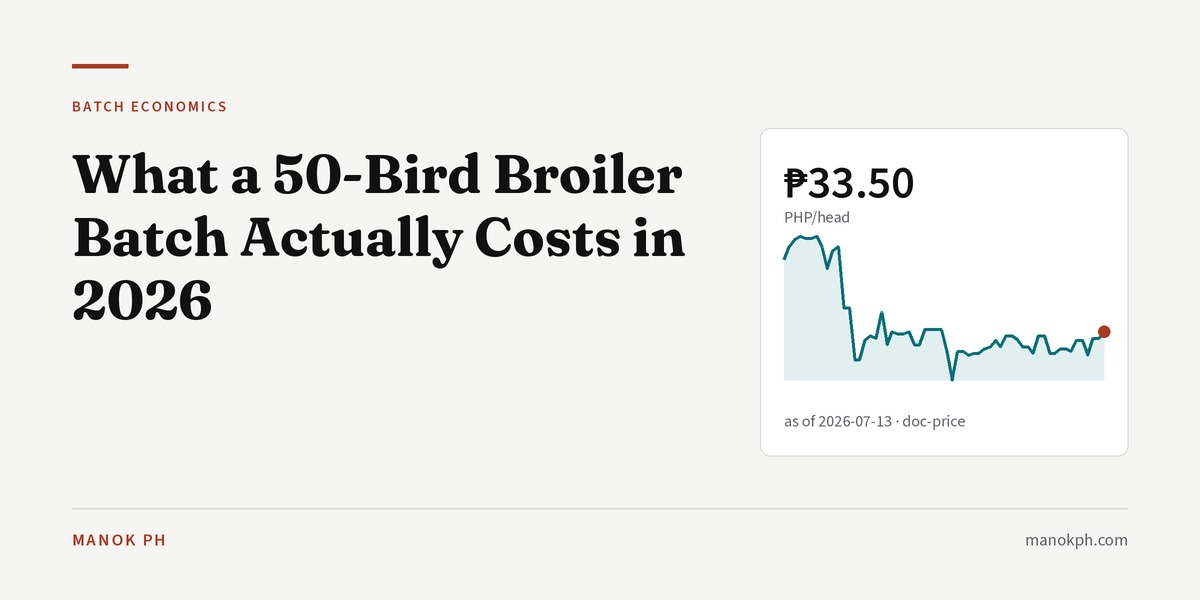
There is no honest single total, and the reason is one missing series rather than a judgement about your farm. The sisiw line is published: ₱33.50/head at BAI monitoring for the week of 13 July 2026, so 50 chicks start at ₱1,675 at wholesale level and cost more than that across a dealer’s counter. The feed line, which is the biggest of the five, has no published price anywhere in this country. What can be handed over is the volume and not the peso figure: 128 to 156 kg, or 2.6 to 3.1 sacks of 50 kg, to carry all 50 placed birds to 1.7 kg liveweight. Take the top of that, multiply by your own dealer’s sack price this week, add the sisiw, and you have the two lines that decide the batch.
Source BAI weekly price monitoring, day-old chick farmgate, week of 13 July 2026 (read on August 13, 2026)
Fifty birds is the batch most backyard keepers settle on. Malaki na para may kita at the end of it, small enough to still fit sa bakuran without turning the whole yard into a farm. The question everybody types into Google is magkano ang puhunan, and the honest answer has a hole in the middle of it.
Five lines carry the gastos: sisiw, feeds, brooding, bakuna, and the small hardware. Of those five, exactly one can be quoted with a date and a source attached, and it is not the big one. Feeds is the largest cost in any broiler batch, and walang naglalathala ng presyo ng sako nito anywhere in this country. Not the Bureau of Animal Industry, not PSA, not the millers themselves.
So the feed line in the table below is blank, and the section under it says exactly why. Every other row carries a link to the archive row it came from. The presyo of the sack is yours to supply, this week, from your own dealer, with the date written beside it.
| Line | Where the figure comes from | 50-bird batch |
|---|---|---|
| Sisiw, 50 head | BAI monitoring, ₱33.50/head, week of 13 July 2026 (/presyo/doc-price) | ₱1,675 at that figure, and a backyard buyer pays above it |
| Feeds, all 50 placed birds | Nobody publishes it (gap G-15) | your sack price × 2.6 to 3.1 sacks |
| Brooding heat, litter, feeder, drinker | No published series | your own numbers |
| Bakuna and vet | No published series | your own numbers |
| Liveweight sold, the 47 birds that reach harvest at 1.7 kg | Datuin et al. (2022) target livability, PH target weight | 79.9 kg |
| Farmgate revenue, backyard seller | PSA Household, ₱150.31/kg, June 2026 (/presyo/broiler-farmgate) | about ₱12,010 |
Two of those rows count different birds and it is deliberate. Feeds is bought for all 50 you place, kasi kumakain ang lahat ng manok mula sa unang araw. Liveweight is sold off the 47 that reach harvest. Mixing the two bases is where most 50-bird costings quietly lose a sack.
Four of those six rows are yours to fill in, and that is the difference between a costing you can defend to whoever holds the puhunan in your house and one you copied off a blog that never said kailan nito nakita ang numero.
Bakit walang presyo ang pinakamalaking gastos?
Because feed pricing here is set per dealer and quoted verbally, never written down. That is not a guess. Every route to a published sack price was worked through on 13 August 2026, mula sa BAI hanggang sa mga miller, retailer at marketplace, and the account of what each one returned lives in /articles/philippine-poultry-data-gaps. The gap is logged as G-15.
BAI prices 15 feed ingredients in pesos per kilo and never a bag, a brand or a tier. Those 15 do sit in the archive, at /presyo/group/feed-ingredients, and they are useful for watching where the cost pressure is coming from. You cannot turn them into a sack price. Getting from corn and soya to a bag of finisher needs the mill’s formula, its energy cost and its margin, and none of the three is published.
Which leaves one move. Go to your suki dealer, ask the presyo of a sack of starter, grower and finisher, write the date beside each one, and bring three quotes back rather than one. The break-even tool at /tools/break-even works the same way, and will not invent a sack price for you either.
Work it out for your own flock
Magkano ang feeds to get a broiler to market? Open the calculator
It wants a sack price and the weight that sack holds, and it does the multiplication for 50 birds from there. Starter and finisher at different prices are two runs, added together.
Gaano karaming feeds ang kakainin ng 50 manok?
The quantity is knowable even when the presyo is not, basta alam mo kung ano talaga ang binibilang ng numerong ginagamit mo.
Datuin et al. (2022), in the Philippine Journal of Veterinary and Animal Sciences 48(1):57-69, surveyed 55 commercial broiler farms and asked them what they were aiming at. Table 5 on page 66 is headed “Broiler production performance targets of growers based on type of housing”, so no cell in it is a result. Only its 48 contract growers were split by housing, and sixteen of them were open-sided, which is what nearly every bakuran coop in this country really is. That is the row to read: a feed conversion of 1.50 to 1.83, harvested at 30 to 34 days, at 94 to 95% livability. For the lighter lechon manok product, below 1.6 kg liveweight, the aim was 1.50 to 2.00 over 28 to 38 days.
How often the aims land is in the same paper, asked of the whole grower group rather than of the open-sided sixteen alone. Across those growers, 33% said they meet their targets only sometimes or not at all (PJVAS 48(1):57-69). That turns the band inside out. 1.50 is not the likely case and 1.83 is not the bad one; 1.83 is the ambition of a trade that misses its ambitions a third of the time, kaya doon mo ilagay ang budget mo.
Now hold that against the breed table, at the row that matches our harvest weight, not the famous one. Aviagen’s as-hatched Ross 308 AP has eaten 2,083 g of feed by day 28 and weighs 1,657 g when it has, which is a cumulative feed conversion of 1.257 (Ross 308 AP Broiler: Performance Objectives, 2022); the week-by-week table carries that column day by day. You will see the same comparison run at a rounded 1.20, on this site included, and that is a convention rather than a row anybody publishes. Para sa climate-controlled na bahay ang numerong iyon, malayo sa bakuran, kaya nasa sariling hilera ito sa ibaba, sa sariling timbang nito.
| Feed conversion used | What it describes | Feed for the 50 birds you place | Sacks of 50 kg |
|---|---|---|---|
| 1.257 | Ross 308 AP on day 28, controlled housing, at the 1,657 g the bird weighs there | 104 kg | 2.1 |
| 1.50 | Datuin et al. (2022), bottom of the open-sided big-bird target band, at 1.7 kg | 128 kg | 2.6 |
| 1.83 | Datuin et al. (2022), top of the same band and the end to buy against, at 1.7 kg | 156 kg | 3.1 |
A full sack separates the top of that table from the bottom. Budget on the breed row and you are a whole sack short of the top of the Philippine band bago ka pa magsimula, and running out of feeds in the last week of a batch is a worse problem than the peso figure makes it look.
Note which birds that middle column counts, kasi ito ang tahimik na mali sa halos lahat ng batch costing. Feed conversion is kilos of feeds against kilos of liveweight, so the tempting sum runs it over the 47 manok you expect to sell. Do that and you have set aside nothing at all for the three that died, at kumain sila araw-araw hanggang sa araw na iyon. The rows above are counted over all 50 placed birds, which is the number your money buys chicks for. The true figure sits a little under that, since a bird lost on day 20 never ate a full ration, and nobody in this country publishes a mortality-timing curve that would let you land it exactly. Erring upward on feeds is the cheap direction to be wrong in.
Tingnan mo rin kung sino ang tinanong. Datuin et al. put the question to 48 contract growers and 7 integrators, and not one hobbyist. Nobody has published a Philippine backyard feed conversion figure at all. That is gap G-1, and anybody quoting you a backyard FCR got it from somewhere they will not name. Week-by-week weights are in /articles/broiler-growth-by-week-philippines.
Ang sisiw: ₱33.50 ba ang babayaran mo?
Hindi. This is the trap most 50-bird costings walk into without noticing.
The ₱33.50 per head in the archive for the week of 13 July 2026 is BAI’s monitored farmgate figure (/presyo/doc-price). Farmgate here means the hatchery gate, at integrator or wholesale level, moving sisiw in the volumes an integrator moves them. It is not the presyo a dealer quotes you for 50 chicks.
Your real figure is higher, at walang naglalathala noon either. Dealer margin on a 50-head order sits in no series, exactly like the sack price. So ₱1,675 is a floor the batch cannot drop below rather than a budget line. Tumawag ka sa hatchery, kunin mo ang quote, at iyon ang gamitin mo.
Watch the unit while you are at it. That series is per head. A calculator that reads it as pesos per kilo returns an answer wrong by two orders of magnitude that still looks perfectly reasonable on the page.
Bakit mali ang halos lahat ng batch costing na nabasa mo
This is a position, not a matter of taste. Almost every 50-bird costing published for this market is wrong, and it goes wrong in the same four places every time. Two of them are the sections you have just read. The other two are the section straight after this one, kaya hindi ito listahan ng mga bagay na wala rito.
Ang apat, isa-isa
The mistake: A confident sack price set down with no date and no dealer beside it, as though somebody had measured it.
Do this instead: Leave the feed line blank until your suki has quoted you this week, then write the date and the dealer next to the figure you got.
Nobody measured it. No agency in this country publishes the price of a sack of finished feed, which is gap G-15, so a figure that does not say kailan at saan ito nakita is invented kahit tama pa ang bilang.
The mistake: The two PSA broiler farmgate series blended into one number, or whichever of them flatters the story quietly picked.
Do this instead: Name the series that describes the seller you actually are, use it on every line, and leave the other one where it is.
They describe different sellers at different market levels. Two readings of one thing can be averaged; these are not that, and the section below prices the distance between them.
The mistake: A cost per kilo held against the presyo ng dressed chicken sa palengke, because that is the figure a keeper sees every week.
Do this instead: Hold your cost per kilo against a farmgate figure, in liveweight, read on the month you are selling in.
Retail is a different market level and dressed weight is a different basis, so the margin doubles on paper without one extra bird being sold.
The mistake: The feed line costed on a breed-table feed conversion.
Do this instead: Cost it at 1.83, the top of the Philippine open-sided band, across all 50 birds you place.
One sako, gone, as the table above shows. The breed row describes a house where somebody chooses the temperature.
A costing with a blank in it beats a costing with a confident wrong number, kasi the blank tells you exactly which figure to go and get. Confidence is free. Ang petsa at ang link ay hindi.
Anong presyo talaga ang bebentahan mo?
PSA publishes two broiler farmgate series, and they describe two different sellers.
The Household series stood at ₱150.31 per kilo liveweight in June 2026 (/presyo/broiler-farmgate). That is the series describing a backyard raiser, kaya iyon ang gamit dito. The commercial establishment series stood at ₱118.69 per kilo for the same month (/presyo/broiler-farmgate-establishment).
₱31.62 per kilo separates them. Across the 79.9 kg a 50-bird batch delivers, that is ₱2,526 in one batch, mas malaki pa sa buong gastos mo sa sisiw. Never blend or average the two. They are different populations, not two readings of the same thing. The full comparison sits in /articles/two-broiler-farmgate-prices.
The third trap is the palengke. Dressed chicken retail stood at ₱213.24 per kilo in July 2026 (/presyo/dressed-chicken-retail), and you cannot hold that against a farmgate figure. Different market level, and a different basis on top of it: dressed weight against liveweight. There is no sourced Philippine dressing percentage anywhere in this archive, kaya hindi ako magko-convert between the two. Anyone who does it without naming a source has told you how careful the rest of their page is.
Once your own sack price is written down, /articles/broiler-break-even-price turns all of this into a peso-per-kilo figure you can hold against those two series.
Anong mga linya ang hindi binibilang ng iba?
Espasyo. PNS/BAFS 262:2018 § 6.3.1 sets broilers in a fixed building at 10 birds per square metre or 17 kg per square metre, whichever binds first. At exactly 1.7 kg per bird the two are the same limit. So 50 birds at target weight is 5 m² whichever limit you compute, and above 1.7 kg the mass limit takes over from the headcount. Sukatin mo ang kulungan mo bago pa dumating ang sisiw. That standard is written for free-range production, and no Philippine body publishes a density standard for confined backyard housing at all. /tools/coop-size does the arithmetic.
Brooding. The first fortnight decides the batch, at ang temperatura ang buong laro. /tools/brooder-temperature carries the schedule.
Bakuna at vet. A real line in a real budget, with no published price series covering it. Tanungin mo ang vet mo o ang agri-supply, and do not take a peso figure for it from anybody who cannot say where theirs came from.
Namatay na manok. At the 94 to 95% livability the open-sided big-bird row of Datuin et al. records as a target, 50 placed birds becomes 47 or 48 sold, which is the good case and not the expected one. In a batch this small one dead bird is two per cent of everything. The feed side of that is already carried above; what is not carried anywhere is the sisiw itself, which was paid for in full at day one.
Ang oras mo. Kept out of the headline break-even deliberately, kasi hindi cash cost ang sarili mong oras, and folding it in makes the number incomparable with every peso-per-kilo figure quoted elsewhere. If you are weighing those hours against a fixed growing fee, /articles/contract-growing-vs-independent is the comparison to read next.
Ang pinakamaliit na linya ang humahawak sa pinakamalaki
Look at the table above one more time, and not at the biggest number in it.
The sisiw were paid for in full on day one, at buo ang bayad kahit ilan sa kanila ang umabot sa benta. Every peso in the feed line then gets spent on the birds that are still standing. So the line that decides what the whole costing comes to is not on the table at all: it is how many of the 50 are alive in week 5, and that is settled in the first fortnight, by temperature, by water, and by somebody actually looking at the birds twice a day.
That fortnight is the cheapest thing in this entire budget. The brooder tool carries the schedule, both PSA farmgate series still move at /presyo, and for the wider picture around all of this, /articles/raising-broilers-philippines is the pillar this sits under.
Ang pinakamaliit na linya sa budget na ito ang humahawak sa pinakamalaki, at wala itong sariling hilera sa kahit anong costing na mababasa mo. Hindi ito nabibili. Pinupuntahan ito.
Questions people actually ask
How much does it cost to raise 50 broilers in the Philippines?
Every line except one can be dated and sourced. Day-old chicks were monitored by the Bureau of Animal Industry at ₱33.50 per head in the week of 13 July 2026, which puts a floor of ₱1,675 on 50 chicks, and a backyard buyer pays above that. The feed line cannot be quoted, because no Philippine source publishes the price of a sack of finished commercial feed. The volume is knowable: 2.6 to 3.1 sacks of 50 kg to carry all 50 placed birds to 1.7 kg, on the 1.50 to 1.83 feed conversion the 16 open-sided farms in Datuin et al. (2022) named as their target. A third of the 55 growers that survey covered said they meet their targets only sometimes or not at all, so buy against the top of that band.
What price will I sell 50 broilers at? Show the answer
PSA publishes two broiler farmgate series and they describe different sellers. The Household series, which is the one that describes a backyard raiser, stood at ₱150.31 per kilo liveweight in June 2026. The commercial establishment series stood at ₱118.69 per kilo for the same month. They are never averaged. On the roughly 79.9 kg a 50-bird batch delivers, the gap between them is about ₱2,526.
How many sacks of feed does a 50-bird broiler batch eat? Show the answer
Between 2.6 and 3.1 sacks of 50 kg, which is 128 to 156 kg. Count it over the 50 birds you place and not over the 47 you expect to sell, because the three that die eat before they die. The range comes from the 1.50 to 1.83 feed conversion that the 16 open-sided growers in Datuin et al. (2022), Table 5, named as their target for a 1.7 kg bird. The same paper has 33% of the growers it split by housing missing their targets at least some of the time, which makes 3.1 sacks the number to buy against rather than 2.6. Aviagen's own day-28 row is smaller and is counted differently: 2,083 g of feed into a 1,657 g Ross 308 AP, a cumulative feed conversion of 1.257, which is 104 kg across 50 birds and about 2.1 sacks. That row describes controlled housing and is never averaged with the Philippine figures.