The Two Broiler Farmgate Prices, and Which One Is Yours
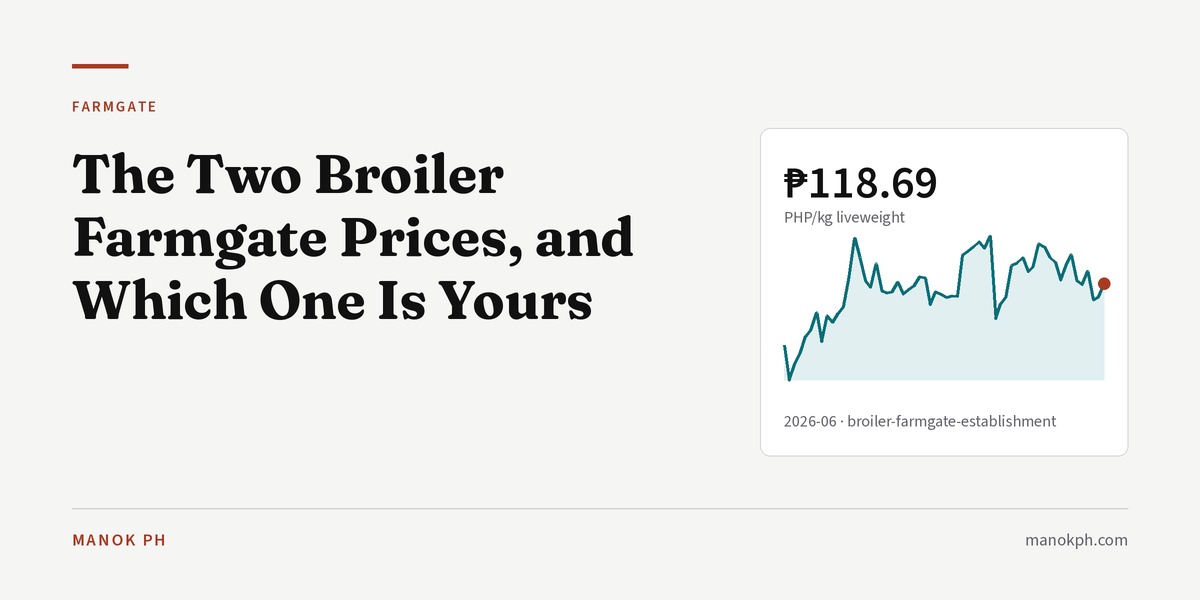
Ask PSA what a Philippine broiler was worth at the farmgate in June 2026 and it hands you two answers. One table says ₱150.31 per kilo liveweight. Another says ₱118.69 per kilo liveweight. Parehong national, parehong buwan, at iisang manok ang sinusukat ng dalawa. The two sit ₱31.62 per kilo liveweight apart.
So the first thing to fix is the belief that there is one national farmgate figure to look up. Dalawa sila, at least, and they disagree by about a fifth. The one that gets quoted in most write-ups is not the one a bakuran flock sells into. Alin sa dalawa ang sa iyo decides whether your batch plan is roughly right or wrong by a fifth on the revenue side, which is more than the margin on most backyard batches.
Alin ang totoong presyo, kung dalawa sila?
Pareho silang totoo, and the one that belongs to you is almost certainly the higher figure. The household series read ₱150.31/kg liveweight in June 2026, and it describes household raisers. The commercial establishment series read ₱118.69/kg for that same month, at hindi bakuran ang sinusukat noon.
Here is where I disagree with almost everything published on this query. Quoting the establishment number as “the Philippine broiler farmgate price” is not a harmless simplification, mali ang populasyon, and the error runs one way: it understates what a bakuran bird earns by ₱31.62 per kilo liveweight. Multiplied across the kilos a batch actually sells, that lands on the side of the ledger you cannot fix by buying cheaper feeds.
The trap on the other side is subtler. Do not average the two, do not take a midpoint, and do not split the difference kasi it feels safer. They are not two estimates of one quantity with the truth somewhere in the middle. They are two market levels, measured separately on purpose, and the average of them describes nobody at all.
Ano ba talaga ang pinagkaiba ng dalawang table?
Less than you would expect, which is exactly why the confusion survives. Both series carry 199 monthly rows from January 2010 to July 2026, both are quoted in pesos per kilo liveweight, and pareho silang national. Bukas pa ang cell ng July sa magkabila, so the newest complete month on both sides is June 2026. Same unit, same geography, same calendar, magkaibang populasyon.
Pare-pareho ang direksyon. Across the 198 months where both series carry a figure, the household price sits above the establishment price in 196 of them, and the exceptions are October 2020 and July 2024. Pwede mong tingnan iyon mismo in the CSV export rather than taking my word for it.
What is not consistent is the laki ng agwat, and that is what makes a fixed correction factor useless. It was ₱8.58 in January 2026 and ₱31.62 by June, averaged around ₱15.12 through 2025, and reached ₱57.64 in October 2024. Anyone handing you a panuntunan like “add fifteen percent to the commercial figure” is fitting a constant to a spread that has run from below zero to nearly ₱58 inside one archive.
Here are the two lines on one axis, every month from January 2010 to June 2026. Nasa itaas ang household halos sa buong stretch, and what actually moves is the distance between them, which opens and closes and never settles anywhere. Hindi mo ito makikita sa alinman sa dalawang presyo page: each one draws its own line only, and only the last 60 months of it.
198 monthly observations from PSA OpenSTAT: Farmgate Prices (New Series), Livestock and Poultry, January 2010 to June 2026. Household starts at PHP 97.49 per kg liveweight in January 2010 and ends at PHP 150.31 in June 2026. Highest PHP 173.04 in August 2022, lowest PHP 90.02 in April 2015. Commercial starts at PHP 87.62 per kg liveweight in January 2010 and ends at PHP 118.69 in June 2026. Highest PHP 134.37 in September 2024, lowest PHP 74.59 in August 2017. Every value, with its source, is on the Presyo page for each of these series.
See every observation on the Presyo pages →Why the household level runs higher is not something I can tell you: neither table publishes a reason. So the direction holds, gumagalaw ang agwat, and the cause stays unpublished.
Paano mo malalaman kung alin ang sa iyo?
By flock size, using the only official line anybody draws around the backyard sector. PSA counts smallhold flocks as 500 birds or fewer, and on 1 July 2026 that class held 89,298,658 birds out of a national flock of 228,489,122. Thirty-nine percent of the national flock sits in holdings at or under 500 birds. Bakuran ang bilang na iyon, and the sector gets nothing like that share of the attention.
Kung 500 pababa ang manok mo, ito ang linya mo, carrying the month it was read and the PSA table it came off rather than leaving either to memory.
Broiler farmgate, PSA Household survey, national
₱150.31/kg liveweight
PSA OpenSTAT: Farmgate Prices (New Series), Livestock and Poultry (read on 2026-08-15)
| Household series | Commercial establishment series | |
|---|---|---|
| Latest complete month | June 2026 | June 2026 |
| Price | ₱150.31/kg liveweight | ₱118.69/kg liveweight |
| PSA table | 0032M4AFN10.px | 0032M4AFN11.px |
| Describes | household raisers | commercial establishments |
| Rows in the archive | 199, from 2010-01 | 199, from 2010-01 |
| Use it if | you keep manok sa bakuran | you run a commercial house |
Kung contract growing ka, neither line is your sale price at all, kasi you are paid a growing fee rather than a farmgate price, and that is a different arrangement covered in contract growing versus independent.
May nagkamali na ba dito? Oo, itong archive mismo
The broiler farmgate archive carries a retracted row on exactly this confusion, still readable where it landed. A trade-press restatement put the Q1 2026 broiler farmgate price at ₱120.51/kg. It was filed into the household series, then retracted in place on 13 August 2026.
Ang retraction note mismo explains what went wrong, and it is worth reading kasi ito rin ang mali na inilalarawan dito. The ₱120.51 figure reproduces to the centavo as the mean of three monthly readings from a third PSA table, the establishment-weighted Average one, 0032M4AFN12.px. The household table’s own readings for that quarter were ₱128.30, ₱127.93 and ₱129.41, a mean of ₱128.55, about 6.7 percent higher. A reader who used ₱120.51 as a backyard farmgate price was reading an establishment-weighted average without knowing it.
Dalawang bagay ang sumusunod dito. First, this is more than a two-way split: PSA keeps a household table, an establishment table and an average table, so “the PSA broiler farmgate price” names at least three different numbers. Second, if you copied a farmgate figure out of anywhere last quarter, it is worth going back to see whether it is still standing. An archive that swaps a bad number for a good one without saying so leaves you no way to tell whether the figure you are still carrying was the bad one.
The withdrawn row was never deleted, so you can still read it where it landed. Nandito ang buong 2026 sa magkabilang table: the seven PSA months on each side, the retracted Q1 figure sitting in the household column between March and April with its reason attached, and the July cell na wala pang laman sa dalawa.
| Period | Household | Commercial establishment |
|---|---|---|
| January 2026 | ₱128.30/kg | ₱119.72/kg |
| February 2026 | ₱127.93/kg | ₱118.32/kg |
| March 2026 | ₱129.41/kg | ₱122.86/kg |
| not published | ||
| April 2026 | ₱139.49/kg | ₱113.53/kg |
| May 2026 | ₱154.77/kg | ₱114.52/kg |
| June 2026 | ₱150.31/kg | ₱118.69/kg |
| July 2026 | not published | not published |
Pesos per kilo liveweight, national, on both tables. The withdrawn row is quarterly and came from a third PSA table, so no establishment figure sits beside it. All 199 household rows and all 199 establishment rows carry their source and their read-date on the Presyo pages.
Bakit hindi mo pwedeng gamitin ang presyo sa palengke?
Kasi the retail figure is a third level and a different basis at once. Fresh dressed chicken retailed at ₱213.24/kg in July 2026. Hindi iyon ang farmgate mo with a markup on it. Dressed weight iyon, sold at retail, after somebody else’s slaughtering, transport and margin.
Converting between liveweight and dressed weight needs a Philippine dressing yield, and no sourced figure for it exists here or anywhere else I can point you to. Any percentage you have seen quoted for that conversion is probably a foreign figure, and using it to work backwards from the palengke to your own gate produces a confident number with nothing under it.
| Market level | What it is | Latest reading |
|---|---|---|
| Household farmgate | what backyard raisers are paid, liveweight | ₱150.31/kg, June 2026 |
| Establishment farmgate | what commercial farms are paid, liveweight | ₱118.69/kg, June 2026 |
| Dressed retail | what a buyer pays sa palengke, dressed | ₱213.24/kg, July 2026 |
Tatlong level, dalawang unit, iisang manok. Read down the column, never across it.
So ano ang gagawin mo sa numerong ito?
Put the household figure on the revenue side of a batch and leave it there. Your break-even comes from the gastos side, and the break-even calculator takes your own numbers. Day-old chicks were monitored at ₱33.50 per head in the week of 13 July 2026, the one input cost that has a published Philippine figure behind it. Ang presyo ng sako ng feeds ay sa iyo manggagaling, walang naglalathala niyon. That is a real gap in the data.
With the household figure and your own presyo ng sako, the arithmetic is worked through bird by bird in what a 50-bird broiler batch costs and the break-even price per kilo. The weight side of it, which decides how many kilos you are selling at that presyo, is in broiler growth by week. The wider picture is in raising broilers in the Philippines.
Bago mo buksan ang susunod na farmgate figure
Nagrerebisa ang PSA, at hindi lang minsan. Both series are refreshed from OpenSTAT and every figure above carries the date it was read, kaya a later row can move any of these numbers, and the July 2026 cell in both series will fill in before anything else does.
The argument is sturdier than the figures, but it is not permanent either. If the household line stopped running above the establishment line for a sustained run of months instead of two scattered exceptions, the ranking here stops being safe advice. If PSA published kung bakit magkaiba ang dalawang level, this article’s “cause unpublished” hedge comes out and something concrete goes in. And if a Philippine dressing yield is ever published with a source, the palengke figure becomes convertible and the retail column stops being off limits.
Wala pa niyan ngayon. So when somebody quotes you a broiler farmgate price tomorrow, at the feed store, in a Facebook group, in a news story about presyo ng manok, there is one question to ask before it goes anywhere near your batch plan: which of the three tables did it come from? Household if your manok are in a bakuran. Establishment if you run a commercial house. And if nobody can say which, it is not yet a price you can plan against, only a number with a peso sign in front of it.
Cite this page
Every figure here carries the source it came from and the date it was read. If you use one, this is the line that says where it came from.
A backyard poultry keeper. "The Two Broiler Farmgate Prices, and Which One Is Yours". Manoknomics. Published August 22, 2026. https://manoknomics.com/articles/two-broiler-farmgate-prices
Select the text to copy it.