Egg Price in the Philippines: ₱6.74 at the Gate, ₱9.07 at the Stall
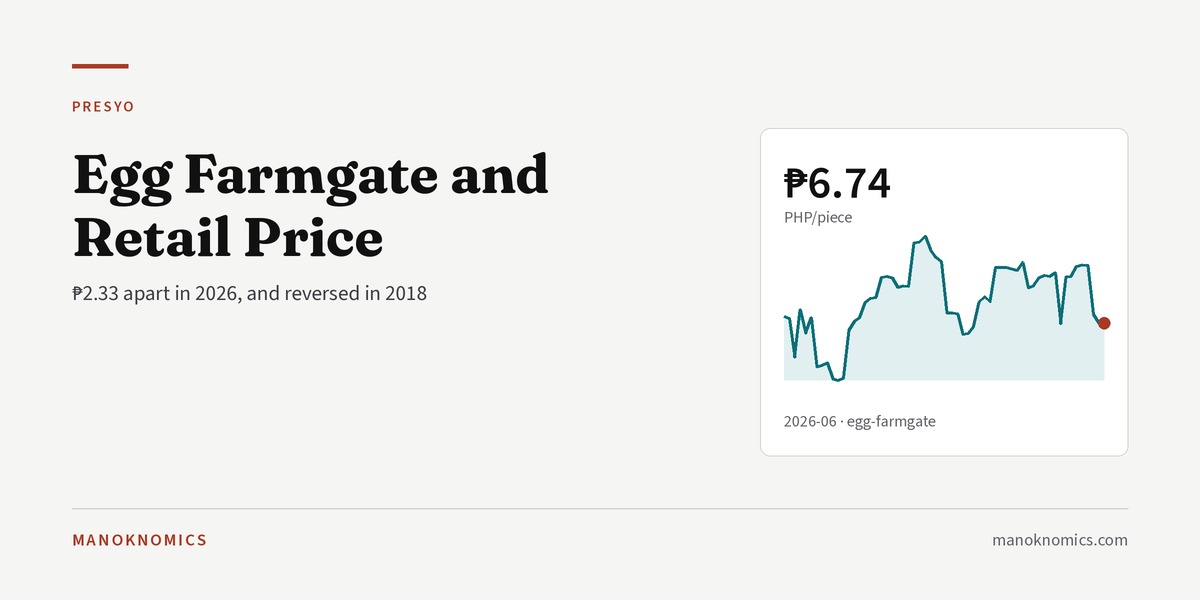
An egg was worth ₱6.74 at the farm gate and ₱9.07 at the stall in June 2026, both national, both per piece. Native eggs read ₱8.61 and ₱9.62 in the same month. Apat na presyo ng itlog, iisang buwan, at hindi mo sila pwedeng ibawas sa isa’t isa nang basta-basta.
The short answer
For June 2026 the PSA household farmgate price of a chicken egg was ₱6.74 per piece and the national retail price of one medium egg was ₱9.07 per piece. Native eggs ran ₱8.61 at the gate and ₱9.62 at retail. Retail publishes a month earlier than farmgate, so July 2026 already reads ₱9.03 at retail with the farm side still empty.
Source PSA OpenSTAT, farmgate and retail price tables (read on August 15, 2026)
| Level, June 2026 | Figure | Who is on the other side of it |
|---|---|---|
| Ordinary egg, farmgate | ₱6.74/piece | what a layer keeper is paid, across all sizes |
| Native egg, farmgate | ₱8.61/piece | what a bakuran keeper is paid for a native itlog |
| Ordinary egg, retail | ₱9.07/piece | what a buyer pays for one medium egg |
| Native egg, retail | ₱9.62/piece | what a buyer pays for one medium native egg |
Four series, one unit, and the whole of this page is about which pairs of them you are allowed to subtract.
The ₱2.33 is a distance, not a margin
Retail less farmgate for an ordinary egg came to ₱2.33 in June 2026, which is 25.7% of the retail price. That reads like the whole trade margin on one itlog, and it is not, because the two series do not describe the same egg.
The retail series prices one medium egg. PSA’s own commodity label says so, and PNS/BAFS 321:2021, the Philippine National Standard for shell eggs, puts Medium at 55 to 59.9 grams in its Table 1, one of eight weight classes running from Peewee under 45 g to Super Jumbo above 75 g. The farmgate series has no size class at all. It is an average across whatever the farm sold that month.
Ang patunay ay nasa archive mismo. Across the 102 months where both series carry a value, January 2018 to June 2026, the average difference is ₱0.72 a piece, not ₱2.33. And in 22 of those 102 months the subtraction comes out the wrong way round: the farm figure sits above the stall figure. January 2018 has the farm ₱1.08 ahead of the counter, and every one of the twelve months of 2018 is reversed, averaging ₱0.69 the wrong way for the full year.
No functioning market pays the producer more than the shopper for twelve consecutive months. So one of two things is true, at hindi ko po masasabi kung alin: either the farm side of the survey is weighted toward larger eggs than the medium the stall side prices, or the two surveys are reaching different populations of sellers. PSA publishes no bridge between them. What follows from either is the same rule, and it is the rule to take away from this page: read the two series each in its own right, and treat the distance between them as a distance, not as somebody’s income.
What the distance has done since 2018
It has widened, steadily, and almost all of the widening is the farm side falling rather than the stall side rising. The yearly means run from ₱0.69 the wrong way in 2018 to ₱1.94 across the first half of 2026, and the archive holds every month behind that.
| Year | Mean retail less farmgate, per piece | Months |
|---|---|---|
| 2018 | farmgate ₱0.69 above retail | 12 |
| 2019 | level, to the centavo | 12 |
| 2020 | ₱0.11 | 12 |
| 2021 | ₱0.37 | 12 |
| 2022 | ₱1.05 | 12 |
| 2023 | ₱0.77 | 12 |
| 2024 | ₱1.72 | 12 |
| 2025 | ₱1.80 | 12 |
| 2026, to June | ₱1.94 | 6 |
Every row is the mean of that year’s monthly differences between the farmgate series and the retail series, each month matched to itself. The 2026 row is six months because PSA has not published the farm side of July.
The three months from March to June 2026 are the cleanest illustration of what is happening underneath. Farmgate fell ₱1.02, from ₱7.76 to ₱6.74. Retail over exactly the same three months fell ₱0.18, from ₱9.25 to ₱9.07. Bumaba ang dalawa, pero halos anim na beses ang lalim ng nahulog sa panig ng nag-aalaga. If you are deciding this year whether to put more inahin in the kulungan, plan against the gate line. The stall line is not your revenue and it did not have your year.
Here are all four egg series on one axis, every month from January 2018. The native gate line runs dashed and is the thin one, because PSA published nothing for it before 2019 and skips months since. What is worth watching is not any single line but the two distances: the ordinary pair opening, and the native pair closing.
Axis starts at ₱4, not ₱0.
103 monthly observations from PSA, January 2018 to July 2026. Ordinary, gate starts at PHP 7.28 per piece in January 2018 and ends at PHP 6.74 in June 2026. Highest PHP 8.27 in September 2023, lowest PHP 5.75 in May 2022. Ordinary, retail starts at PHP 6.20 per piece in January 2018 and ends at PHP 9.03 in July 2026. Highest PHP 9.40 in October 2025, lowest PHP 6.20 in January 2018. Native, retail starts at PHP 8.06 per piece in January 2018 and ends at PHP 9.60 in July 2026. Highest PHP 10.43 in April 2025, lowest PHP 7.31 in August 2018. Native, gate starts at PHP 7.63 per piece in January 2019 and ends at PHP 8.61 in June 2026. Highest PHP 9.16 in February 2025, lowest PHP 6.44 in June 2021. One period has no published figure: July 2026. 13 periods have no published figure: January 2018, February 2018, March 2018, April 2018, May 2018, June 2018, July 2018, August 2018, September 2018, October 2018, November 2018, December 2018, July 2026. Every value, with its source, is on the Presyo page for each of these series.
See every observation on the Presyo pages →The month behind the newest complete reading on the farm side, written the way a figure should be written down:
Egg farmgate, PSA Household survey, national
₱6.74/piece
PSA OpenSTAT: Farmgate Prices (New Series), Livestock and Poultry (read on 2026-08-15)
Who takes the distance? One Philippine document tries to say
The DA-BAI Philippine Poultry Layer Industry Roadmap 2022-2040 is the only Philippine government document I can find that puts a peso figure on the middle of the egg chain. It does it from focus groups in CALABARZON rather than from a price series, and it says so.
On page 49 a medium-scale trader moves at least 10,500 eggs per delivery and is expected to earn as much as ₱6,448 on it, which is ₱0.61 an egg. On page 50 an ordinary retailer sells 3,000 eggs over two to four days for an expected income of ₱2,277, which is ₱0.76 an egg. Add them and the two intermediaries between a layer house and a buyer take ₱1.37 on one itlog, or 58.9% of the June 2026 gap.
That is a bearing, not an accounting, and three things stop it being more. The roadmap’s figures rest on a 2018 analysis, so they are eight years older than the PSA month they are being read against. They describe CALABARZON, not the country. And the roadmap’s own distribution of profit, on page 51, gives the retailer 38%, the farmer 35% and the trader 35%, which sums to 108%. Read the shares as a ranking of who does best out of an egg. Do not read them as a division of anything.
Even so, the direction is useful and it agrees with the archive: the retailer, not the trader, takes the larger single slice, and the farmer is not the party being squeezed hardest by the middle. What the archive adds is that the farmer’s own line has been falling while the stall line held, and no focus group from 2018 could have seen that.
Kung ikaw ang maghahatid ng sarili mong itlog sa palengke, ito ang laban mo: ₱1.37 ang buong gitna ng chain kada itlog, at kailangan mong ilagay doon ang pamasahe, ang tray, ang mga nabasag sa daan, at ang maghapon mong nakatayo sa puwesto. Divide your own trip cost by the eggs you carried before you decide it is worth it. Three trips written down beats any national average.
The native premium moved from the stall to the gate
A native egg used to be worth more mainly at the counter. It is now worth more mainly at the farm, and the two crossed in 2025.
| Year | Native premium at the gate | Native premium at retail |
|---|---|---|
| 2019 | ₱0.56 | ₱1.61 |
| 2025 | ₱1.51 | ₱0.89 |
| June 2026 | ₱1.87 | ₱0.55 |
Both columns are the native series less the ordinary series in the same month and at the same market level, averaged across the year, in pesos per piece. The 2019 gate figure is the first full year PSA published the native farm series at all.
For a keeper this is the most actionable pattern on the page, kasi it changes who you sell to. In 2019 the extra a native itlog earned mostly appeared after it left your hands. In 2026 it mostly appears before it does, which means the premium is now something a buyer at the gate is already paying you rather than something a stall is capturing downstream. Kung native ang alaga mo, iyan ang argumento mo sa presyo, at may numero ka na sa likod nito.
Bakit ito nangyari, wala akong masabi. There is no PSA table that explains it and I would rather leave the observation bare than attach a reason it cannot carry. Note also that the native series is thin: PSA published nothing before 2019 and skips months since, so a comparison drawn across a gap is a comparison across two different years of coverage. The data-gaps page has the full account of what this archive can and cannot see.
Is there a season? The roadmap makes two claims and one survives
Yes, a small one, and testing it settles an argument the roadmap started.
The roadmap says two things about egg seasonality. First, that prices used to trough in the summer months of March to May, and that after the 2014 school-calendar change the pattern “moved by a month starting 2015”. Second, that prices “are also seen to pick up in Quarter 3” because typhoons hit production. Both are checkable against 132 months of PSA farmgate readings, and the archive splits them.
| Calendar month | Mean deviation from trend |
|---|---|
| January | -0.91% |
| February | +0.25% |
| March | +0.11% |
| April | -2.53% |
| May | -1.44% |
| June | -2.59% |
| July | -0.02% |
| August | +0.42% |
| September | +0.60% |
| October | +0.78% |
| November | +1.41% |
| December | +2.73% |
Each cell is the mean gap between that month’s PSA egg farmgate reading and the thirteen-month centred mean around it, over the eleven occurrences of that month between January 2015 and December 2025. A positive number is a month that runs above its own year. The window ends in December 2025 because a centred mean needs six months on each side and the series stops at June 2026.
The first claim holds. The three weakest months are April, May and June, not March, April and May. March reads +0.11%, flat to within a tenth of a point, and June is the weakest at 2.59% below trend. The trough did move a month later, exactly as the roadmap says, and this is the only place I can find where that claim has been checked against the data.
The second claim does not hold. The third quarter averages +0.33%, which is flat. The pick-up is in the fourth quarter, at +1.64%, and it is mostly December at 2.73% above trend. Ang Pasko, hindi ang bagyo, ang nagtataas ng presyo ng itlog.
Now the size of it, because that matters more than the shape. December less June is 5.32 percentage points, which on a ₱6.74 egg is ₱0.36 a piece. Ganoon lang kaliit. A keeper who times a batch to hit the December market instead of the June one gains about 36 centavos an egg, before doing anything about size, region or who they sell to. Each of those three is worth more than the season is, at hindi mo naman kayang piliin ang buwan na nangingitlog ang inahin mo.
Why you cannot turn tons into pieces
Because nobody publishes the size mix, and the arithmetic without it is a billion eggs wide.
PSA publishes chicken egg production quarterly, in metric tons. 2026 Q2 came to 235,152.32 MT, the largest quarter in the 106 the archive holds. Every egg price on this site is per piece. Turning one into the other needs an average egg weight, and this archive does not carry one because PSA does not publish one.
You can see how much that costs by bracketing it. Assume every egg in that quarter is Medium at the PNS Table 2 tray minimum, 1.653 kg per 30 pieces, and the quarter comes to 4.27 billion eggs. Assume instead that every egg is 75 g, the top of the Jumbo band, and the same tonnage comes to 3.14 billion. The two answers are 1.13 billion eggs apart on one quarter, which is why the archive refuses the conversion rather than publishing a plausible midpoint.
The nearest thing to a Philippine weight anchor I could find is in the roadmap’s own processor table on page 51, which assumes 20 eggs per kilogram of pasteurised whole egg. That is liquid egg, shell removed, so it cannot be used on a production tonnage that includes shell. Naming it is more useful than using it. If PSA ever publishes the size distribution of national egg production, this section becomes one sentence and a number.
Where this comes from
- What it measures
- What layer farms are paid per egg at the farm, across all sizes.
- Unit
- ₱/piece
- Geography
- PH
- Covers
- –
- Observations
- 199
- Source
- Download the whole series
- /data/egg-farmgate
- How to cite this
PSA OpenSTAT: Farmgate Prices (New Series), Livestock and Poultry. Egg farmgate price. Compiled by Manoknomics, manoknomics.com/presyo.
Every figure above is downloadable as CSV and JSON, row by row with its source and its read-date: egg farmgate, egg retail, native egg farmgate, native egg retail and egg production. Where the numbers come from sets out how the archive is built and the price archive puts these four prices beside the seven chicken ones.
What to do with these four numbers
Price per piece, always, and write the month beside it. A tray is 30 pieces under clause 3.13 of PNS/BAFS 321:2021, so the June 2026 farmgate works out at ₱202.20 a tray and retail at ₱272.10. Neither of those is a published tray price. No Philippine agency publishes one, and any tray figure you are quoted is a local shop’s, not a national series.
Then decide which end you are selling into. Selling to a buyer who collects from the bakuran puts you on the gate line, and the gate line lost ₱1.02 in three months this year. Selling direct at a stall puts you somewhere between the two, and the roadmap says the whole middle is worth ₱1.37 an egg, of which you would be taking on the retailer’s share and the retailer’s day. Ang laki ng itlog at ang lugar mo ay mas malaki ang epekto kaysa sa alinman sa dalawang iyon.
Three siblings carry the parts this page deliberately does not. Egg production per hen has the lay curve that decides how many pieces you have to sell at these prices. Point-of-lay pullets against day-old chicks runs the ₱6.74 farmgate through an eighteen-week head start and prices it. Raising layers in a Philippine backyard is the pillar and carries the feed-cost-per-egg ceiling that these prices have to clear.
Cite this page
Every figure here carries the source it came from and the date it was read. If you use one, this is the line that says where it came from.
A backyard poultry keeper. "Egg Price in the Philippines: ₱6.74 at the Gate, ₱9.07 at the Stall". Manoknomics. Published September 11, 2026. https://manoknomics.com/articles/egg-price-philippines
Select the text to copy it.
Questions people actually ask
How much is an egg in the Philippines?
For June 2026, PSA put the national household farmgate price of a chicken egg at ₱6.74 per piece and the national retail price of one medium egg at ₱9.07 per piece. Native eggs ran ₱8.61 at the farmgate and ₱9.62 at retail in the same month. Retail is published a month ahead of farmgate, so July 2026 already reads ₱9.03 for an ordinary egg at retail while the July farm figure is still empty. These are national monthly averages and a provincial stall can sit either side of them.
How much does a farmer get per egg in the Philippines? Show the answer
₱6.74 per piece nationally in June 2026, from the PSA household farmgate survey, down from ₱7.54 in June 2025. That figure is an average across every size the farm sells, which is why it cannot be compared cleanly against a retail price quoted for one weight class. What a specific keeper is paid also depends on the region and on the size mix of the flock, and both of those move further than the national monthly average does.
Why is the retail price of eggs higher than the farmgate price? Show the answer
Somebody covered the distance between the two, but the published difference is not a clean margin. In June 2026 retail read ₱9.07 per piece and farmgate ₱6.74, a difference of ₱2.33. Across the 102 months where both PSA series carry a value, the average difference is only ₱0.72, and in 22 of those months the farm figure sat above the stall figure. No market runs that way for twelve consecutive months, which is what 2018 did, so the two series are measuring different things rather than the two ends of one transaction.
Is the price of eggs seasonal in the Philippines? Show the answer
Slightly. Across the 132 months from January 2015 to December 2025, the PSA egg farmgate price sat 2.59% below its own twelve-month trend in June and 2.73% above it in December, a swing of 5.32 percentage points, or about ₱0.36 on a ₱6.74 egg. The DA-BAI Layer Industry Roadmap says the trough shifted a month later after the 2014 school-calendar change, and the archive agrees: the three weakest months are April, May and June. The same roadmap says prices pick up in the third quarter, and the archive does not agree with that one.
Are native eggs more expensive than ordinary eggs? Show the answer
At the farm gate, yes and increasingly so: ₱8.61 against ₱6.74 in June 2026, a premium of ₱1.87 per piece. At the retail counter the two nearly meet, ₱9.62 against ₱9.07, a premium of ₱0.55. That is a reversal. In 2019 the native premium averaged ₱0.56 at the gate and ₱1.61 at retail, so the extra a native egg commands used to appear mostly at the stall and now appears mostly at the farm. The crossover year is 2025. PSA publishes no explanation for it.