What raising manok in the Philippines costs, and what it pays
This is a public record of what Philippine poultry actually costs, kept where anybody can check it. Every peso figure names the document it came from and the date it was read, and the link opens on the page carrying the number. A figure that turns out to be wrong is struck through where it stands, with the reason beside it, hindi binubura.
The archive today
48 price series
Every one downloads whole, as CSV and as JSON, libre at walang sign-up.
9,205 figures on record
Each names the document it came from and the date it was read. Wrong ones are struck through where they stand, never deleted.
30 named sources
Every link opens on the page carrying the figure, hindi sa homepage ng agency.
A number that quietly disappears is worse than one that was wrong out loud. That is the difference between this site and most guides sa pag-aalaga ng manok: not longer, just checkable.
Magkano ngayon?
Four figures a keeper reads before placing a batch: magkano ang sisiw, what the grown broiler pays back, what the same kilo of native pays instead, at ang presyo sa palengke that everybody already knows. The archive holds 48 series in all.
▼Down ₱8.45/kg (3.8%) against July 2025.−₱8.45/kg(−3.8%)vs July 202572 days old
What a whole dressed broiler costs per kilo in a Philippine market. The figure most people mean when they ask what manok costs.
PSA OpenSTAT: Retail Prices of Agricultural Commodities (2018-based), Poultry (read on 2026-08-15)
103 periods on record, back to 2018-01
Each line is drawn to its own low and high, so the shapes compare direction and not level. A line that looks flat next to a line that looks steep can still be much the larger figure. Read the levels from the figures, not from the lines.
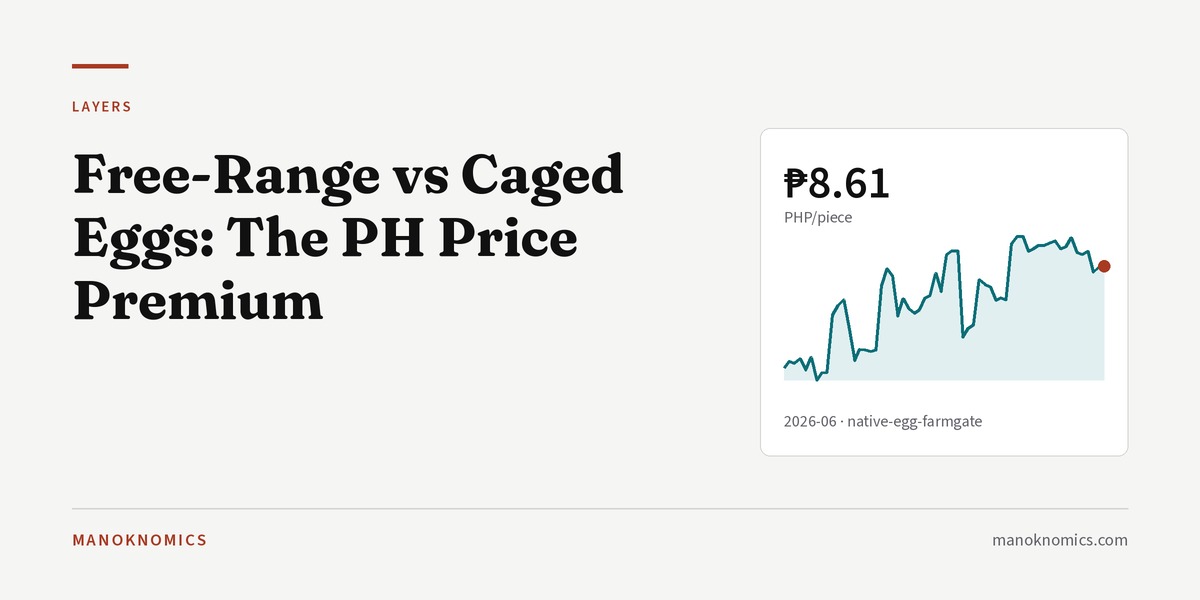
Two Philippine standards written by the same bureau authorise the two words on an egg tray on opposite terms: one asks a farm to comply and then label its own eggs, the other asks for a certificate from a competent authority its own scope puts in the future tense. One caps outdoor range at a square metre a hen and forbids beak trimming; the other excludes any outdoor area from its space count and heads beak trimming Optional.
DA Administrative Order No. 5 s. 2019 gives the spent hen her own row in the transport rules, and of the twenty species rows in that section hers is the only one that closes a geographic route: no culls from Luzon to Visayas or Mindanao, and no spent chickens between major islands at all. What none of the four Philippine documents that legislate on her will tell you is which bird in your kulungan she is. Two fingers between the pubic bones answers that, and the sheet it comes from was written in Mississippi.
Is the pugad in your kulungan the hottest box in the building? DA Administrative Order No. 12 files nest boxes under TEMPERATURE rather than under housing, and the standard that describes the box asks for it enclosed, curtained and draught free. On the light half, three Philippine documents set an intensity three times over and an hour target never, and the bulb that would close December costs ₱12.12 a month.
One Philippine institution ran the textbook breeding setup on two stock groups for eight months and got 41 to 48 percent of the eggs it set to hatch. The reference figure every guide quotes is 70 to 77. Plan on the measured one.
Chicken liver retails above the fully dressed broiler it came out of, ₱226.52 against ₱213.24 a kilo in July 2026. A dressing percentage tells you what the bird lost. It says nothing about what the losses are worth.
Which channel you may legally use is settled before price comes into it. The one Philippine table that puts a peso figure on the broiler middleman sits on page 47 of a DA roadmap almost nobody cites, and its retailer row is ₱4.70 out.
Answer grids, hindi form. Hanapin ang hilera ng alaga mo and the answer is already sitting there, and every page lists the coefficient behind each column and where it was read. Where two sources disagree they are printed side by side, walang pinagsamang average.
Indoor floor area, outdoor run, feeders, drinkers, nest holes and perch, for 5 to 100 manok, from the Philippine national standard rather than a US rule of thumb.
Week-by-week target bands from two schedules that disagree, the one Philippine figure that exists, brooder floor area by chick count, and kung kailan dapat patayin ang heater at a given room temperature.
The three dates counted off your own set date, what the machine should be holding at each stage, and the one honest answer to how many chicks a clutch under an inahin actually produces: about half of it.
The volume a flock needs from what it eats and how hot the coop is, the temperature at which that doubles, and the second problem nobody prints: a drum in the sun holds water your birds will not drink.
Kilos, sacks and pesos to harvest day, at the feed conversion Philippine open-sided farms work to rather than the one the breed table promises. Bring your own sack price.
Pesos per kilo liveweight at which a batch stops losing money, from your dealer sack price and the day-old chick price in the archive. A floor, honestly labelled as one.
How heavy a Boholano native bird actually is at day 21, 45, 75, 100 and 120, off the one published Philippine growth curve, and what that is worth at the PSA farmgate. No feed cost, because nobody publishes what a native chicken eats.
What one egg costs you in feed, beside what an egg is currently fetching, and the lay rate at which those two meet. No payback period and no projected profit, because this tool exists so you can find out the answer is no.
Sixteen years of PSA farmgate, month by month, with the placement date counted back from the month you want to sell in. It names the two months the record actually supports and refuses to rank the other ten.
Ang buong archive
Every series downloads whole, as CSV and as JSON with schema.org Dataset markup, libre at walang sign-up. Retracted rows travel with the file, so a copy you took last month can be checked against the archive today.
Some figures a keeper needs are not published by anybody. Those are listed rather than estimated. The biggest hole is the presyo of a sack of finished feeds: no agency, miller or dealer in the country publishes it, kaya nakalista ito bilang kulang rather than guessed at.