Dressing Percentage: Liveweight to Dressed, and the Parts PSA Prices
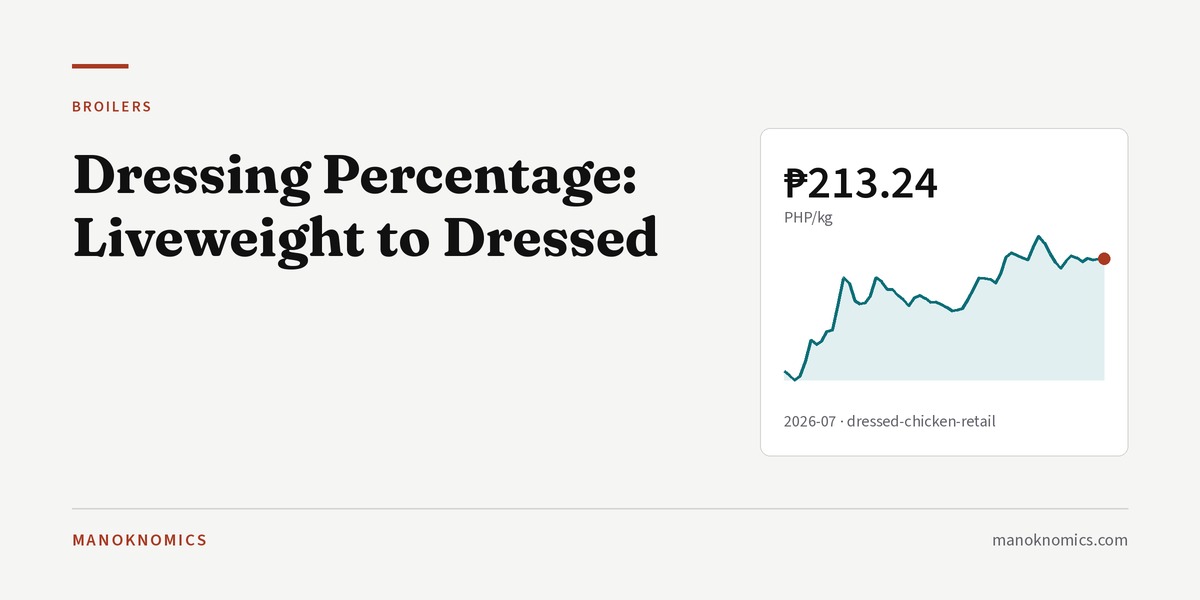
PSA priced fresh chicken liver at ₱226.52 a kilo in July 2026 and the fully dressed broiler at ₱213.24 in the same month, off the same national retail survey (PSA OpenSTAT, table 0042M4ARN10). Nasa loob ng manok ang atay. ₱13.28 more per kilo ang lamang nito sa buong manok na pinaglabasan niya.
A dressing percentage answers the weight question and stops there. Saan napupunta ang pera, hindi na niya sagot, kasi may sariling presyo pala ang mga bahaging itinatapon niya. Three Philippine figures are in circulation for that percentage, they sit five points apart, and on one 1.7 kg bird that is ₱18.13.
The short answer
Three Philippine dressing percentages circulate: 75, 77 and 80. On a 1.7 kg broiler they are 0.085 kg apart, which is ₱18.13 at July 2026 dressed retail and about ₱906 across a 50-bird batch. All three were arrived at by assumption rather than by weighing a Philippine broiler. Isang timbangan lang ang makakasagot para sa manok mo: timbangin bago katayin, timbangin pagkatapos, hatiin.
Source PSA OpenSTAT, Retail Prices of Agricultural Commodities (2018-based), Poultry, table 0042M4ARN10, July 2026 (read on August 23, 2026)
What the bird loses, and what the losses are worth
| PSA retail, national monthly average, July 2026 | ₱ per kg |
|---|---|
| Fresh chicken, fully dressed, broiler | ₱213.24 |
| Edible offal, liver, chicken, fresh | ₱226.52 |
| Edible offal, gizzard, chicken | ₱197.31 |
| Edible offal, feet, chicken | ₱138.03 |
Those are PSA’s own commodity labels, shortened, from the same retail table that carries the dressed broiler series. The liver row runs at 106.23% of the dressed bird and the feet row at 64.73%.
Set that against what the DA says the discarded fifth of a broiler consists of. On printed page 20 of its broiler roadmap the department lists it as “feathers, blood, head, feet, offals, etc.” (DA-BAI Philippine Poultry Broiler Industry Roadmap 2022-2040). Dalawa sa limang bagay na iyon ay may sarili nang presyo sa PSA retail basket, at ang isa sa dalawa ay mas mahal pa, per kilo, kaysa sa dressed na manok. Table 9 of the same roadmap, printed page 45, books the whole 0.38 kg dressing loss as a cost line of ₱26.81 a bird in 2021 pesos, which is the accounting choice of a plant that sells meat and values everything else at nothing.
Those are retail figures, presyo sa puwesto, and no Philippine series prices offal at a farm
gate at all. A keeper who sells the bird alive captures
none of it either way, kasi sa nagkakatay napupunta ang mga bahaging iyon at hindi sa
nag-aalaga. PSA does not say whether the offal rows are broiler or native, local or imported;
the label reads CHICKEN and nothing more. And nobody publishes how many kilos of feet, gizzard
or liver come off a 1.7 kg bird, so the parts can be priced and a bird’s worth of them cannot.
Three numbers, one bird, ₱18.13 between them
| Yield | Where it comes from | 1.7 kg bird dresses to | At ₱213.24 per kg |
|---|---|---|---|
| 75% | USDA FAS Manila, GAIN RP2025-0039, Figure 1 note, p. 3 | 1.275 kg | ₱271.88 |
| 77% | DA-BAI roadmap, Table 9, printed p. 45 | 1.309 kg | ₱279.13 |
| 80% | DA-BAI roadmap, printed p. 20 | 1.360 kg | ₱290.01 |
Top to bottom that is 0.085 kg and ₱18.13 on one bird, ₱906 on a batch of fifty. Bago ka pa magtimbang ng kahit ano, napili na ng numerong pinili mo kung ₱272 o ₱290 ang sagot. The right-hand column prices the weight difference at a retail shelf figure. Retail shelf ang ₱213.24, at nasa gate ang bayad sa iyo. Timbang lang ang sinusukat ng kolum na iyan: kung magkano ang halaga ng constant na pinili mo.
Three percentages from four documents, each a different kind of claim. The 77% is a costing assumption inside a cost model. The 80% is an undated rule of thumb the roadmap attributes to “an industry expert” on page 20, with no sample and no method, and then uses in a worked conversion of its own: ₱80 a kilo live becomes ₱100 a kilo dressed in the roadmap’s prose, “since about 20% of the live weight is discarded during the dressing process” (roadmap p. 20). The 75% is a foreign agency’s working conversion applied to PSA data. And the 0.77 in PIDS Discussion Paper 2022-20 is a constant borrowed from a 2013 PSA metadata volume; the cost of production per kilo follows that trail to its end and there is no point walking it twice.
There is a fourth number inside Table 9, and it is this page’s own arithmetic. No document carries it. Divide each row by its own printed peso-per-kilo entry: seven of the nine operating rows land between 1.182 and 1.191 kg; the two smallest rows, rounded to centavos, do not. The purchase row divides by 1.65 kg, the live bird. The Sub-Total and Total divide by about 1.49 kg, a third weight again. So the roadmap’s headline ₱128.50 per kilo fully dressed, in 2021 pesos is priced per kilo of a bird that weighs 1.49 kg, while the same table derives a 1.65 kg live bird and a 1.27 kg dressed one. Which weight the column belongs to is left to the reader.
Set 1.188 against the 1.65 kg live bird and it is 72 percent of it, five points under the 77 the table prints two rows up. Read it the other way and it is roughly the 1.27 kg dressed bird less a deduction the size of the table’s own shrinkage line. Both readings survive the printed page, which is why 72 stays out of the three above: this article computed it, and it describes the table’s own bookkeeping. The roadmap’s cost model runs on one basis and prints another. Worth knowing before you borrow either figure.
The one that was measured came off a native bird at twelve weeks
Lambio, Grecia and Amado evaluated four genetic groups of Philippine native chicken at 12 weeks of age and published the carcass results in the Philippine Journal of Veterinary and Animal Sciences 26(2) in 2000. The abstract states that dressing percentage of the Bolinao group “with (86.20 %) and without giblet (81.06 %) was higher (P<0.05) than the Camarines group” (Lambio et al. 2000, abstract). A carcass trial, with ANOVA, at a stated age, in a Philippine journal.
The interesting number there is not either percentage. It is the 5.14 percentage points between them. Same birds, same trial, same day, and the only difference is whether the giblets stayed in. On a 1.7 kg bird that gap is 0.0874 kg, or ₱18.63 at the July 2026 dressed retail figure above. It is wider than the whole published Philippine range: 75 to 80 is five points, and the giblets on their own are 5.14. Ask which side of the giblets a quoted percentage falls on before you use it.
Read it inside its scope: native chicken, 12 weeks, year 2000. Carry it across to a broiler at five weeks and you have built a confident wrong answer faster than by any other route on this page. The abstract gives Bolinao only; the Banaba, Paraoakan and Camarines figures stay behind in the paper. The full text could not be opened at all, because the journal’s download route returns a JavaScript reader shell behind a login, so the abstract is the readable record and every figure here comes from it. And the trial is 26 years old, which puts it before the DOST-PCAARRD native breeding programmes that produced the strains a keeper can buy today.
There is a second Philippine figure and it is a weaker kind of number. Paraoakan carries a dressing percentage of 50 to 66 percent from a 2026 Palawan survey, and that survey collected it by asking 96 raisers what they remembered. A recalled 50% is what a keeper believes about a bird they never put on a scale, at malayo iyon sa 81.06% na tinimbang ni Lambio sa parehong uri ng manok.
Which “dressed” is the number about?
Two Philippine national standards define the word and they do not define it the same way.
PNS/BAFS 285:2019 § 3.4 defines a chicken carcass as the “body of the chicken after bleeding, removal of the feathers and extremities (head, feet), digestive, respiratory, excretory, reproductive and circulatory organs and minimum trimmings as required by the competent authority”. Its § 3.8 defines a whole bird as an intact carcass with the head, feet and viscera removed, and then adds the clause that undoes the arithmetic: “The tail, skin and abdominal fat may or may not be present” (PNS/BAFS 285:2019). Two birds can both be a compliant whole bird at two different weights. Across its 31 pages the standard prints definitions and grading language and stops there: zero percentages, zero weight units.
| PNS/BAFS 285:2019 § 3.4, carcass | Feathers, head, feet, and the digestive, respiratory, excretory, reproductive and circulatory organsPlus minimum trimmings as required by the competent authority. No percentage stated. |
|---|---|
| PNS/BAFS 285:2019 § 3.8, whole bird | Head, feet and visceraTail, skin and abdominal fat may or may not be present, so two compliant birds can differ. |
| DA-BAI broiler roadmap, printed p. 20 | Feathers, blood, head, feet, offals, etc.About 20% of liveweight, attributed to an industry expert. The "etc." is doing real work. |
| Lambio, Grecia and Amado (2000) | Reported both ways, with giblets and withoutBolinao native chicken at 12 weeks: 86.20% and 81.06%, 5.14 points apart. |
PNS/BAFS 314:2021 grades carcasses, and its § 3.1 defines one more loosely still, as the “body of animal after bleeding and dressing”, two years after 285 was approved. Its Table 1 sorts birds into Class A+, A, B and C on cleanliness, carcass conformation and fleshing, with defect classes for keel bone prominence, hematoma, ammonia burns and bile stains. Section 5.4 allows only A+, A and B to be sold as a whole carcass and 5.5 sends Class C to cut-up (PNS/BAFS 314:2021). The Philippine standard for grading a chicken carcass grades it on how it looks. A keeper who earns a Class A has a verdict on cleanliness, conformation and fleshing, and still has to reach for a scale to learn what the bird weighs.
The register runs past the hole. The BAFS list of approved standards carries poultry standards for primal cuts, carcass grading, table eggs, good animal feeding, egg incubators and cage-free eggs. The two above are the pair that define a dressed chicken. Between them they define the product, the cuts and the labelling, and they leave the yield, the conversion and the moisture-loss allowance to somebody else. It does carry a pork carcass grading standard from 2022 and a rabbit carcass grading standard from 2025. The meat regulator stops short of it too: NMIS classifies dressing plants AAA, AA and A by how far their meat may legally travel, which is a statement about premises and market access with no carcass classification and no yield in it.
Has anyone actually measured a Philippine broiler?
This site has been writing that no Philippine institution publishes a dressing percentage. That is wrong as worded. Figures exist: the three national constants above, Lambio’s measured native pair, and Paraoakan’s recalled band. The correct sentence is that no Philippine institution publishes a measured broiler dressing percentage, and for native chicken one has been in print since 2000.
Philippine broiler dressing percentage has been measured, more than once, at UPLB. Castroverde, Olarve and Cruzana slaughtered 45 market-weight Ross birds under three fasting regimes and report that “Dressing percentage were higher in fasted chickens compared to chickens not fasted before slaughter (P<0.05)” (UPLB repository record). Tolentino slaughtered 125 commercial broilers weekly from day 28 and found “dressing percentage was not significantly affected by age” (UPLB repository record). Both abstracts report the comparison and withhold the value. So the broiler measurement exists, twice, in a Philippine university’s own repository, and both times the abstract keeps the number. That is a narrower claim than an absence and a more irritating one, and it is the one two broiler farmgate prices named as the thing that would change its refusal.
The state’s native-chicken database explains the shape of the hole better than any of this. DOST-PCAARRD’s breed information system publishes the list of what it collects for Darag, Camarines, Boholano, ZamPen and Itik PINAS: body weight, height, body length, chest circumference, wing span, shank length, then egg production, fertility, hatchability and egg quality (PAB-IS). Anim na paraan ng pagsukat sa buhay na manok, at wala ni isa sa karne. Sinusukat ng estado ang manok habang buhay at sinusukat ang itlog nito. Hindi nito sinusukat ang katawan pagkatapos.
One more route looks open and closes. PSA prices native chicken live and dressed at the same market level in the same month, which is the only place in Philippine official data where that happens, so the quotient looks like a free dressing percentage. Divide July 2026 and it gives 85.58%. Divide May 2026 and it gives 79.07%. That is 6.51 percentage points in two months, out of a quotient of two independently surveyed baskets that also carries dressing labour and a stall margin, and PSA never says the two rows hold the same birds. The price archive works that refusal out in full and the native chicken price page hands it on rather than repeating it. The two months above are the arithmetic underneath it.
What usually goes wrong
The mistake: Adding up the PSA offal prices to work out what the parts of your bird are worth.
Do this instead: Take from those rows only that the parts have a market price, and stop there.
Prices exist for feet, gizzard and liver. The kilograms do not: no Philippine source publishes how much of each comes off a bird, so any per-bird total has an invented weight inside it.
The mistake: Applying 86.20% or 81.06% to a broiler.
Do this instead: Read them as native chicken at 12 weeks, from a trial published in 2000.
Lambio, Grecia and Amado measured four Philippine native genetic groups, not a commercial broiler at five weeks. The species, the age and the quarter-century all move the answer.
The mistake: Reading 79 to 86% as the Philippine dressing percentage range, because it is what dividing the two PSA native retail rows gives.
Do this instead: Read the swing as proof the division does not work.
Two independently surveyed price series moved 6.51 points apart between May and July 2026. That quotient carries dressing labour and the stall margin as well as the yield, and PSA never states that the live row and the dressed row are the same birds.
The mistake: Averaging the national figures to get one working number.
Do this instead: Pick one, write down which one you picked and why, or measure your own.
A mean of unmeasured constants is one more unmeasured constant, carrying a false air of care. It also weights a foreign agency's working conversion equally with a cost model built for a different purpose, and buries which one you actually used.
The mistake: Working backwards from ₱213.24 per kilo dressed to what your birds earn.
Do this instead: Keep the revenue side on a liveweight farmgate figure.
That is a retail shelf price, after somebody else’s slaughtering, transport and margin. The household broiler farmgate read ₱150.31 per kilo liveweight in June 2026 and that is the side of the market a keeper sells into.
Weigh your own bird
One bird, two weights, one ratio. Timbangin mo ang manok bago katayin, timbangin mo ulit pagkatapos, hatiin ang pangalawa sa una. Dressing percentage mo na iyon, at ang inilalarawan niyan ay ang lahi mo, ang edad na kinakatay mo, ang feeds mo at ang taong nagkatay.
Three things get written down beside it, or the next reading answers a different question. Whether the giblets were in or out, dahil 5.14 percentage points ang nasa pagitan ng dalawang basa sa parehong manok. How long the bird had been off feed: Castroverde and colleagues measured a 0.1 kg live weight loss in the first 12 hours of feed withdrawal (UPLB record), so weigh at the same point in the routine every time and the ratio moves for reasons that belong to the bird. And whether the head and feet came off, since PNS/BAFS 285:2019 lets the tail, skin and abdominal fat vary inside a compliant whole bird.
That assumes a bird. If you are sizing a batch that has not hatched yet, carry 75 to 80 percent as a range rather than a point and plan against both ends of it. The ₱18.13 a bird between them is the width of what nobody has measured, and a batch that still clears its costs at 75 percent survives the range turning out to be wrong.
The native chicken price page already asks a keeper to record hakot after hakot and divide by kilos carried, and that exercise answers a different question. Two weights on one bird answers this one. What a hanging or platform scale costs is not in this archive, not in PSA’s retail basket and not in any BAI report I could find, kaya walang presyo dito para diyan. What it buys has a figure: ₱906 of guessing across a 50-bird batch, replaced by one bird weighed twice.
Kapag natimbang mo na, isang panig lang ng merkado ang pinapasok mo. Liveweight ang bayad sa gate, at ₱150.31 per kg liveweight ang binasa ng PSA household series noong June 2026, kaya doon nakapatong ang revenue side ng batch at hindi sa ₱213.24.
Work it out for your own flock
What farmgate price do you need to break even? Open the calculator
Break-even here is a liveweight number, because liveweight is what the gate pays. Feed cost, chick cost and mortality go in; the ₱/kg live your batch has to beat comes out, with no dressing yield anywhere in the arithmetic.
The gaps register keeps this one on its list, beside the rest of what nobody publishes about Philippine poultry. Kung wala ka pang manok na matitimbang, raising broilers in the Philippines ang simula.
What does your bird weigh alive, and what does it weigh dressed, at the age you actually kill it and dressed the way you actually dress it? Every document above answers a nearby question, on another bird, at another age, in another decade. Yours takes one scale and one afternoon. Ilang manok mo na ang nadaanan nang hindi mo nasagot iyan?
Questions people actually ask
What is the dressing percentage of chicken in the Philippines?
Three figures circulate in Philippine documents and they range from 75 to 80 percent. The DA-BAI broiler roadmap costs a batch at 77 percent in Table 9 on printed page 45 and quotes an industry expert at about 80 percent on page 20. USDA FAS Manila converts PSA data at 75 percent. PIDS traces a 0.77 ratio to a 2013 PSA metadata manual, which is the same 77. None of the three was measured on a Philippine broiler. The one measured Philippine figure in print is for native chicken: Lambio, Grecia and Amado (2000) put the Bolinao group at 86.20 percent with giblets and 81.06 percent without, at 12 weeks of age.
How much does a chicken weigh after dressing? Show the answer
It depends which yield you use, and the choice is worth more than most people expect. A 1.7 kg liveweight broiler dresses out at 1.275 kg using 75 percent, 1.309 kg at 77 percent and 1.360 kg at 80 percent. That is a spread of 0.085 kg on one bird. Priced at the July 2026 PSA national retail figure for fully dressed broiler, ₱213.24 per kilo, the three answers are ₱18.13 apart, or about ₱906 across a batch of 50 birds.
How do you calculate dressing percentage? Show the answer
Weigh the bird alive, weigh it again once it has been dressed, divide the second figure by the first and multiply by 100. Three things have to be written down beside the answer for it to be comparable to the next one: whether the giblets are in or out, how long the bird was off feed before slaughter, and whether the head and feet came off. Weigh at the same point in the routine every time, since feed withdrawal alone moves the live weight. Lambio, Grecia and Amado (2000) measured 5.14 percentage points between the with-giblets and without-giblets readings on the same Philippine birds.
Is chicken liver more expensive than chicken meat in the Philippines? Show the answer
By the kilo, yes. In July 2026 the PSA national retail average for fresh chicken liver was ₱226.52 per kilo against ₱213.24 per kilo for fully dressed broiler, so the liver was ₱13.28 a kilo dearer than the whole bird. Chicken gizzard sat at ₱197.31 and chicken feet at ₱138.03 per kilo in the same month and the same survey. PSA does not state whether those offal rows are broiler, native, local or imported.
Can you convert a chicken farmgate price into a retail price? Show the answer
Not with a published Philippine number, because no agency publishes a measured broiler dressing percentage. The DA-BAI broiler roadmap performs the conversion at about 80 percent in a worked example on printed page 20, using a constant with no sample and no method behind it. Dividing PSA figures does not recover one either: live native chicken at retail against dressed native chicken at retail gives 79.07 percent in May 2026 and 85.58 percent in July 2026, a swing of 6.51 percentage points in two months that no bird anatomy explains.