Native Chicken Price: Three Market Levels and the Gap That Did Not Scale
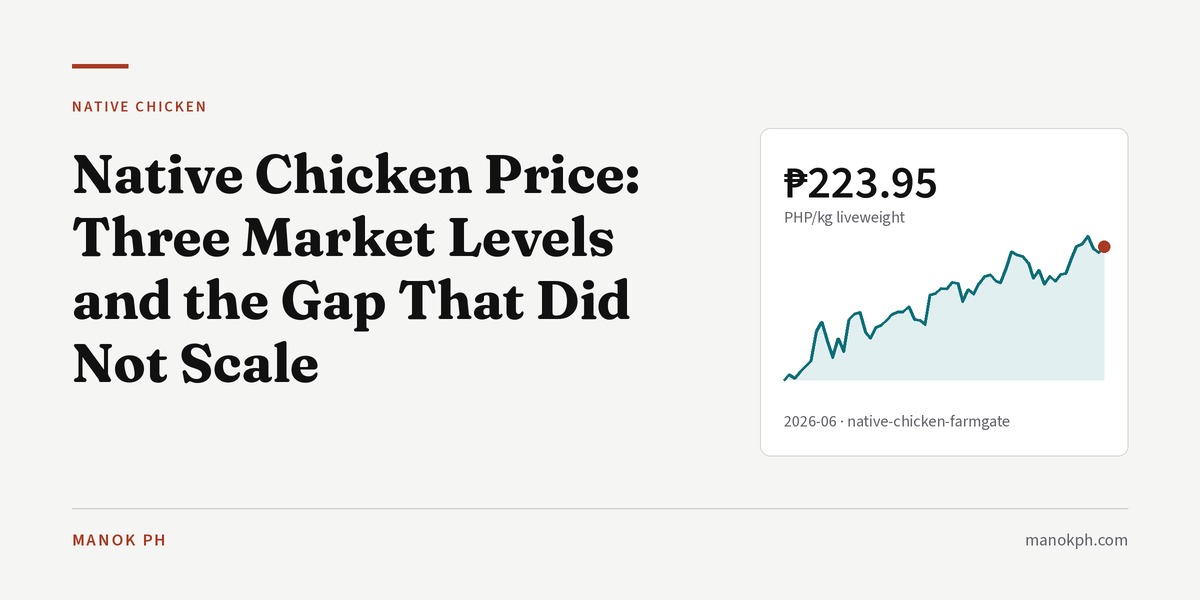
₱223.95, ₱289.37, ₱343.40. Tatlong presyo para sa iisang manok sa iisang buwan, June 2026, sa tatlong magkakaibang antas ng merkado. No other bird in this archive carries three levels.
| Level, June 2026 | Figure | Who is on the other side of it |
|---|---|---|
| Farmgate, PSA household | ₱223.95/kg liveweight | what a grower is paid for a live bird |
| Retail, live bird | ₱289.37/kg | what a buyer pays for the same live bird |
| Retail, dressed | ₱343.40/kg dressed | what a buyer pays once somebody has dressed it |
Only one subtraction in that table means anything. The first two rows are the same bird, in the same state, in the same month, so the ₱65.42 a kilo between them is a real distance that somebody was actually paid to cover. The third row is a different product, and the agwat above it is not a dressing yield; the price archive works that refusal out in full and I am not going to repeat it here.
What that agwat has done over the eight and a half years since 2018 is the rest of this page.
Has the gap grown while the manok got more expensive?
Across the 102 months where both PSA series carry a value for the same month, January 2018 through June 2026, live native at retail minus native at farmgate averaged ₱60.50 a kilo, with a median of ₱60.78, and it landed between ₱50 and ₱75 in 92 of those 102 months. Over exactly the same span the farmgate price went from ₱139.01 to ₱223.95 per kilo liveweight, up 61.1%.
So the gap is not a share of the bird. Bayad ito sa serbisyo: ang hakot, ang puwesto sa palengke, ang oras ng nagtitinda, at ang tubo ng namamagitan. Those things cost roughly what they cost whether the manok underneath them is worth ₱139.01 or ₱223.95 a kilo, and the record says they were charged that way for eight and a half years.
The extremes sit close in. The narrowest month in the run was February 2025 at ₱45.57 and the widest was September 2025 at ₱76.16, seven months apart, so the movement that does happen is short and reverses. Mean of the first twelve months, ₱62.19. Mean of the last twelve, ₱68.78.
One rule sits under all of that. Subtract two prices only when the bird, the state and the unit match on both sides; across market levels the month has to match too, and inside a single series the months are supposed to differ, because that is the whole point of a series.
June against June, 2018 to 2026
| June | Farmgate | Live retail | Gap | Gap as % of farmgate |
|---|---|---|---|---|
| 2018 | ₱140.40 | ₱207.99 | ₱67.59 | 48.1% |
| 2019 | ₱147.62 | ₱210.06 | ₱62.44 | 42.3% |
| 2020 | ₱157.15 | ₱219.03 | ₱61.88 | 39.4% |
| 2021 | ₱170.10 | ₱234.69 | ₱64.59 | 38.0% |
| 2022 | ₱179.98 | ₱248.36 | ₱68.38 | 38.0% |
| 2023 | ₱198.86 | ₱260.01 | ₱61.15 | 30.8% |
| 2024 | ₱204.03 | ₱259.66 | ₱55.63 | 27.3% |
| 2025 | ₱214.09 | ₱271.12 | ₱57.03 | 26.6% |
| 2026 | ₱223.95 | ₱289.37 | ₱65.42 | 29.2% |
All figures per kilo, both columns the live bird, each row a single month read on both sides.
June is the month because July is not available on the farm side. The farmgate cell for July 2026 is empty, and it is empty across all six PSA farmgate series in this archive, kaya June ang huling buwan na may laman ang magkabilang panig. Retail runs a month ahead of farmgate, which is a publication schedule and not a price movement.
Read the gap column straight down and it wanders between ₱55.63 and ₱68.38. Nine Junes, walang trend. As the archive held these two series on 13 August 2026, the retail pair runs 103 monthly rows from January 2018 and the farmgate series runs 199 from January 2010, 198 of them with a value.
The stall side did not follow the farm side upward in 2024; the gap closed to ₱55.63, the narrowest of the nine, in a year when farmgate had just climbed to ₱204.03. June 2026 is the widest since 2022.
The whole of 2026 at all three levels, side by side, kaya makikita mo kung ano ang hinihintay. Both retail columns run through July. The farmgate column stops at June and the cell after it is empty, not because the manok was free that month but because PSA has not published the farm side of it yet.
| Period | Farmgate, live | Retail, live | Retail, dressed |
|---|---|---|---|
| January 2026 | ₱224.12/kg | ₱287.48/kg | ₱367.15/kg |
| February 2026 | ₱225.29/kg | ₱289.07/kg | ₱368.10/kg |
| March 2026 | ₱228.48/kg | ₱288.04/kg | ₱367.63/kg |
| April 2026 | ₱223.20/kg | ₱293.44/kg | ₱369.53/kg |
| May 2026 | ₱221.52/kg | ₱290.17/kg | ₱366.97/kg |
| June 2026 | ₱223.95/kg | ₱289.37/kg | ₱343.40/kg |
| July 2026 | not published | ₱292.47/kg | ₱341.74/kg |
Pesos per kilo, national monthly averages. The farmgate column is liveweight; the two retail columns are what a buyer pays, once for the live bird and once dressed. All 199 farmgate rows and all 103 rows on each retail series carry their source and their read-date on the Presyo pages.
Is selling direct worth what it was in 2018?
The gap averaged 43.7% of the farmgate price across the first twelve months of the overlap and 31.6% across the last twelve. The last column of the June table is where you watch it happen.
Most advice on direct selling gets this backwards. The usual framing is that hauling your own birds to the palengke lets you capture the retail margin, which is a percentage idea and invites you to think the prize grows with the bird. Hauling is billed in pesos, not in percentages, at ganoon din ang sarili mong gastos sa biyahe.
A raiser carrying the same number of kilos to the stall gains about the same peso amount today as in 2018, because the published gap barely moved. That raiser is also handling a much larger sale, since farmgate rose 61.1% underneath it, so the trip is now a smaller slice of what a batch is worth. And if your own fare, fuel and crates rose over those eight and a half years the way most costs did, the trip has quietly become worse business without the published figure moving at all. That last part is not in the archive. Nasa resibo mo iyon.
How the ₱60.50 splits is not published either, as far as I can find. Puwedeng isang tao lang ang namamagitan, puwede ring hakot, komersyante at tindera na may hati-hati sa iisang kilo, and PSA prices the two ends of the chain without describing the middle of it. So the figure tells you what the whole trip is worth and not which part of it you could take over. A keeper twenty minutes from the palengke and a keeper two hours away read the same national number and face trips with nothing in common but the unit. PSA does publish regional farmgate splits and this archive carries only the national mean, so the number above is not the last word available on what your own province pays.
Four parties, three handovers, two published prices. The drawing sets Bakuran, Viajero, Palengke and Buyer in a row, prints ₱223.95 under the first handover as Farmgate, live and ₱289.37 under the last as Retail, live, both read on June 2026, and leaves the viajero’s box dashed and empty because nobody publishes what changes hands there. The bracket underneath reaches from one end to the other and carries ₱65.42 a kilo.
Mind which agwat that bracket is. ₱65.42 is June 2026 on its own, the bottom row of the June table above; ₱60.50 is the mean of all 102 months and the figure the rest of this page argues from. Magkalapit sila at madaling mapagpalit, four pesos apart, so a note that says only “₱65.42, native chicken” will read a month later as though the whole record came to that.
So the comparison a keeper needs is peso against peso, in the same unit as the archive. What does one trip cost you: fuel or fare, the crates, the puwesto rent or market fee at the far end, the weight the birds lose on the road, the ones that do not arrive, and the hours you spend standing there. Divide that by the kilos you carried. ₱60.50 is the benchmark only if you sell at retail yourself, hakot and puwesto and the whole day included; under that figure you are ahead of what the chain has charged since 2018, over it and the trip is a hobby na may kasamang pagod. Sell to a trader at the palengke instead and you have taken over one link rather than the whole chain, so you capture an unpublished fraction of the ₱60.50 and not the ₱60.50. That trip cost is published nowhere I can find, so it has to come from your own record.
Per-kilo figures only become kita when they meet a weight, and a native manok is not a kilo at market age; native chicken raising in the Philippines carries the only published Philippine growth curve and the per-bird arithmetic that follows from it.
The dressed series fell ₱23.57 in a single month
₱366.97 in May 2026, ₱343.40 in June. The month lost ₱23.57, a 6.4% drop, and the largest one-month fall the dressed native series has recorded in the 103 months it holds as of 13 August 2026. The next largest is ₱16.37, in March 2022, which is not close.
Here is the whole series, every month since January 2018. One month falls off a ledge and nothing else in the record comes near it. The group page for the two retail cuts cannot show you that: it draws the last 60 months only, so half the record the word largest rests on sits outside the frame.
Axis starts at ₱200, not ₱0.
103 monthly observations from PSA, January 2018 to July 2026. Dressed starts at PHP 219.79 per kg in January 2018 and ends at PHP 341.74 in July 2026. Highest PHP 369.57 in September 2025, lowest PHP 219.79 in January 2018. Every value, with its source, is on the Presyo page for this series.
See all 103 observations on the Presyo page →Sa parehong buwan, halos hindi gumalaw ang buhay na manok sa palengke: ₱290.17 in May against ₱289.37 in June. Tumaas naman ang gate, ₱221.52 up to ₱223.95. Three levels of the same bird, three directions, one month.
Why it happened, hindi ko po alam, and I would rather leave it bare than attach a reason it cannot carry. It did not bounce back either: July 2026 reads ₱341.74. Anyone pricing dressed native birds off a figure looked up around the middle of 2026 should look it up again, because a series that normally steps along in small moves dropped by that much in a single month and left it there.
Why can’t you run this for broiler?
PSA publishes two broiler farmgate series, the household one at ₱150.31/kg liveweight for June 2026, and a dressed retail series at ₱213.32/kg dressed for the same month, at walang buhay na broiler sa retail, kaya walang mapagbabawasan.
The only pair the commercial bird offers puts a live figure against a dressed one, which is not the same measurement taken twice. So the gate-to-stall distance, the number every raiser wants before deciding whether to haul, is computable for native chicken and not for the bird most Philippine backyard flocks actually contain.
That leaves the native series doing double duty. Any argument about farm-to-market margins in Philippine poultry that wants a published number has to reach for this one, because it is the only pair in the archive with the right shape. Borrowed for broiler it would be wrong more than once: different bird, different chain, different volumes moving per trip, and a retail counter selling a carcass rather than a live animal.
Worth remembering when somebody quotes you a farm-to-market markup for chicken in general. If it was not built on a live figure at both ends, it was built on two different products.
What do you do before the next batch goes out?
Write down your trip. One page, one line per hakot: petsa, ilang kilo ang dinala, magkano ang gastos sa biyahe, ilang manok ang hindi nakarating, at magkano ang napagbentahan kada kilo. Three trips and you have your own peso-per-kilo cost, which is the only figure that turns the ₱60.50 average above into a decision rather than a fact.
Then check the two series in the same month before you quote either one. Native farmgate and live native at retail both carry their full monthly history, and the retail page will usually be a month ahead of the farm one. Pairing them across months manufactures a gap that never existed, and it will always come out looking bigger than the real one because the retail month is the later month.
Copy the month down with the price, every time. A note that reads only “native chicken, ₱366.97” will outlive your memory of which month produced it, and on the dressed series that particular figure was ₱23.57 away from being current four weeks later.
This is what a complete figure looks like written down: the number, the month it came from, and a source na kayang buksan ng kahit sino.
Native chicken, dressed, PSA retail, national
₱343.40/kg
PSA OpenSTAT: Retail Prices of Agricultural Commodities (2018-based), Poultry (read on 2026-08-15)
And read the row you are actually selling. Live at retail is ₱289.37 and dressed is ₱343.40, both June 2026. Ang mas mataas na numero ay para sa nagkakatay, hindi para sa nag-aalaga.
Cite this page
Every figure here carries the source it came from and the date it was read. If you use one, this is the line that says where it came from.
A backyard poultry keeper. "Native Chicken Price: Three Market Levels and the Gap That Did Not Scale". Manoknomics. Published August 22, 2026. https://manoknomics.com/articles/native-chicken-price-three-market-levels
Select the text to copy it.
Questions people actually ask
How much is native chicken per kilo at the palengke?
PSA put the national retail price of live native chicken at ₱289.37 per kilo in June 2026, and dressed native chicken at ₱343.40 per kilo in the same month. The farm side of the same market read ₱223.95 per kilo liveweight at the household farmgate. Those are national monthly averages, so a provincial stall can sit either side of them.
Why is native chicken more expensive in the market than at the farm? Show the answer
Because somebody covered the distance between the two. In June 2026 a live native chicken cost ₱289.37 per kilo at retail and earned ₱223.95 per kilo at the household farmgate, a difference of ₱65.42 per kilo for the same live bird in the same month. That difference pays for hauling, the stall, the seller time and the trader margin, not for any change in the bird.
Is it worth selling native chicken direct to the market? Show the answer
The gap between live retail and farmgate for native chicken has averaged ₱60.50 per kilo across every month from January 2018 to June 2026, and it was ₱65.42 per kilo in June 2026. What a trip to the palengke costs a small raiser in fuel, crates, the puwesto fee, weight lost in transit and a day of labour is not published in this country as far as I can find, so the decision has to be made against your own recorded trip cost rather than a published one.
Has native chicken gotten more expensive in the Philippines? Show the answer
Yes, and by a lot. The PSA household farmgate price of native chicken rose from ₱139.01 per kilo liveweight in January 2018 to ₱223.95 in June 2026, an increase of 61.1% over eight and a half years. The retail price of the live bird rose alongside it, from ₱207.99 per kilo in June 2018 to ₱289.37 in June 2026.