Presyo: The Philippine Chicken Price Archive
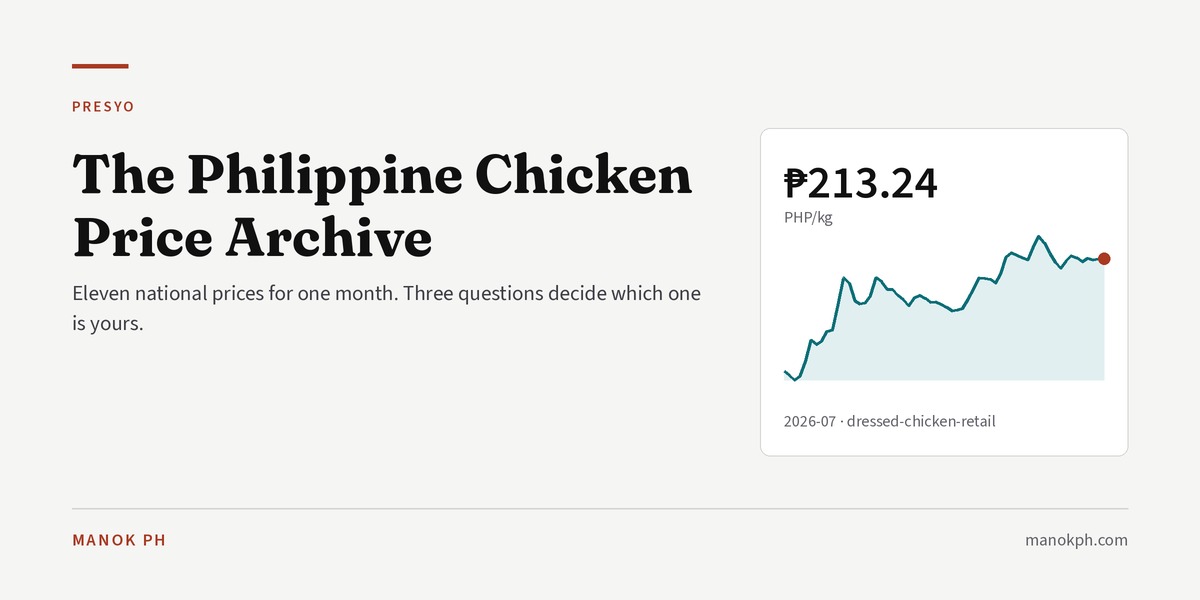
Eleven. That is how many national prices for manok and itlog the PSA published for a single month, June 2026, and not one of them is wrong.
Bumibili ka ng ulam sa palengke? Fully dressed chicken, ₱213.32/kg.
Nagbebenta ka ng broiler mula sa bakuran? ₱150.31/kg liveweight, which works out to ₱255.53 for one bird at the 1.7 kg liveweight Philippine broilers are grown to.
Readings as of 13 August 2026. Every series page below carries the current month, so check there before you quote anything.
| What is priced | Which side | Bird state | June 2026 |
|---|---|---|---|
| Broiler, household | farmgate, you are paid | live | ₱150.31/kg |
| Broiler, commercial establishment | farmgate, you are paid | live | ₱118.69/kg |
| Native chicken, household | farmgate, you are paid | live | ₱223.95/kg |
| Layer chicken, household | farmgate, you are paid | live | ₱117.47/kg |
| Chicken, fully dressed | retail, you pay | dressed | ₱213.32/kg |
| Native chicken, live | retail, you pay | live | ₱289.37/kg |
| Native chicken, dressed | retail, you pay | dressed | ₱343.40/kg |
| Egg, household | farmgate, you are paid | n/a | ₱6.74/piece |
| Native egg, household | farmgate, you are paid | n/a | ₱8.61/piece |
| Egg | retail, you pay | n/a | ₱9.07/piece |
| Native egg | retail, you pay | n/a | ₱9.62/piece |
Seven of those eleven price manok by the kilo, and they span ₱117.47 at the bottom to ₱343.40 at the top inside one month. Subtracting one end from the other answers no question anybody asked: a spent layer at the gate and a dressed native bird sa palengke are different animals, sold in different states, to different buyers. What the span is good for is this: anyone who quotes you the Philippine chicken price without saying which of these eleven it is has answered something other than what you asked.
Which of these eleven prices is yours?
| The question | What the answer changes | Where it lands, June 2026 |
|---|---|---|
| Anong manok? | broiler, native, or a layer at the end of lay | four separate farmgate series: a spent hen at ₱117.47 against native at ₱223.95, same gate, same month, nearly twice apart |
| Which side of the deal are you on? | farmgate is what you are paid, retail is what you pay | two market levels, never one, and inside farmgate a further split between household ₱150.31 and establishment ₱118.69 |
| Buhay o katay? | liveweight or dressed weight | two units that do not convert: native at retail is ₱289.37 live and ₱343.40 dressed |
| Saan? | your province, or the whole country averaged | nothing in this archive, which is national only |
That last row is the one the archive cannot answer. Every figure above is a national monthly mean, smoothed across 18 regions and across every week inside the month, at ang lalawigan mo ay hindi ang buong bansa. PSA is not the obstacle. The farmgate table behind these series, 0032M4AFN10.px, carries 111 geolocation values including provinces and regions, verified on 12 August 2026, so the regional spread is retrievable today by anyone willing to pull it, and it is logged as G-7 in the gaps register until somebody does.
Most people ask it in three words, and three words hide all four questions. Somebody pricing a batch they are about to sell, somebody checking whether the tindera overcharged them, and somebody choosing between broilers and native stock for next year are reading different rows of that table, and one national figure serves exactly one of them properly. The archive keeps the rows apart for that reason and not out of pedantry.
Why is the same manok ₱117 and ₱343 in the same month?
Because they are not the same manok, not the same market level, and not the same bird state, and each of the three moves the presyo on its own.
Most pages answering this query do something I would not. They pick one figure, print it as the Philippine chicken price, and never say whether it is farmgate or retail, live or dressed, native or broiler. That is not a rounding problem. Kung farmgate ang kailangan mo at retail ang ibinigay sa iyo, mali ang sagot mo by more than the whole margin on a backyard batch, and the page that gave it to you looked exactly as confident as this one.
Even inside farmgate the level splits again. PSA runs a household broiler series and a commercial establishment series, and only one of the two describes a bakuran flock; which one is yours is the whole of a separate article.
The live-against-dressed pair is the one that gets misread most often. Native chicken at retail carries two published figures for June 2026, ₱289.37/kg for the live bird and ₱343.40/kg dressed, and the gap between them is not a dressing yield. It is not a conversion factor, it cannot be turned into one, and no percentage applied to a liveweight presyo arrives at a dressed one. No Philippine institution publishes a dressing percentage for local birds, so any figure you have seen used for that conversion came from somewhere else and travelled here without a passport.
Tumaas ba o bumaba sa loob ng isang taon?
Itlog is where the answer changes a decision. Egg farmgate fell -10.6% from June 2025 to June 2026, ₱7.54 down to ₱6.74 a piece. Egg retail over the same twelve months fell 2.3%, ₱9.28 down to ₱9.07. Bumaba ang presyo sa magkabilang dulo ng transaksyon, pero halos limang beses ang lalim ng nahulog sa panig ng nag-aalaga kaysa sa panig ng bumibili. If you are deciding this year whether to put more inahin in the kulungan, plan against the gate line and not the stall line. Ang gate ang binebentahan mo. A retail price that barely moved is not evidence that your own kita held up.
| Series | Jun 2025 | Jun 2026 | Change |
|---|---|---|---|
| Broiler farmgate, household | ₱147.67 | ₱150.31 | +1.8% |
| Broiler farmgate, establishment | ₱131.86 | ₱118.69 | -10.0% |
| Native chicken farmgate | ₱214.09 | ₱223.95 | +4.6% |
| Layer chicken farmgate | ₱109.15 | ₱117.47 | +7.6% |
| Dressed chicken retail | ₱217.33 | ₱213.32 | -1.8% |
| Native chicken live retail | ₱271.12 | ₱289.37 | +6.7% |
| Native chicken dressed retail | ₱363.45 | ₱343.40 | -5.5% |
| Egg farmgate | ₱7.54 | ₱6.74 | -10.6% |
| Egg retail | ₱9.28 | ₱9.07 | -2.3% |
| Native egg farmgate | ₱8.99 | ₱8.61 | -4.2% |
| Native egg retail | ₱10.18 | ₱9.62 | -5.5% |
June against June, same month both years, which is the only comparison these series support without an argument about seasonality. Both endpoints are printed so you can check either one against its own series page rather than trusting the percentage.
Read down the change column and the headline collapses. Four series went up and seven went down, and the broiler line most write-ups quote is one of the four. So “tumaas ang presyo ng manok” and “bumaba ang presyo ng manok” are both true statements about the twelve months to June 2026, and which of the two you get depends entirely on which of the eleven series the person talking to you happened to read.
Native manok is the standout on the way up. It gained 4.6% at the gate and 6.7% at the live retail counter, while native dressed at retail went the other way and lost 5.5%. Native eggs slipped on both sides. Walang iisang merkado ng manok dito, and none of that set reads as one thing moving together.
Where does the palengke price fit?
Read farmgate and retail for the same month or do not read them together at all. June 2026 is the month on this page because PSA publishes farmgate roughly a month behind retail, so the July farmgate cells are still empty. July retail exists and reads ₱213.24/kg dressed, ₱292.47/kg for live native and ₱341.74/kg for native dressed. Useful on its own, useless beside a June farmgate figure. Huwag mong ipares ang July retail sa June farmgate, kasi ang lalabas ay agwat ng dalawang buwan na ipinasa bilang agwat ng dalawang market level.
Here is that same list of eleven, read for July 2026 instead. Five rows carry a figure and six do not, at farmgate lahat ng anim.
| What is priced | Which side | July 2026 |
|---|---|---|
| Broiler, household | farmgate, you are paid | not published |
| Broiler, commercial establishment | farmgate, you are paid | not published |
| Native chicken, household | farmgate, you are paid | not published |
| Layer chicken, household | farmgate, you are paid | not published |
| Chicken, fully dressed | retail, you pay | ₱213.24/kg |
| Native chicken, live | retail, you pay | ₱292.47/kg |
| Native chicken, dressed | retail, you pay | ₱341.74/kg |
| Egg, household | farmgate, you are paid | not published |
| Native egg, household | farmgate, you are paid | not published |
| Egg | retail, you pay | ₱9.03/piece |
| Native egg | retail, you pay | ₱9.60/piece |
A cell reads as unpublished only where the source has published nothing. All six farmgate rows carry a July period with no figure in it, which is how this archive records a month PSA has not released yet rather than dropping the row. All 199 rows of the broiler series carry their source and their read-date on the Presyo pages.
For June, then. Fully dressed chicken retailed at ₱213.32/kg. Native chicken sold live at retail reached ₱289.37/kg and native dressed reached ₱343.40/kg. Every one of those sits above every farmgate figure in the archive, at hindi tubo lang ng tindera ang dahilan. Between the gate and the stall there is slaughter, chilling, transport, spoilage and the vendor’s own araw ng trabaho, and none of it is free.
One comparison in that group is clean, because both sides are the same bird in the same state. Live native chicken cost ₱65.42 per kilo more at the stall than at the gate in June 2026: ₱223.95 at farmgate against ₱289.37 at retail. Live on both sides, walang dressing loss na nakatago dito.
Ibenta sa gate, o ikaw na mismo ang magdadala sa palengke, that is the decision the ₱65.42 puts in front of a native raiser, and what the gap has done since 2018 answers it better than any single month can.
Note the shape of that comparison, because it is the only kind worth making. Iisang manok, iisang estado, iisang bansa, iisang buwan. Change any one of the four and the subtraction stops meaning anything in particular, which is why so few clean comparisons exist across eleven prices.
Ano ang presyo ng itlog?
Itlog behaves nothing like manok, and the shortest way to see it is the distance from gate to stall.
The ordinary egg travels from gate to stall for ₱2.33 a piece. That is the whole retail markup on a single itlog, and it is a small enough number that selling direct from the bakuran at somewhere between the two lines is a real option rather than a fantasy. Ang itlog ay hindi kailangang dumaan sa katay, kaya mas maikli ang biyahe nito kaysa sa manok.
Malaki ba ang ₱2.33? Depende sa dating layo ng dalawa. Here are the two ordinary-egg lines from January 2018, where the retail series begins, to June 2026. Nagsalubong sila noong una, at unti-unting lumalayo sa isa’t isa halos taon-taon mula noon.
102 monthly observations from PSA, January 2018 to June 2026. Gate starts at PHP 7.28 per piece in January 2018 and ends at PHP 6.74 in June 2026. Highest PHP 8.27 in September 2023, lowest PHP 5.75 in May 2022. Retail starts at PHP 6.20 per piece in January 2018 and ends at PHP 9.07 in June 2026. Highest PHP 9.40 in October 2025, lowest PHP 6.20 in January 2018. Every value, with its source, is on the Presyo page for each of these series.
See every observation on the Presyo pages →The native egg is the odd one in the set. It commands a clear premium at the gate, ₱8.61 against ₱6.74, and yet at retail the two eggs nearly converge, ₱9.62 against ₱9.07. The premium a native egg earns is now mostly captured before it reaches a stall, which has only been true since the start of 2025. I am not going to tell you why, kasi walang table na nagpapaliwanag nito, and inventing a reason would be worse than leaving the observation bare. If you keep layers, that pattern belongs in your pricing thinking, and the layer article works the rest of the egg economics through.
A layer flock generates two of the eleven prices rather than one, which is easy to miss when the meat and egg tables sit in different places. It sells itlog at ₱6.74 a piece for most of its working life, and then it sells itself at ₱117.47 a kilo liveweight when lay drops off and the bird is cleared. That second figure is the smallest per-kilo chicken price in the whole table and the easiest to write off as scrap. Treating the spent inahin as revenue instead, budgeted from the start, is one of the differences between a layer plan that survives contact with the second cycle and one that quietly does not. It also rose 7.6% over the twelve months to June 2026, faster than the broiler line did.
Eggs are priced per piece throughout, never per tray, so a tray figure quoted anywhere is somebody’s arithmetic rather than a published series. If you want one, do the multiplication yourself and write the date beside it.
How do I check any of these numbers myself?
By going to the series and reading it, which takes less time than arguing about whether a figure is right.
Every price in the tables above is a link, and every link lands on a page carrying that series’ full monthly history, the unit it is measured in, the PSA or BAI table it came from, and the date the figure was read. Nothing on those pages is typed in by hand. They are generated from the archive, which on 15 August 2026 held 49 series and 4,655 rows against 30 registered sources, and all 49 download as CSV from the data page without an account or a form. The forty-ninth is the HPAI event log, which is not a price series and has no page of its own under /presyo. It downloads anyway: what a page shows is tiered here, what a reader can carry away never is.
Ganito ang hitsura ng isang record kapag inalis mo sa page nito: the figure, its month, the PSA table behind it, and the day it was read.
Chicken, fully dressed, PSA retail survey, national
₱213.32/kg
PSA OpenSTAT: Retail Prices of Agricultural Commodities (2018-based), Poultry (read on 2026-08-15)
Keep two habits. Since a series page always shows the latest complete month, and that month is not the same one on the farmgate side as on the retail side, check the label before you use the figure under it. Check the unit too, because per-kilo liveweight, per-kilo dressed and per-piece sit in adjacent rows at the price archive and look identical at a glance.
Ano ang hindi kayang sagutin ng archive na ito?
The shape of the whole thing, said plainly: this archive prices almost everything you sell and almost nothing you buy.
Eleven output prices sit on this page. On the input side there is exactly one figure, day-old chicks at ₱33.50/head of 13 July 2026, and that is BAI-monitored integrator and wholesale farmgate rather than the counter price your local dealer will quote you, which is published nowhere. The sack of feeds, the single largest gastos in any batch, has no national published price at all. That is gap G-15 in the gaps register. So the revenue side of a batch plan comes from this archive and the cost side comes from your own quotes, which is why the break-even tool asks you for your figures instead of assuming them, and why the 50-bird batch cost leaves the feed line for you to fill in.
Two more holes, both named above. The regional farmgate breakdown sits at PSA and not in these series, so nothing here knows what your lalawigan pays. And no Philippine institution publishes a dressing yield, which is why ₱289.37 and ₱343.40 stay two unrelated facts instead of one bird measured twice. If that ever gets published with a method behind it, the wall between the live and dressed columns comes down and the third question on this page loses most of its force. Until then the wall stays up, and every page that quietly converts across it is showing you a figure with nothing underneath.
Apat pa rin ang tanong: anong manok, anong panig, buhay o katay, at saan. Ang lahat ng numerong nabanggit dito ay nasa price archive na may petsa at pinagmulan. Kunin mo ang CSV at tingnan mo mismo. Ang listahan ng mga butas ay nasa gaps register, may petsa kung kailan huling tiningnan ang bawat isa.
Three pages carry the question further. Where the numbers come from works through the four figures this archive published wrong, the fifth row that was retracted without being wrong at all, and the six questions that catch the first four and could not have caught the fifth. What nobody publishes is the account of the missing side, including the eight routes to a sack price, two of which came back with a published figure that nobody had paid. And the five decisions before a first flock is where a beginner spends these numbers before a single sisiw arrives.
One last thing about how to read this page, and it follows from the first line of this section. Eleven of these prices describe the day you sell. One describes a day you cannot buy on. So the archive is the revenue half of a batch plan and it is never the cost half, at kung buo mong kukunin dito ang plano mo, dalawang beses mong kinuha ang parehong panig. The sum will look healthy for exactly as long as nobody puts a price on a sack.
Cite this page
Every figure here carries the source it came from and the date it was read. If you use one, this is the line that says where it came from.
A backyard poultry keeper. "Presyo: The Philippine Chicken Price Archive". Manoknomics. Published August 22, 2026. https://manoknomics.com/articles/philippine-chicken-price-archive
Select the text to copy it.
Questions people actually ask
How much is chicken per kilo in the Philippines?
PSA published eleven national chicken and egg prices for June 2026. The seven quoted per kilo ran from ₱117.47 per kilo liveweight for a layer chicken at farmgate to ₱343.40 per kilo dressed for native chicken at retail, with fully dressed ordinary chicken at ₱213.32 per kilo. Per bird rather than per kilo, a broiler at the 1.7 kg Philippine target liveweight was worth ₱255.53 at the June 2026 household farmgate price. The other four prices are eggs, quoted per piece.
What price does a backyard chicken raiser actually get? Show the answer
The PSA household farmgate series, per kilo liveweight, for June 2026: ₱150.31 for broilers, ₱223.95 for native chicken and ₱117.47 for a layer sold at the end of lay. Those are national monthly averages, not an offer any buyer is obliged to match.
Why is the farmgate price so much lower than the palengke price? Show the answer
They are different market levels and often different bird states. A farmgate figure is what a raiser is paid for a live bird at the gate; a retail figure is what a buyer pays after somebody else has handled slaughter, transport and margin, and it is usually quoted on dressed weight. The two cannot be converted into each other without a Philippine dressing yield, which nobody publishes.
How much is an egg in the Philippines? Show the answer
For June 2026, PSA put the household farmgate price at ₱6.74 a piece and retail at ₱9.07 a piece. Native eggs ran higher at farmgate, ₱8.61 a piece, and reached ₱9.62 at retail.