Broiler Cost of Production per Kilo: What Is Published, and What Is Not
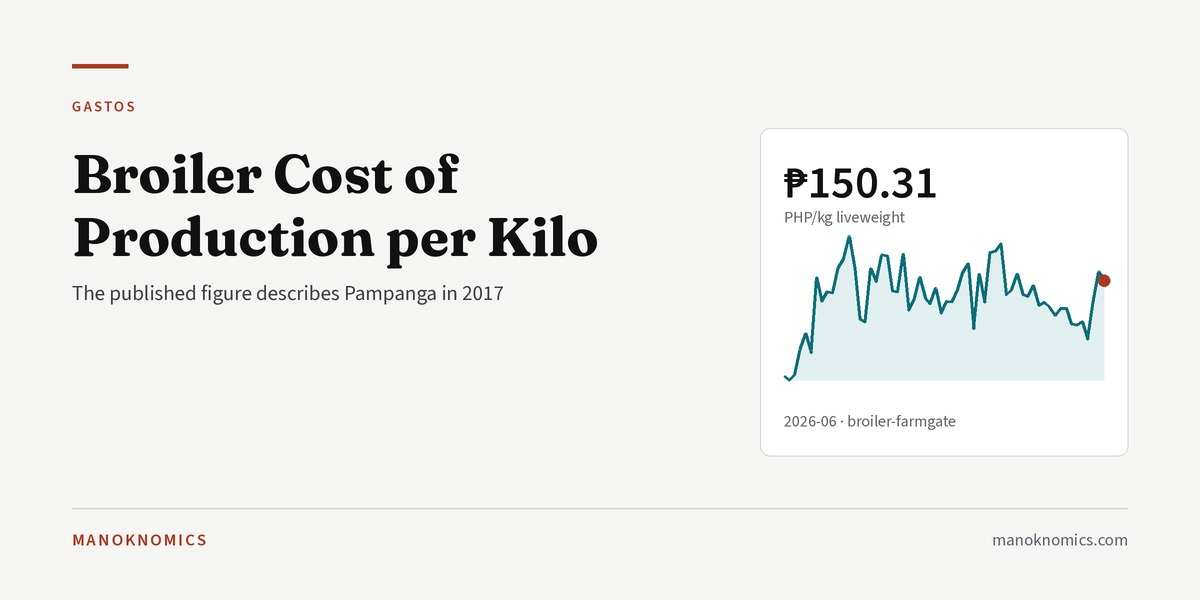
Nobody publishes what it costs to produce a kilo of broiler in the Philippines. PSA costs a kilo of palay every year, nationally and for all 17 regions, and it costs a kilo of milkfish too. Walang manok. The figure in circulation, ₱77.90 per kilo liveweight, describes one province in 2017.
The short answer
The most-quoted Philippine broiler cost of production is ₱77.90 per kilo liveweight, from Table 9 of PIDS Discussion Paper 2022-20, and that table’s own title dates it to Pampanga in 2017. DA and BAI costed a cycle at ₱79.18 per kilo liveweight in September 2021. Rebuilt from the input prices in this archive, a bakuran kilo in 2026 lands between ₱88.70 and ₱105.79 liveweight, and the sack price inside that band is your dealer’s, not a published one.
Does PSA publish a cost of production for chicken?
No, and it is not a matter of looking harder. The PSA OpenSTAT Costs and Returns database held exactly nine tables when it was read on 22 August 2026: palay, palay and corn together, rootcrops, legumes, vegetables, fruits, commercial crops, nuts, and milkfish and tilapia. Dalawang isda ang may sariling talaan doon. Chicken has none, and neither does any other livestock or poultry animal.
What palay gets is worth spelling out, kasi it is the shape of the thing broiler is missing. The palay table carries 46 items for each of 17 regions and each cropping season, from hired labour and irrigation fees down to depreciation, family labour and interest on operating capital, and the last of those items is Cost per kilogram (in PhP). For 2025 it reads ₱13.26 a kilo nationally, against ₱14.52 in 2024. A rice farmer can look up what a kilo cost in his own region last season. A broiler keeper cannot look up anything of the kind, sa buong bansa, for any year.
Iyan ang dahilan kung bakit may ganitong pahina. Every peso-per-kilo broiler figure you will meet is a researcher’s estimate rather than a statistical series, and an estimate carries an author, a sample and a date. Ang tatlong iyon ang magsasabi kung sa iyo ba talaga ang numero o sa ibang tao.
The one table everybody is quoting
₱77.90 per kilo liveweight, and it comes from Table 9 of PIDS Discussion Paper 2022-20. The table’s own title is “Cost and returns of broiler production in Pampanga, 2017, by scale of operation”, and its source line credits Curibot et al. (2019) for the basic figures. One province. One year. Nine years ago as of this writing.
Here is what the backyard column is made of, per kilo of liveweight.
Tatlong bagay sa talaang iyon ang mas mahalaga kaysa sa kabuuan mismo.
The first is the concentration. Feeds at ₱49.40 and sisiw at ₱15.30 are 83.1% of the cost of a kilo. Everything else a keeper worries about, the labour, ang kuryente, ang gamot, ang upa sa lupa, comes to under ₱13 a kilo between them. Kaya ang pagtitipid sa maliliit na linya ay halos hindi mararamdaman. The two lines that decide a broiler kilo are the two you buy before the batch starts.
The second is the footnote. The note under Table 9 says the “original figures converted to liveweight using 0.77 ratio of dress-weight to liveweight, following PSA (2013)”, and the reference list points that at Metadata for Agricultural Statistics in the Philippines, a 2013 documentation volume rather than a measurement series. So the headline Philippine liveweight cost figure is a dressed-weight figure divided by a thirteen-year-old constant out of a metadata manual. That does not make it wrong. It does mean nobody has measured a Philippine dressing yield and published it as data, which is the same hole the two farmgate prices runs into from the other direction.
The third is the one I did not expect. The same ₱77.90 appears twice in that paper under two different units. Table 9 prints it as pesos per kilo liveweight. Table 10, on the facing page, prints it as the Philippine small-scale operating cost in a table headed “Php per kg, dressed-weight”, beside China at ₱88.75 and Vietnam at ₱114.91. Both cannot be true, because the paper’s own conversion factor between them is 0.77. Whichever one is the error, a reader comparing the Philippines to Vietnam on that page is comparing a liveweight cost to dressed-weight costs.
What DA and BAI added, and what PIDS left out
Four years later there is a second Philippine costing, and it is the more honest of the two about what a batch actually pays for. Table 8 of the Philippine Poultry Broiler Industry Roadmap 2022-2040 carries BAI’s own calculation, dated 22 September 2021, for a 6,000-bird cycle at a 1.65 kg market weight: ₱79.18 per kilo liveweight, total cost.
That is ₱1.28 above the PIDS backyard figure from four years earlier, which is close enough that neither number should be treated as precise. What is interesting is not the total but the rows PIDS has no equivalent for. BAI charges depreciation at ₱0.78 a kilo, mortality at ₱4.20, and cost of money at ₱1.27. ₱6.25 a kilo of real expense that a pure operating-cost table cannot see, because it is not a purchase and no receipt arrives for it.
BAI’s own cost concentration lands in the same place: cost of stock at ₱16.36 and feeds at ₱47.73 come to 80.9% of the kilo. Two costings, four years apart, different scales, different authors, and they agree on the share to within about two points. Iyan ang bahagi ng kuwenta na tumatagal.
Side by side, with every figure in the left column from Table 9 of DP 2022-20 and every figure in the right from Table 8 of the roadmap:
| Cost line, per kg liveweight | PIDS Table 9, Pampanga 2017 | DA and BAI Table 8, 2021 |
|---|---|---|
| Feeds | ₱49.40 | ₱47.73 |
| Day-old chick | ₱15.30 | ₱16.36 |
| Labour | ₱6.60 | ₱0.87 |
| Veterinary or biologics | ₱1.80 | ₱2.39 |
| Utilities, fuel, water | ₱3.60 | ₱3.31 |
| Land rent | ₱1.10 | ₱1.82 |
| Brooding | not a line | ₱0.45 |
| Depreciation | not a line | ₱0.78 |
| Mortality | not a line | ₱4.20 |
| Cost of money | not a line | ₱1.27 |
| Total | ₱77.90 | ₱79.18 |
The labour row is the one to read twice. A 500-bird bakuran house charges ₱6.60 a kilo for somebody’s time and a 6,000-bird cycle charges ₱0.87, which is the whole of what economies of scale mean in this trade. Your own hours are the line a published costing is least likely to describe.
The roadmap also disagrees with itself, and I would rather say so than quietly pick the convenient row. Its Table 11 puts a grower’s production cost at ₱109.11 per head, which on the same 1.65 kg bird is about ₱66 a kilo, against Table 8’s ₱79.18. The document does not reconcile them.
Neither does PIDS, in the other paper it published the same year. Discussion Paper 2022-19 runs the same Curibot figures through its own Table 18 and gets ₱77.86 per kilo liveweight for the backyard column, then states ₱70.61 in the body text four paragraphs earlier. ₱7.25 a kilo apart, one paper, one bird. Neither of the two documents on this page is careless work, and both of them print two answers to their own question, which is what happens to a figure that no statistical series exists to check it against.
| Source | Period described | Figure | Unit | Scope |
|---|---|---|---|---|
| PIDS DP 2022-20, Table 9 | Pampanga, 2017 | ₱77.90 | per kg liveweight | backyard, 500-bird house |
| PIDS DP 2022-20, Table 9 | Pampanga, 2017 | ₱71.10 | per kg liveweight | commercial, 10,000-bird house |
| PIDS DP 2022-20, Table 10 | Philippines, 2018 | ₱77.90 | per kg dressed | small-scale farms |
| PIDS DP 2022-20, Table 10 | Philippines, 2018 | ₱92.36 | per kg dressed | large-scale farms |
| PIDS DP 2022-19, Table 18 | 2018 prices | ₱77.86 | per kg liveweight | backyard, 500-bird house |
| PIDS DP 2022-19, body text | 2018 prices | ₱70.61 | per kg, unstated | backyard |
| DA and BAI roadmap, Table 8 | 22 September 2021 | ₱79.18 | per kg liveweight | 6,000-bird cycle, 1.65 kg bird |
| DA and BAI roadmap, Table 11 | 2021 | ₱109.11 per head | per head, not per kg | growers |
| UBRA, via DOST-PCAARRD | November 2024 | ₱105 to ₱110 | per kg, unstated | producers, unstated scale |
Every Philippine broiler cost-of-production figure this archive could find, in publication order. Read the unit column before comparing any two rows: the third row carries the same ₱77.90 as the first, on the same page of the same paper, labelled dressed weight instead of liveweight.
Read down that Period column and the newest entry with a peso-per-kilo attached is a trade association’s, quoted through DOST-PCAARRD in December 2024: the United Broiler Raisers Association put production cost at ₱105 to ₱110 per kilo while the farmgate had fallen to ₱80, a loss they placed at ₱25 to ₱30 a kilo. No unit, no scale, no method. It is the only figure on the list that describes a recent market, and it is the one you can check least.
One more thing about the age of all this. PIDS published a revised version of the benchmarking study in October 2025, same authors, same title. The Philippine broiler cost inside it is still the 2017 and 2018 material above. A 2025 publication date on a study does not date the numbers in it, and that is a general habit worth keeping.
Building the 2026 number from what is actually sourced
Two of the cost lines have current Philippine prices behind them and the rest do not. So the honest construction is to price the two that are sourced, then use the published cost structure to size everything else, and to say out loud that the second half is a shape and not a measurement.
Sisiw first. Day-old chicks were monitored at ₱33.50 per head in the week of 13 July 2026 by BAI. That is an integrator and wholesale farmgate reading rather than the counter price a backyard keeper pays for 20 sisiw, and the counter price is not published anywhere (gap G-16 in the register).
Broiler farmgate, PSA Household survey, national
₱150.31/kg liveweight
PSA OpenSTAT: Farmgate Prices (New Series), Livestock and Poultry (read on 2026-08-15)
Feeds next, and this is where the archive stops being able to help. Nobody in this country publishes a price for a sack of finished broiler feed, which is gap G-15 and the largest single line in the batch. The feed ingredient prices this archive does carry are what the miller pays, not what you pay. An illustrative ₱1,800 per 50 kg sack is used below for the same reason the batch cost article uses it: it is a stated example, and the moment you have your own dealer’s quote you should substitute it.
Put those two together on a 1.7 kg bird at the open-sided feed conversion band Datuin et al. (2022) records for Philippine growers, 1.50 to 1.83, and sisiw-and-feeds alone cost ₱73.71 to ₱85.59 per kilo liveweight. That pair is worked through bird by bird in the break-even price per kilo, and the feed leg on its own is in feed cost to market weight.
Now the part nobody publishes. If chicks and feeds are 83.1% of the kilo on the PIDS structure and 80.9% on BAI’s, then the full cost is the floor divided by that share: ₱88.70 at the tighter end, ₱105.79 at the looser. The gross-up adds ₱20.21 a kilo at the top, and that ₱20.21 is the whole of what nobody in the Philippines publishes for a bakuran flock: kuryente sa brooder, gamot, tubig, ang oras mo, ang lumang kulungan na kailangan nang palitan, at ang mga manok na hindi umabot sa harvest.
Three caveats, none of them optional. The share is 2017 and 2021, so what is being carried forward is the shape of the cost and not its level. A gross-up assumes the other lines move with the price of feed, which they only roughly do. And the sack price inside it is an illustration, so the band moves when yours does. Kung mababa ang bili mo sa sako, mababa rin ang totoong bilang mo, and the arithmetic to redo it is one division.
Is that above the farmgate or below it?
Above it, and with room, if you are selling into the household level. The PSA household broiler farmgate read ₱150.31 per kilo liveweight in June 2026, which leaves ₱44.52 a kilo over the top of the reconstructed band, bago pa may itabi para sa kulungan mismo.
60 monthly observations from PSA OpenSTAT: Farmgate Prices (New Series), Livestock and Poultry, August 2021 to July 2026. Household farmgate starts at PHP 101.95 per kg liveweight in August 2021 and ends at PHP 150.31 in June 2026. Highest PHP 173.04 in August 2022, lowest PHP 99.69 in September 2021. One period has no published figure: July 2026. Every value, with its source, is on the Presyo page for this series.
See all 199 observations on the Presyo page →The commercial establishment level is where the losses in the headlines live. That series sat under the same ₱105.79 in seven of those 60 months and under ₱88.70 in one, and it reads a different population of sellers entirely. Its June 2026 figure is ₱118.69 per kilo liveweight, ₱31.62 below the household line. Overlaying a backyard cost band on a commercial price line is the wrong comparison in both directions, and it is roughly what happens every time a news story about producers selling below cost is read as being about a bakuran.
Where this comes from
- What it measures
- What growers are paid per kilo of live broiler at the farm, before anyone hauls, dresses or sells it.
- Unit
- ₱/kg liveweight
- Geography
- PH
- Covers
- –
- Observations
- 199
- Source
- Download the whole series
- /data/broiler-farmgate
- How to cite this
PSA OpenSTAT: Farmgate Prices (New Series), Livestock and Poultry. Broiler farmgate price. Compiled by Manoknomics, manoknomics.com/presyo.
Why the Philippine kilo is expensive, in one column
The most useful thing in PIDS’s benchmarking is not the Philippine total, it is the cost share beside three other countries. On large-scale farms, day-old chicks are 29.93% of Philippine operating cost, against 14.20% in China, 17.66% in Vietnam and 21.03% in Thailand. Filipino producers pay 2.11 times the Chinese share for their stock. Feeds are 64.63% here against 74.06% in Thailand, so it is not that Philippine feed is a smaller problem, it is that the chick is a much bigger one.
Ang sisiw ang pinaka-Pilipinong bahagi ng problema, and it is the line a bakuran keeper has least control over: ang dealer ang nagtatakda ng presyo sa counter, and the wholesale figure anchoring it is not the one you are quoted. Feed conversion is the other half, and what a bakuran flock actually hits is unmeasured here too, which broiler FCR in backyard batches works through.
What would close this gap
One institution and one survey. PSA already runs a Costs and Returns Survey with a per-kilo output, a regional breakdown and 46 cost items, and it already extends past crops to milkfish and tilapia. Adding broiler to it points an instrument that exists at a commodity it does not currently cover, rather than standing up a new statistical programme. Ang mahirap na parte ay nagawa na.
Until then, the number on this page is the best I can construct and it is not a measurement. The two figures inside it that are real are ₱33.50 for a chick and ₱150.31 for a kilo at the gate, both dated, both sourced, both linked above. The share is borrowed from 2017. The sack price is an example. Kung isang numero lang ang dadalhin mo mula dito, ito na iyon: your own sack receipt and your own harvest weight, written down with the date beside them, beat every published Philippine broiler cost figure listed on this page, because every one of those describes somebody else’s manok in a year that has finished.
That is not a rhetorical flourish. Six of the nine rows in the table above were published between 2022 and 2025 and every one of them describes 2017, 2018 or 2021. A notebook from your own last batch describes 2026. Where the numbers come from sets out the questions to ask any figure before it goes into a budget, and the gaps register carries the rest of what is missing. The batch-level view of all of this, from placement to sale, is raising broilers in the Philippines.
Cite this page
Every figure here carries the source it came from and the date it was read. If you use one, this is the line that says where it came from.
A backyard poultry keeper. "Broiler Cost of Production per Kilo: What Is Published, and What Is Not". Manoknomics. Published September 21, 2026. https://manoknomics.com/articles/cost-of-production-per-kilo-broiler
Select the text to copy it.
Questions people actually ask
How much does it cost to produce a kilo of broiler chicken in the Philippines?
No agency publishes a current figure. The most-quoted number is ₱77.90 per kilo liveweight for a backyard operation, from PIDS Discussion Paper 2022-20, and its own table title dates it to Pampanga in 2017. DA and BAI costed a 6,000-bird cycle at ₱79.18 per kilo liveweight in September 2021, in the Philippine Poultry Broiler Industry Roadmap. Rebuilt from 2026 input prices in this archive, a backyard kilo lands somewhere between ₱88.70 and ₱105.79 liveweight, and the sack price inside that is your own dealer's rather than a published one.
Does PSA publish a cost of production for chicken? Show the answer
No. The PSA OpenSTAT Costs and Returns database held nine tables when it was read on 22 August 2026: palay, palay and corn together, rootcrops, legumes, vegetables, fruits, commercial crops, nuts, and milkfish and tilapia. There is no chicken table, no poultry table and no livestock table of any kind. Palay gets a cost per kilogram nationally and for all 17 regions, split into 46 items down to depreciation and family labour, most recently ₱13.26 per kilo for 2025. Broiler gets none of that.
What share of broiler cost is feed? Show the answer
Between 60 and 65 percent on the two Philippine cost structures that itemise it, and feed plus day-old chicks together run 80 to 83 percent. PIDS Table 9 puts backyard feeds at ₱49.40 and chicks at ₱15.30 against a ₱77.90 total, which is 83.1% of the kilo. DA and BAI put feeds at ₱47.73 and chicks at ₱16.36 against ₱79.18, which is 80.9%. The two were built four years apart from different data and land within about two points of each other.
Is the farmgate price above the cost of production right now? Show the answer
For a backyard flock, on the reconstruction here, yes and with room. The PSA household broiler farmgate read ₱150.31 per kilo liveweight in June 2026, against a reconstructed cost band topping out at ₱105.79. Across the 60 months to June 2026 the household series fell below that ceiling in three of them, all in late 2021, and below the ₱88.70 floor in none. The commercial establishment series is a different story and a different population, which is why a news headline about producers selling below cost is often not about a bakuran at all.