Where to Sell Broilers: Viajero, Palengke or Direct
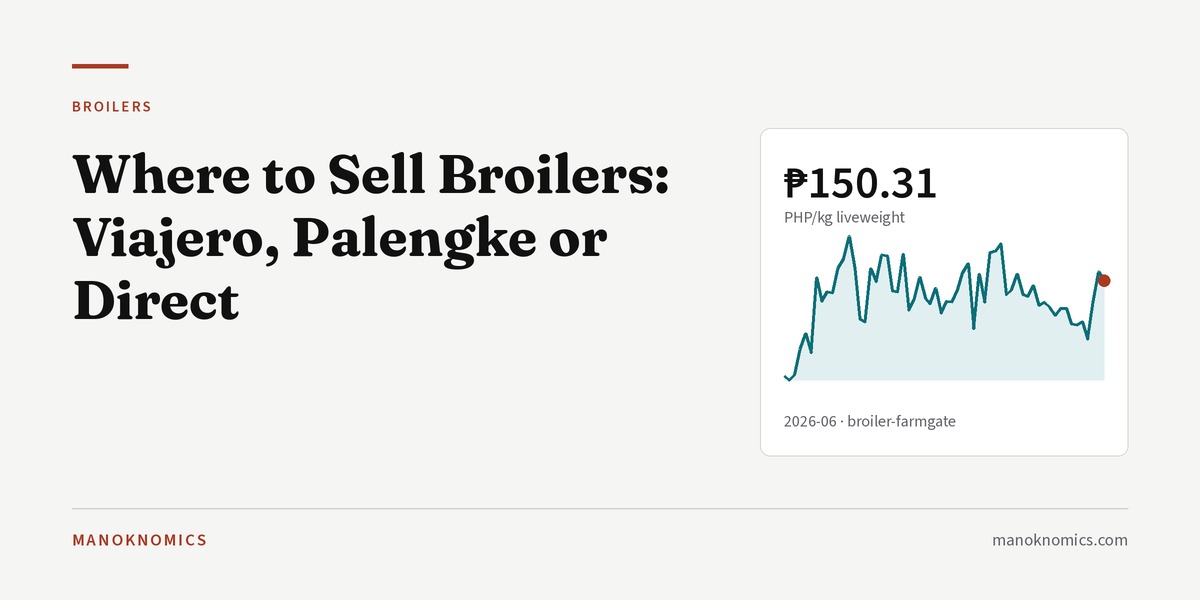
Ask where to sell a batch of broilers and you are usually told to check demand in your area. The Department of Agriculture published a better answer in 2022 and nobody has quoted it since. On printed page 38 of its own broiler roadmap, under Weaknesses, the DA lists “lack of market information access for backyard raisers causing a disconnect between farmgate price and retail price” (DA-BAI Philippine Poultry Broiler Industry Roadmap 2022-2040). The state says in writing that you cannot see the price. Then, nine pages later, it prints one.
The short answer
Three channels are open to a backyard batch: live at the gate to a viajero, your own palengke day, or dressed and sold direct. A contract grower has none of them. Table 11 of the DA-BAI broiler roadmap gives the trader ₱11.89 per head against the grower’s ₱35.39, on 2018 data, and its retailer row misses its own subtraction by ₱4.70. Kung sulit ba ang maghakot, nasa tala mo lang iyon at wala sa kahit anong inilathalang numero.
Source DA-BAI, Philippine Poultry Broiler Industry Roadmap 2022-2040, Table 11, printed p. 47 (read on August 22, 2026)
Who actually buys a backyard broiler, and are you allowed to sell to them?
Tatlo ang bumibili sa bakuran: ang viajero na kukunin ang lahat nang buhay, ang palengke kung ikaw mismo ang maghahakot, at ang kapitbahay kung kakatayin mo. Settle who may use which before comparing them. The roadmap describes the trade on printed page 35: “Traders or ‘viajeros’ buy broilers from independent commercial growers or contract growers. They then sell chickens as live birds to the wet markets.” The sentence after it closes a door: “the integrators retain ownership of the birds so contract growers are not allowed to sell to viajeros and the integrators harvest the birds at the end of the cycle” (roadmap p. 35).
Kung contract grower ka, wala kang channel. Hindi sa iyo ang manok sa kulungan mo, at growing fee ang bayad at hindi presyo. Contract growing against independent sets out what that arrangement transfers; everything below assumes the birds are yours.
Page 35 says viajeros sell live. The table below does not say what any of its three players sells: it states no output form at all, and the roadmap’s own post-production table on printed page 45 totals a cost marked fully dressed, carrying a ₱10.00 per bird dressing fee. So the ₱11.89 is a profit per head and this page will not say what form it was earned in.
| Table 11, DA-BAI broiler roadmap, printed p. 47. PRDP 2018 data. The ₱85/kg farmgate on a 1.7 kg bird is stated for the grower’s row only | Grower | Trader | Retailer |
|---|---|---|---|
| Sales per head | ₱144.50 | ₱165.24 | ₱179.60 |
| Production cost per head | ₱109.11 | ₱153.35 | ₱167.77 |
| Profit per head, as printed | ₱35.39 | ₱11.89 | ₱7.13 |
| Profit share, as printed | 65% | 22% | 13% |
| How often that turns over | 32-35 days | Everyday | Everyday |
The prose above it gives the table’s basis: “the selling/farmgate price used is Php85/kg of 1.7kg market weight and the cost to produce was at PhP 64.18kg” (roadmap p. 46), and 85 times 1.7 is the ₱144.50 in the first cell. That ₱85 farmgate sits ₱65.31 a kilo below the ₱150.31/kg liveweight PSA household reading for June 2026, which is the household series and not the commercial one: the two are ₱31.62 apart. The table is a picture of the chain. It is not a price for 2026.
One more thing picks your channel, and it is settled the day the chicks land. Page 9 reproduces the UBRA size classes, off size 1.30 to 1.49 kg, regular 1.50 to 1.69 kg and prime 1.70 kg up, with the flat remark that “The viajeros prefer the heavier birds”, while a 1.4 to 1.5 kg bird goes into the lechon manok trade (roadmap p. 9). Ang target na timbang mo ang pumipili ng bumibili, hindi ang kabaligtaran, at ang tanong kung ilang araw ay sumusunod lang doon.
What the middleman earns, and the row that does not subtract
The printed profits are the numbers to quote: ₱35.39 for the grower, ₱11.89 for the trader, ₱7.13 for the retailer. Sum them and the chain earns ₱54.41 a head. The table’s footnote says the percentages come from “summing up all the profit in the chain (growers, traders, retailerrs) and dividing each player’s share to that total profit”, and that reconciles: the trader’s share recomputes to 21.85 percent against a printed 22.
The grower’s row works: 144.50 less 109.11 is 35.39. The trader’s row works, 165.24 less 153.35 being 11.89. The retailer’s row does not. 179.60 less 167.77 is ₱11.83 and the table prints ₱7.13, ₱4.70 apart, in the only Philippine table that prices this chain.
One page gives the grower’s share three times. Page 46 says “the growers acquire the highest profit share of 65 percent”, then “63 percent of the profit share goes to the growers”, then on 2021 data “only around 34.21 percent of the whole value chain instead of the 65 percent in the PRDP study” (roadmap p. 46). Only the 65 reconciles with the printed profits.
The distance across the table is ₱144.50 to ₱179.60, or ₱35.10 a head, 24.29 percent on top of what the grower was paid. Call it a distance and not a gate-to-stall spread. The table never states what form each row sells in, so that ₱35.10 may be crossing a live bird into a dressed one, which is the subtraction the mistake list below tells you never to make.
PSA prices a live native bird at both ends, so the same picture can be drawn for native chicken. For broiler it cannot, kasi walang live retail row kahit saan sa opisyal na datos.
Magkano ang kinukuha ng bawat channel sa iyo?
The roadmap answers this one in a table it built for somebody else. Table 10, printed page 46, itemises a retailer’s own operation per kilo, and every cash line carries its divisor in the cell.
| Table 10, retailer’s operation, printed p. 46 | Printed ₱/kg | The divisor printed with it |
|---|---|---|
| Stall rental | ₱1.26 | ₱150 a day over 100 dressed chickens |
| Labour and vendor | ₱1.68 | ₱200 a day over the same 100 |
| Market fee | ₱0.17 | ₱20 a day over the same 100 |
| Shrinkage | ₱1.50 | |
| Other | ₱0.69 |
Iyon ang araw mo sa palengke, nakasulat na ng gobyerno. Ang puwesto ay ₱150 per day, ang market fee ₱20 per day, at ang maghapong tayo mo doon ₱200 per day. All three are divided by a hundred dressed chickens. Bring fifty and the same day’s cash spreads over half as many birds, so the cost per bird doubles. That is why a palengke day pays a fifty-bird keeper worse than the vendor beside you.
The trader’s side has the same shape. Table 9, printed page 45, puts Incidental Expenses at ₱0.09 per kilo and explains it as ₱200 per trip over 1,800 birds. Hatiin mo ang parehong ₱200 sa 50 manok at ibang laki na ng bagay iyon. That, and not haggling, is what the viajero is selling you.
Two more lines from Table 9 are worth carrying. Dressing cost is ₱8.56 per kg, broken out in the row label as a ₱10.00 per bird dressing fee plus ₱0.10 per kg for quality control, and shrinkage is ₱7.00 per kg, stated as 6 percent of liveweight. Ang timbang na nawawala sa daan ay bayad din, kahit walang resibo. Do not chain Table 9 into Table 10 to manufacture a margin. The four tables run on three different farmgate assumptions, so a subtraction across them looks reasonable and means nothing. The cost of production per kilo works the cost side of the same document properly.
Moving the birds: the paperwork the viajero is holding and you are not
Part of what the trader’s margin buys is a folder. DA Administrative Order No. 05, s. 2019, dated 3 September 2019, names the category in regulation. Section 4(l) defines a Livestock/Poultry and its By-Products Handler’s License as covering a “person engaged in the trade of livestock, poultry … usually in its transport from one farm or establishment to another”, and section 4(t) registers the vehicle under it (DA AO 05 s. 2019, BAI-NVQSD).
| Handler's licence | Held by the person trading and moving the birdsSection 4(l). This is the viajero’s licence, and it has a name in Philippine regulation. |
|---|---|
| Registered transport carrier | The vehicle itself, registered with BAI or the DA Regional Field OfficeSection 4(t). |
| Veterinary Health Certificate | Valid for a maximum of three daysSections 5.1 and 5.5.5. Counting starts the day after issuance, including weekends and holidays. |
| Shipping Permit | Valid for a maximum of seven days, and freeSections 5.6.1 and 5.6.2. The Authority to Ship was abolished by section 5.1 and BAI no longer issues one. |
Read the scope before assuming any of it binds you. Section 1 applies the order to shipments that “shall depart from seaport or airport and/or pass through established interregional veterinary quarantine checkpoints within the Philippines” (DA AO 05 section 1). A run to the market in your own municipality does neither, so what governs it is your local government, and poultry permits and registration covers that layer.
Backyard farms are not shut out of the interregional route. Section 5.3 states that “Backyard/Smallholder farms shall be allowed to transport animals” on compliance with the mandatory requirements, and adds that “For slaughter purposes, shipment shall be allowed provided a VHC is presented”.
Then the order becomes ambiguous. Section 5.9 sets out requirements species by species. Section 5.9.2 covers “Broilers from Commercial Farms” and requires, among other things, that “The source farm must be BAI accredited and has undergone required testing”. Section 5.9.3 covers “Free range/native chickens raised in the backyard” and asks instead that the source area have no reported Newcastle Disease in the last 21 days and that the birds “were vaccinated within the last three (3) months against ND”, with no farm accreditation at all. There is no row for a broiler raised in a backyard. Such a bird at a checkpoint is read either under section 5.3 or under a section written for accredited commercial farms, and which one is a reading of an issuance rather than a published fact. Take both sections to your Provincial Veterinary Office and ask for the answer in writing before you book the trip.
Dressing them yourself, and what the Meat Inspection Code does not say
The third channel has the most money in it and the most law around it. Republic Act No. 9296, the Meat Inspection Code, defines a meat establishment at section 4(23) as premises “such as slaughterhouse, poultry dressing plant, meat processing plant, cold storage, warehouse and other meat outlets that is approved and registered by the NMIS in which food animals or meat products are slaughtered, prepared, processed, handled, packed or stored”, and section 13 applies the Code to “all meat establishments where food animals are slaughtered, prepared, processed, handled, packed or stored or sold” (RA 9296). Poultry is a food animal under section 4(15).
For anyone who has been told there is a home exemption: across the full text of RA 9296 and of RA 10536, which amended it in 2013, the phrases “own consumption”, “backyard”, “personal use” and “household” return zero occurrences between them. There is no backyard-slaughter exemption in the statute. What exists instead is a pair of sections. Section 10 puts slaughterhouses, meat inspection, meat transport and post-abattoir control in the hands of local government units, and section 11 gives them “full and complete authority over the activities mentioned in the immediately preceeding section” (sic) “within their respective territorial jurisdiction”. So the binding answer for your town is your town’s, it is not readable from any national website, and I am not a lawyer.
Two edges before you ask. Section 31 calls meat that has not passed ante-mortem inspection “hot meat”, which inspectors may seize, confiscate, condemn or dispose of. And RA 10536 section 56 sets the penalty at imprisonment of “not less than six (6) years and one (1) day but not more than twelve (12) years”, or a fine between ₱100,000 and ₱1,000,000.
On the same page 38 the roadmap records that “The unavailability or limited number of accredited poultry dressing plants in the region forces producers to dress chickens in the backyard; hence, putting in question if sanitary slaughter measures were observed” (roadmap p. 38). The document describing the practice and the statute providing no exemption for it are the same government. NMIS runs the accreditation register, but its page returned an HTTP 403 on 22 August 2026, so nothing here is cited to it.
How far the legal option is has a number on it. DA Administrative Order No. 15, s. 2021 records that under a 2006 joint circular only cities and first class municipalities slaughtering at least 21 hogs, 6 large cattle “or 1,001 birds” a day could qualify to build an “AA” standard slaughterhouse, and that from 2007 to 2020 fifteen cities, thirty-two first class municipalities and seven second class ones were granted assistance under the NMIS establishment programme. Fifty-four local government units in fourteen years. The order scales that threshold down for third to sixth class municipalities, defining a small scale facility as one handling “less than 1,000 birds per day” in class A or class AA, with eligibility written as “1 to 999 heads of poultry”. The CALABARZON value chain map on page 28 counts twelve accredited dressing plants, and they sit in four of the five provinces: Cavite has no entry. Ring the municipal hall before you build a channel on one, and ask two things. Which dressing plants inside this municipality are accredited, and what does the LGU require of somebody dressing birds here for sale.
Fresh poultry meat is a basic necessity under section 3 of the Price Act, RA 7581, with the Department of Agriculture as implementing agency. That is where your bird sits, and it is not a statement that a ceiling applies to what you charge.
What nobody publishes, and the log that replaces it
Three things a seller needs are not published anywhere I could find them.
No Philippine agency publishes what a viajero pays at a farm gate. Checked against every series in this site’s archive, the PSA tables behind the household series and the commercial establishment series, the DA Bantay Presyo NCR weekly for 10-16 August 2026 and the week before it, and the roadmap end to end. The nearest thing is Table 11’s ₱11.89, a focus-group profit from 2018. It sits in the gaps register with the rest.
No live broiler price exists at retail in Philippine official data. PSA publishes a fully dressed broiler row and no live one; the dressed retail series read ₱213.24 a kilo dressed in July 2026, and the DA’s NCR weekly priced whole dressed local chicken at ₱199.76 per kg for 10-16 August 2026 against ₱200.86 the week before, across 36 named markets. Two surveys, two geographies, two cadences, and neither is a live bird.
Nothing quantifies the direct channel. The roadmap says so on pages 31 and 32: of smaller operations that might be classified as backyard, “there is no available study yet to ascertain this”. Its CALABARZON value chain map counts 17 backyard farms and 467 commercial ones, and neither figure is a regional total. Quezon’s cell is blank in both rows, and Cavite and Rizal carry no backyard row at all, so each number is a sum of the provinces that reported. The 147 licensed handlers is a real five-province count, and it is the only one of the three that is.
What usually goes wrong
The mistake: Chaining Tables 8, 9 and 10 of the roadmap into a middleman margin.
Do this instead: Read each table only against its own stated basis, and take the chain figures from Table 11 alone.
Tables 8 and 9 are built on a ₱84.00/kg farmgate, Table 10 on ₱100.00 and Table 11 on ₱85.00 with a heavier bird. Any subtraction across them produces a plausible number resting on two different assumptions.
The mistake: Reading ₱11.89 as what a viajero is making off you this week.
Do this instead: Read it as the shape of the chain in 2018, and get your own figure out of your own trip log.
It is a profit per head from a 2018 DA PRDP study. The ₱85/kg farmgate the roadmap states is for the grower's row, and it sits ₱65.31 a kilo below the June 2026 household reading. It is also a profit, not a buying price.
The mistake: Subtracting a farmgate price from a palengke price to find the margin.
Do this instead: Read down the column, never across it.
The farmgate figure is a live bird at your gate and the retail figures are dressed meat on a stall. They are different weights of different things, and no sourced Philippine yield joins them on this page.
Ang tanong ay hindi kung magkano ang kita ng viajero. Ang tanong ay kung magkano ang natitira sa iyo pagkatapos ng isang biyahe, sa bawat kilong dala. The native chicken price page already runs this log on five lines. What it does not carry are the divisors Tables 9 and 10 print, or the subtraction underneath. Eight lines, one run per channel where you can.
| Write this down, one line per hakot | Why the line is there |
|---|---|
| Date, buyer, channel | One buyer over and over is a habit, not a comparison |
| Birds carried, kilos carried | The kilo is the denominator for everything below |
| Fare or fuel, both ways | The line most often left out |
| Crates, sacks, ice, rope | Bought once, worn out over many trips |
| Puwesto and market fee, actually paid | Table 10 says ₱150 and ₱20 a day. Yours will differ |
| Birds that did not arrive or did not sell | Table 9 carries shrinkage at 6 percent of liveweight |
| Hours, gate to gate | Table 10 prices a vendor’s day at ₱200. Price yours |
| Pesos actually received | Not the price agreed. What came home |
The number to take from it is pesos received less trip cost, over kilos carried. Run it for a gate sale, run it for a palengke day, run it for a dressed sale, and the highest of the three is your channel. Cost on its own cannot rank them, kasi ang biyaheng hindi mo ginawa ay laging pinakamura. Ang natitira, hindi ang gastos, ang sumasagot. Ang gastos ng 50-manok na batch is where the puhunan for that test comes from, and raising broilers in the Philippines is the batch this page is trying to move.
Work it out for your own flock
What farmgate price do you need to break even? Open the calculator
Put your own sack price in and read the farmgate price a batch has to clear. Any channel that lands under that line is costing you money however busy it looks.
Questions people actually ask
Where can I sell broiler chickens in the Philippines?
Three outlets are realistically open to a backyard batch: a viajero or trader who buys live birds at your gate and resells them into a wet market, your own stall day at the palengke, or dressing the birds and selling direct to households. A contract grower has none of the three, because the integrator owns the birds until harvest. Which of the three pays best cannot be answered from published Philippine data. No agency publishes what a viajero pays at a farm gate, so the comparison has to be made against your own recorded trip costs.
How much does a viajero make per chicken in the Philippines? Show the answer
The only Philippine figure is a profit of ₱11.89 per head for the trader, printed in Table 11 on page 47 of the DA-BAI Philippine Poultry Broiler Industry Roadmap 2022-2040. It comes from a 2018 DA PRDP value chain study. The ₱85 per kg farmgate on a 1.7 kg bird that the roadmap states alongside it is given for the grower's row, not for the trader's, and it sits far below current farmgate readings. It is a profit, not a buying price, and it is not a price series that anybody updates. The same table gives the grower ₱35.39 per head and the retailer ₱7.13.
Do I need a permit to transport live chickens in the Philippines? Show the answer
For shipments that depart from a seaport or airport, or pass an established interregional veterinary quarantine checkpoint, DA Administrative Order No. 05 s. 2019 requires a Veterinary Health Certificate valid for three days and a Shipping Permit valid for seven days, which the order states is free. It also requires the handler to hold a Livestock/Poultry and its By-Products Handler's License and the vehicle to be a registered transport carrier. A trip to a market inside your own municipality falls outside that scope, and the rules that bind there are your local government's. Ask the Provincial Veterinary Office for a written answer for your own route.
Is it legal to dress chickens at home in the Philippines? Show the answer
Republic Act No. 9296, the Meat Inspection Code, contains no backyard or own-consumption exemption. A full-text search of the Act and of RA 10536, which amended it, returns zero occurrences of "own consumption", "backyard", "personal use" and "household". Section 13 applies the Code to all meat establishments where food animals are slaughtered, prepared, handled or sold, and sections 10 and 11 give local government units full and complete authority over slaughterhouses and meat inspection inside their own territory. So the answer for your own municipality is set by your own municipality, and this is not legal advice.
What weight do broiler buyers want in the Philippines? Show the answer
The DA-BAI broiler roadmap reproduces the UBRA size classes on page 9: off size is 1.30 to 1.49 kg liveweight, regular size 1.50 to 1.69 kg, and prime size 1.70 kg and up. The same page states that viajeros prefer the heavier birds, that Luzon buyers go for 1.5 to 1.8 kg and Visayas buyers for 1.4 to 1.5 kg. A 1.4 to 1.5 kg bird is described as a lechon manok or rotisserie bird, and a 1.8 to 2.1 kg bird as one sold whole and dressed in supermarkets and wet markets.