When to Harvest a Broiler: Day 28, Day 35 or Day 42
The short answer
Day 28 for most Philippine backyard batches, day 35 if your buyer pays for size, day 42 almost never. Aviagen puts an as-hatched Ross 308 AP at 1,657 g on day 28, and that lands inside the 1.6 to 1.7 kg liveweight Datuin et al. (2022) record as the Philippine market target against 2.1 to 2.5 kg abroad. Hindi ang feeds ang humahadlang sa pagpapatagal: the extra kilos are worth more than the extra sacks at any presyo a dealer quotes. Ang humahadlang ay ang bibili, ang laki ng kulungan, at ang panganib sa manok na may halaga na.
Source Datuin et al. (2022), Production System of Selected Commercial Broiler Chicken Farms in the Philippines, PJVAS 48(1):57-69 (read on August 13, 2026)
Day 28, for most Philippine backyard batches. Here is what each of the three answers actually puts on the hook.
- Day 28 is 1,657 g for an as-hatched Ross 308 AP (Aviagen 2022). That is the weight this market was built around. Datuin et al. (2022) put the Philippine target liveweight at 1.6 to 1.7 kg (PJVAS 48(1):57-69), so this is the lechon manok bird and the ordinary bilihin sa palengke.
- Day 35 is 2,360 g. Above the 1.6 to 1.7 kg Philippine target, and inside the 2.1 to 2.5 kg band the major producing countries grow to. A bird for a buyer who pays by the kilo and wants size, not for a suki who buys kada ulo.
- Day 42 is 3,086 g. Heavier than the 2.1 to 2.5 kg the big producing countries grow to, and past the 3 kg liveweight Aviagen recommends against exceeding in an open-sided house with no environmental control (Ross Broiler Management Handbook, 2025). Ibang bansa ang bumibili ng ganitong manok.
Cobb500 runs heavier at all three ages, and the two strains are never averaged here. Itanong mo sa hatchery kung anong strain ang binili mo, bago pa dumating ang sisiw. If you are still deciding whether to place a batch at all, the broiler pillar walks the whole thing from day 1.
Day 28 is the Philippine market weight, not an early exit
Most guides written for a Philippine reader treat day 28 as cutting the batch short. It is not. It is the weight this market was built around, and day 42 is the outlier here.
Datuin et al. (2022) surveyed 55 commercial broiler operations, 48 contract growers and 7 integrators, and record a Philippine target liveweight of 1.6 to 1.7 kg against 2.1 to 2.5 kg in the major producing countries (PJVAS 48(1):57-69). The same paper splits its birds into two products by that weight: lechon manok at 1.6 kg and under, big bird at 1.7 kg and over.
Line that up against the breed table and the whole question changes shape. Ross reaches 1,657 g on day 28 and 2,360 g on day 35, so the local market sits between one row and the next. There is no third week after that which the palengke is asking for. Day 42 is the row a European or American grower reads, and reading it here is how a Philippine batch plan ends up describing somebody else’s country.
Two consequences follow, and neither is about feed. The harvest decision here is a narrow window rather than a broad choice, because there is barely a week between the local target and the point where the bird stops being the product anybody asked for. And the call gets made at a weight where the breed table is still steep, so the weekly curve is worth having open beside the buyer’s spec.
Ano ba ang kinakain ng bawat dagdag na linggo?
The FCR printed in a breed table is cumulative. It divides everything the bird has ever eaten by everything it now weighs, so week one, when a sisiw converts at well under 1.0, keeps flattering week six forever. Subtract one row from the next and the flattery stops.
| Day 28 to day 35 | Ross 308 AP | Cobb500 |
|---|---|---|
| Liveweight gained | 703 g | 738 g |
| Feed eaten over those 7 days | 1,185 g | 1,276 g |
| Feed conversion, that week alone | 1.69 | 1.73 |
| Day 35 to day 42 | ||
| Liveweight gained | 726 g | 757 g |
| Feed eaten over those 7 days | 1,406 g | 1,465 g |
| Feed conversion, that week alone | 1.94 | 1.94 |
Worked by subtraction from the published day-28, day-35 and day-42 rows of Aviagen (2022) and Cobb-Vantress (2022), as-hatched, metric. Both are performance objectives for controlled housing. The two strains land on the same last-week figure out of two unrelated tables, which is coincidence and not a relationship.
Now hold 1.94 against the only Philippine conversion figure anybody has published. The open-sided growers in Datuin’s Table 5, page 66, named 1.50 to 1.83 for a big bird, and that band covers the whole batch from day-old to harvest. So the last week of a breed-table bird, in a house where somebody sets the temperature, converts feed worse than a Philippine open-sided grower is aiming to convert across the entire batch.
Read the scope before you carry that anywhere. Table 5 splits growers, not respondents, so the denominator is 48 and not 55; 16 of them are open-sided and those 16 are the column a bakuran keeper reads. Every cell is a target the farm named for itself, and Table 6 on the same page has 33% of the growers meeting their targets only sometimes or not at all. Contract growing with technical support, hindi bakuran.
What nobody has published is the marginal figure for an open-sided Philippine bird, which is the number this section would rather have had. The archive logs the absence as gap G-1. The real figure is worse than 1.94, because of heat and because feed access in an open-sided coop is nobody’s controlled variable. No Philippine study says by how much, and multiplying 1.94 by a factor of your own invention produces a decimal point with nothing behind it.
On feed alone the extra week pays, so the feed argument is the wrong one to reach for
The obvious next line is: stop at day 28, then. Iyan ang linyang sinusulat ng halos lahat, at hindi ito nakakaligtas sa presyo sa bentahan.
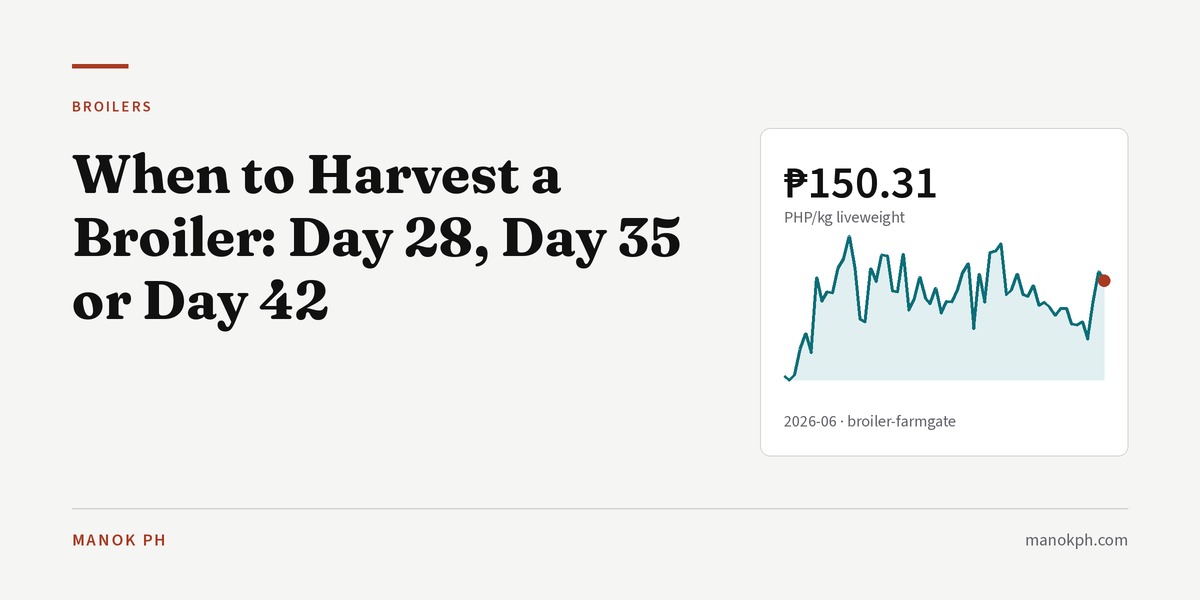
Take the seven days between day 28 and day 35. Ross adds 703 g of liveweight over them. At ₱150.31 per kilo liveweight, the June 2026 PSA household broiler farmgate reading, that gain is worth ₱105.67. It cost 1,185 g of feed. Divide one by the other and the feed price at which that week stops paying for itself is ₱89.17 per kilo of feed.
Wala pang dealer sa Pilipinas na naniningil ng ganoon. Finished commercial feed is quoted at ₱1,850 to ₱1,950 for a 50 kg sack depending on brand and area, and even that spread is hearsay rather than a published figure: no Philippine agency prices a sack of finished feed at all, by any brand or tier, which is gap G-15. The break-even sits far above anything in circulation, and it would take a feed market nobody has ever seen here to change the sign.
So the marginal conversion number is real and it does not decide anything on its own. Say it plainly rather than burying it: on feed arithmetic, growing on pays, at hindi feeds ang dahilan para ibenta mo nang maaga.
Two honest cracks in that arithmetic, both worth naming. The gain is an imported controlled-housing figure priced at a Philippine observation, which is an assumption and not a measurement. And an open-sided bird eats more than the table for the same gain, which pulls the break-even down. Neither moves it by the factor it would take to reach a real sack price. What the arithmetic does leave out is everything else that week costs: gamot, tubig, oras mo, at ang kulungan na hindi pa pwedeng pasukan ng susunod na batch. None of those has a published Philippine figure either.
The raw material at least has one. BAI prices 15 feed ingredients weekly in pesos per kilo, and the week of 13 July 2026 read yellow corn at ₱24.75 and soybean meal at ₱29.38. That record explains why a sack price moves. It cannot be built into a sack price, and BAI has published no weekly report since that date.
Bakit day 30 to 34 ang target ng mga grower dito?
Because the constraint is the product, not the conversion. Here is what the commercial growers told their own survey.
| Housing | Product | Target harvest age | Target livability |
|---|---|---|---|
| Open-sided | Big bird, 1.7 kg and over | 30 to 34 days | 94 to 95% |
| Open-sided | Lechon manok, 1.6 kg and under | 28 to 38 days | 93 to 96% |
| Climate-controlled | Big bird | 30 to 39 days | 92 to 98% |
| Climate-controlled | Lechon manok | 26 to 35 days | 85 to 98% |
Table 5, p. 66 of Datuin et al. (2022), read on 13 August 2026. It disaggregates the survey’s 48 contract growers by housing, so the 7 integrators are out; 16 of the growers are open-sided and those are the two rows that describe a coop without a thermostat. Every figure is a stated target rather than a recorded result, and the paper publishes ranges with no mean, so there is no midpoint to take.
The open-sided big-bird window, 30 to 34 days, is 4 days wide. Not a season, not a fortnight. Sixteen commercial farms with technical support behind them, contracted feed and a scheduled hauler, gave themselves a four-day slot, and a third of the growers in the same survey admitted they miss what they set. Do not plan on anything looser in a bakuran.
Notice too that the lechon manok row runs 28 to 38 days, wider at both ends, because that product is selected by weight rather than by the calendar. A bird sold at 1.5 kg out of a slow batch and a bird sold at 1.5 kg out of a fast one are the same product on different days, at iyon ang totoong ibig sabihin ng harvest age dito.
The breed company sets the other end of it. In open-sided houses with no environmental control, Aviagen recommends against growing birds above 3 kg liveweight (Ross Broiler Management Handbook, 2025). Day 42 on Aviagen’s own performance table is 3,086 g. The document that publishes the bottom row is the document telling you not to chase it in the house you have.
The kulungan runs out before the calendar does
PNS/BAFS 262:2018 § 6.3.1 sets a fixed broiler building at 10 birds per m² or 17 kg per m², whichever binds first (BAFS, Department of Agriculture). Those two limits cross at exactly 1.7 kg per bird, which is the Philippine target liveweight and is also roughly where a Ross bird sits at day 28.
Below that weight your bird count is the limit. Above it, floor area is, and ang kulungan na sinukat mo para sa 50 manok ay hindi na sukat para sa 50 manok. Carry the same birds to day 35 at 2,360 g and the weight limit has taken over completely: the same floor now legally holds fewer birds than you put in it, and nothing about the coop changed except what is standing in it.
Two things travel with that standard every time. It covers free-range production, and no Philippine body publishes a stocking density for a meat bird in confined housing at all, which is gap G-18. So it is the closest Philippine figure rather than the right one, at ito lang ang meron.
Work it out for your own flock
How big should the kulungan be? Open the calculator
Floor area, run, feeders and drinkers for 5 to 100 manok, worked from PNS/BAFS 262:2018 rather than a US rule of thumb. Read the broiler column at 1.7 kg and again at the weight you are actually aiming for: the gap between those two rows is the harvest day the coop will let you have.
Every extra week holds a more expensive bird
Ang panganib ang huling hadlang at ang pinakamadalas kalimutan. A sisiw that dies in week one costs you a chick and a few hundred grams of feed. Ang mamamatay sa ikalimang linggo ay dala na ang lahat.
The BAI figure for a day-old chick is ₱33.50 per head for the week of 13 July 2026, and that is integrator and wholesale farmgate rather than what a dealer charges a backyard keeper for 50 sisiw, which nobody publishes. By the time the same bird reaches the 1.7 kg Philippine target it is carrying ₱255.53 of liveweight at the June 2026 household farmgate. Every day past that is a day you are holding the larger number, not the smaller one.
Losing it costs more than the bird, too. The FCR column in both breed tables excludes mortality by the publishers’ own footnote, so the feed eaten by a bird that dies never appears in any conversion figure you have read, at ang linggong iyon ng feeds ay hindi na babalik. Datuin’s open-sided growers targeted 94 to 95% livability for a big bird. Again a target, from 16 commercial farms, and there is no published Philippine backyard mortality figure to put beside it (gap G-1).
Which price you are protecting depends on who you sell to. PSA publishes two broiler farmgate series for the same month and they are ₱31.62 apart, ₱150.31 for household sellers against ₱118.69 for commercial establishments. They are different surveys of different sellers and blending them is its own defect, which the two farmgate prices works through properly. Kung sa mababang serye ka nakaupo, mas maliit ang natatakpan ng bawat dagdag na linggo.
What usually goes wrong
The mistake: Reading the cumulative FCR column as the cost of the next week.
Do this instead: Subtract one row from the next. Ross converts at 1.69 between day 28 and day 35 and 1.94 between day 35 and day 42, against a cumulative column that never gets past 1.516.
The cumulative figure averages every week against week one, when a chick converts at well under 1.0. It is the right number for a whole batch and the wrong one for a decision about seven more days.
The mistake: Deciding the harvest day from the feed bill.
Do this instead: Decide it from the buyer specification, the floor area and the risk. On feed alone, day 28 to day 35 pays until feed reaches ₱89.17 per kilo.
The extra weight is worth more than the extra feed at every sack price in circulation, so the feed argument points the opposite way from the one most guides use it for.
The mistake: Planning to day 42 because the breed table has a day-42 row.
Do this instead: Aviagen recommends against growing above 3 kg liveweight in an open-sided house with no environmental control, and its own day-42 figure is 3,086 g.
The bottom row of a performance objective is written for controlled housing and for markets that sell 2.1 to 2.5 kg birds. The Philippine target is 1.6 to 1.7 kg.
The mistake: Taking the midpoint of the 30 to 34 day open-sided window.
Do this instead: Use both ends. Datuin et al. publish ranges with no mean, and 32 days is a number the source does not contain.
A midpoint invented from a published range looks like a measurement and is not one. The same applies to the 1.50 to 1.83 conversion band from the same table.
The mistake: Treating the PSA retail dressed price as what a heavier bird earns you.
Do this instead: Farmgate is liveweight and retail is dressed. Compare a liveweight plan against a liveweight series only.
No Philippine institution publishes a dressing percentage, so there is no honest conversion between the two in either direction.
Ano ang itatanong mo sa bibili bago dumating ang sisiw?
Hindi kalendaryo ang tunay na tanong dito. The harvest day is set by the weight specification of whoever is buying, and everything above only tells you what it costs to meet it. Kunin mo ang spec sa kilo bago pa mailagay ang sisiw sa brooder.
| Ask the buyer | Why it sets the day |
|---|---|
| What liveweight do you want, in kilos? | It is the only input that fixes a day. 1.6 kg and 2.4 kg are roughly a week apart on either breed table. |
| Do you pay by the kilo or by the head? | Paid by the head, every gram past the spec is feed you gave away. Paid by the kilo, the extra week is worth what it weighs. |
| Live or dressed? | No Philippine dressing percentage is published, so a dressed price cannot be worked back into a liveweight target. If the spec is dressed, get the liveweight he expects to see on the hook. |
| Which week do you collect, and how firm is it? | Datuin’s own open-sided growers, with contracted haulers, gave themselves a four-day slot. A buyer who might come the week after is a bird you feed past your plan. |
| At what price, and to which kind of seller? | The two PSA farmgate series are ₱31.62 apart for the same month. Knowing which one describes you is the difference between a plan and a wish. |
A keeper with a viajero who wants 1.6 kg birds and a keeper selling whole lechon manok to a roadside grill are answering two different questions, at wala sa kanila ang sumasagot ng “ilang araw”. One is answering 1.6 kg and the other is answering what fits the spit. The day falls out of the answer.
Ask it before the chicks land rather than in week four. The size of the kulungan, the bird count and the strain you buy all hang on that weight, and all three are decided the day you place the batch. Once the sisiw are on the ground the only lever left is how long you hold them, which is the narrowest one and the most expensive to pull.
So make the call in this order: get the weight in kilos, size the coop to it against the standard, pick the strain and the count, then let the calendar say whatever it says. Kapag nakuha mo na ang spec, kalkulahin mo kung anong presyo ang kailangan mong abutin gamit ang break-even piece, at kung magkano ang bubuhusin mo bago ka pa makabenta gamit ang 50-bird cost breakdown.
Questions people actually ask
How many days before a broiler is ready to sell in the Philippines?
Most Philippine backyard batches go out between day 28 and day 35. Datuin et al. (2022) record the local target liveweight at 1.6 to 1.7 kg against 2.1 to 2.5 kg in the big producing countries, and Aviagen puts an as-hatched Ross 308 AP at 1,657 g on day 28. The 16 open-sided growers in that survey named 30 to 34 days as their target for a big bird and 28 to 38 days for lechon manok. Those are targets stated by commercial contract growers, not measurements, and a third of the growers said they meet their targets only sometimes or not at all.
Is it cheaper to sell a broiler at day 28 or day 42? Show the answer
Not on feed. Between day 28 and day 35 an as-hatched Ross 308 AP adds 703 g of liveweight and eats 1,185 g of feed to do it (Aviagen 2022). At the June 2026 PSA household broiler farmgate of ₱150.31 per kilo liveweight that gain is worth ₱105.67, which puts the break-even feed price at about ₱89.17 per kilo of feed. No sack quote in the Philippines comes near that. The reasons to harvest earlier are the buyer specification, the floor area in the coop and the risk of holding a heavier bird, not the feed bill.
What is the feed conversion of the last week of a broiler batch? Show the answer
About 1.94 for both major strains, worked from the published tables. Ross 308 AP eats 1,406 g between day 35 and day 42 for 726 g of gain; Cobb500 eats 1,465 g for 757 g. The cumulative FCR column in a breed table hides this, because it averages the last week against the first week when a chick converts feed at well under 1.0. Both figures are controlled-housing objectives, and no Philippine source publishes a week-by-week conversion for an open-sided flock.
How heavy is a broiler at 42 days? Show the answer
Aviagen publishes 3,086 g for an as-hatched Ross 308 AP and Cobb-Vantress publishes 3,278 g for a Cobb500, both in controlled housing. Aviagen recommends in its own management handbook against growing birds above 3 kg liveweight in open-sided houses with no environmental control, so day 42 is past the breed company advice for the housing most Philippine keepers have.
Should I ask my buyer what weight he wants before I buy chicks? Show the answer
Yes, and in kilos rather than in days. A buyer paying by the head has no reason to pay for weight you added, and a buyer paying by the kilo does. Ask whether the price is live or dressed as well: PSA publishes retail dressed chicken separately from farmgate liveweight and no Philippine institution publishes a dressing percentage, so a dressed specification cannot be converted back into a liveweight target.