Raising Broilers in the Philippines: One Backyard Batch, Day 1 to Harvest
The short answer
Fifty day-old sisiw reach the 1.7 kg this market wants somewhere between day 30 and day 34, and the raising is the easy part. Heat for the first two weeks, floor sized to harvest weight rather than to chick count, feed budgeted at the top of the Philippine conversion band, revenue held against the household farmgate series. The hard part is that nobody publishes what a sack of feed costs.
Source Datuin et al. (2022), PJVAS 48(1), Table 5 p. 66, the 16 open-sided farms among the 55 surveyed (read on August 13, 2026)
Fifty day-old sisiw arrive in a box and leave roughly a month later as about 85 kg of manok, at 1.7 kg a bird. The hard part of that is not the raising. It is that half the numbers you would want to plan it with do not exist.
This is one batch, day 1 to harvest, with a number attached wherever a Philippine number exists and an honest blank where none does. There are more blanks than you would expect. Some of the most ordinary costs in this business, starting with the sack of feeds, are not published by anybody, and I would rather say so than fill the hole with something plausible.
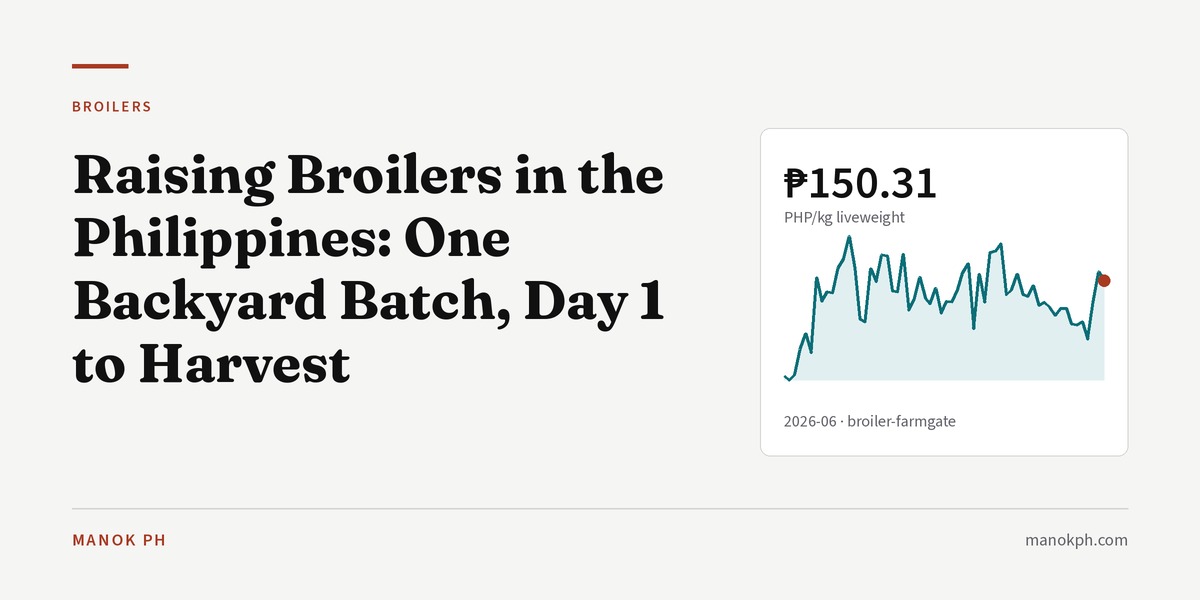
One thing to settle before any of it means anything: PSA publishes two broiler farmgate prices and they sit ₱31.62 a kilo apart, ₱150.31 for households against ₱118.69 for commercial establishments in June 2026, and if you sell out of your own bakuran the household figure is yours. Which series describes you, and why no fixed correction factor joins them, is a page of its own. Every peso below is held against the household one.
Hindi gilid ng industriya ang bakuran, since two birds in five in this country stand in holdings of 500 or fewer, and the five decisions before a first flock is where that count gets spent.
Your buyer has not read the PSA release
The household series surveys backyard and smallhold raisers and the commercial-establishment series surveys registered operations, so they are two market levels rather than two estimates of one price, and the two-prices page does the adjudication. What a batch plan needs is the habit that comes after you have picked the right one.
Whichever series is yours, the monthly figure in it is an average across every region PSA surveys. Your buyer is under no obligation to meet it and in a bad week will not. Where the series earns its keep is direction and level: kung mas mataas o mas mababa ang presyo ngayon kaysa noong huli kang naglagay ng batch. Gumagalaw din ang agwat ng dalawang series buwan-buwan, so open the page rather than carrying June 2026 around in your head. Use it to sanity-check an offer, hindi pagbatayan ng eksaktong halaga.
One batch, day 1 to harvest
| Batch size | 50 day-old sisiwSmall enough that a first-batch mistake is affordable, large enough to teach you something about your own channel |
|---|---|
| Harvest window | Days 30 to 34The big-bird target of the 16 open-sided farms in Datuin et al. (2022) Table 5, not a weight anybody recorded. A free-range claim needs day 52 at the earliest, and day 90 for native chicken, under PNS/BAFS 262:2018 § 6.5 |
| Liveweight at harvest | About 1.7 kg a birdThe weight at which the standard’s two floor rules cross over |
| Floor area | 10 birds per square metre, or 17 kg per square metreWhichever binds first, PNS/BAFS 262:2018 § 6.3.1. Past 1.7 kg the mass rule is the one doing the work |
| Feed conversion to budget at | 1.50 to 1.83 kg of feed per kg of gainThe Philippine open-sided band, and a table of targets rather than of measured results |
| Price of a sack of feed | Not published by anybodyGap G-15. Your own dealer, priced this week, with the sack weight written next to it |
A broiler batch is short, which is most of its appeal. Lumalabas ang puhunan sa unang sampung araw at bumabalik sa isang hapon, and almost everything that decides the result happens in the brooder while the birds still look like cotton.
Ang unang linggo ang pinakamahirap. Day-old sisiw cannot hold their own body temperature, so heat is the entire job. The MSD Veterinary Manual starts them at 29.4 to 32.2°C and steps down 2.8°C a week until it reaches 21.1°C; Mississippi State Extension starts at 32.2°C and reaches that same 21.1°C by the end of week three, two weeks earlier. Both schedules sit side by side on the brooder temperature tool, unaveraged, because they disagree and the disagreement is information.
The Philippine complication is that the ambient is already warm. PAGASA puts the mean annual temperature here at 26.6°C, which sits at or above the week-three target in both schedules. Sa tag-araw, a closed brooder box can pass the ceiling on ambient alone with nothing switched on. From week three the job is getting heat out, at doon nagkakamali ang mga gabay na isinulat para sa malamig na bansa.
There is a second reading problem buried in that drawing, and it is worth saying out loud: both published bands are floor temperatures, taken at the litter where the sisiw actually sits, not air read at the lamp. A thermometer hung at eye level in a finished brooder gives you a number that belongs to nothing.
Floor space is the other thing decided early and regretted late. PNS/BAFS 262:2018, the Philippine free-range standard drafted with BAI and Central Luzon State University, puts a fixed broiler building at 10 birds per square metre or 17 kg per square metre, whichever binds first. Those two rules meet at exactly 1.7 kg a bird. Above that weight the kilo rule takes over, so a batch grown to 2.5 kg needs about 47% more floor than the bird-count rule gives it. The coop size tool works that through for the flock sizes people actually keep. Ang timbang sa dulo ang sukatan ng sahig mo.
Worth knowing what that floor drawing is standing on: 262 is a free-range standard, and no Philippine body publishes a density for a confined meat-bird coop at all. So the figure everyone reaches for is a borrowed one, at hindi iyon sinasabi ng karamihan ng gabay.
| Week | Age | What the batch needs | What usually goes wrong |
|---|---|---|---|
| 1 | days 1–7 | Heat at chick level, feed and water within a step of every bird, starter ration | Heat managed by the clock instead of by watching the sisiw; brooder overheating on ambient alone |
| 2 | days 8–14 | Step the temperature down, widen the brooder guard, keep litter dry | Space held constant while the birds double; wet litter under the drinkers |
| 3 | days 15–21 | Both published schedules want heat off or nearly off by now | Heat left running out of habit through a warm week |
| 4 | days 22–28 | Move to grower ration, full floor area, ventilation matters more than warmth | Density that was fine at day 1 becoming the binding problem |
| 5 | days 29–35 | Finisher ration, feed bill at its heaviest, and from day 30 the harvest window is standing open | Budget built on brochure feed conversion running out here |
| 6 | days 36–42 | Past the target window, on birds nobody sold in time; every extra day is feed against a gain that has already slowed | Selling with no buyer arranged, at whatever the gate offers |
Two pieces of equipment decide more than their cost suggests. Trough space per bird is a Penn State Extension small-flock figure and the drinker ratios are Aviagen’s post-brooding ones; both are worked out per flock size on the coop size tool. Imported ratios travel better than imported density figures do, kasi a nipple delivers the same water in Nueva Ecija as it does anywhere else, while a stocking density written for a closed winter house does not survive a May afternoon in a bakuran.
Water is the cheapest input and the one most often short. A broiler drinks more in a Philippine dry season than any temperate table allows for, and I have not found a published Philippine requirement figure to cite, so I will not give you one. What I will say without a citation is behavioural: if the drinkers run dry in the afternoon and you top them up in the evening, the birds spent the hottest hours of the day without water, at lumalabas iyon sa timbang sa dulo.
Litter is the other unglamorous one. Wet litter under the drinkers is where most of a batch’s foot and respiratory trouble starts, and in this humidity it goes wet faster than the guides assume. Turning it and topping it up is free. Replacing a batch is not.
The harvest decision at the end of that table deserves its own treatment and will get one. What fixes the last two rows is a single table: Datuin et al. (2022), Table 5 on page 66, in which the 16 open-sided farms among 55 surveyed commercial growers gave day 30 to day 34 as their big-bird target. Four days wide, and it is what those sixteen growers said they were shooting for rather than what any batch was weighed at. That width is the whole argument for finding your buyer while the birds are still eating. The single hard rule worth carrying now: if you intend to sell the birds as free-range, PNS/BAFS 262:2018 § 6.5 sets the earliest harvest at day 52, and for native chicken at day 90. Making that claim on a bird harvested at 35 days is a claim you cannot support.
The growth table on the sack is not describing your kulungan
Standard advice is to take the breed company’s feed conversion figure, add a small allowance for local conditions, and budget from that. I think this is backwards, and it is the most expensive piece of received wisdom in Philippine broiler raising.
Aviagen’s Ross performance objectives, the source of the familiar figure of roughly 1.2 kg of feed per kilo of gain, describe a bird in a climate-controlled house. The nearest Philippine figure, 1.50 to 1.83, comes from the 16 open-sided farms inside a survey of 55 commercial operations, and it is set out with the European column beside it on the feed cost tool rather than merged into a single number. A budget built on 1.2 is short by something close to a third before the first bag is opened.
Two things follow, and the second is the one most guides skip. First, the allowance is not small. It is the largest single correction in the plan. Second, and this is the part almost every page quoting that band leaves out, 1.50 to 1.83 is what those sixteen growers said they were aiming at, in a table of targets rather than results. Widen the frame from the sixteen to every grower the survey split by housing and a third of them said they meet their targets only sometimes or not at all. Every one of them was a commercial operation, with better housing, better ventilation and tighter feed management than a backyard kulungan has. So a bakuran flock has no particular reason to land inside a band that a third of commercial growers miss, and planning to beat it is planning on optimism.
In my experience the published growth curves get treated as a standard a keeper has failed to meet, when they are better read as a description of a building nobody here owns. The honest move is to budget at the top of the Philippine band and treat anything better as luck rather than as the plan. Kung tumama ka sa 1.5, magaling ka na.
Apply a correction factor to the European curve and you get a number with a decimal point and nothing under it, which the week-by-week page works through at length.
The practical effect is simple enough to state. Feed is the dominant line in a broiler batch, so a conversion assumption wrong by a third is a total cost wrong by roughly a quarter. Everything downstream inherits it: the break-even price, the tubo, the decision about whether to place 50 birds or 100. Kaya kung isang bagay lang ang tatamaan mo sa buong plano, ito na iyon.
Work it out for your own flock
Magkano ang feeds to get a broiler to market? Open the calculator
Kilos, sacks and pesos to harvest day, at the feed conversion Philippine open-sided farms work to rather than the one the breed table promises. Bring your own sack price.
Magkano ba talaga ang gastos?
Here is where an article has to be careful, kasi ito ang bahaging pinupuno ng ibang pahina ng tiwalang-tiwalang halaga na walang kahit isang sipi.
Ang pinakamalaking gastos mo ay feeds, at least two thirds of the cash in most batch plans, and nobody in this country publishes what a sack of it costs. That is gap G-15 in the register of what Philippine poultry does not publish, which walks the dead ends one by one. Every article quoting you a firm sack price is quoting a memory.
So the honest order is bags first, pesos second. Bilangin mo muna kung ilang sako ang kakainin bago mo hanapin kung magkano ang isa, because the count is arithmetic anybody can check and the price is a number nobody publishes. Note also what the two cuts in that span are doing: no Philippine issuance sets the day you switch starter to grower or grower to finisher, so the brands each publish their own and the sack in front of you is the only instruction that applies.
What does exist is the ingredient side. BAI monitors wholesale prices for fifteen feed ingredients, all in ₱ per kilo, and they are archived on the feed ingredients group page: yellow corn, the soybean meals, copra meal, rice bran, pollard, fishmeal, and the fats and oils. Useful for seeing which way the input cost is moving. Hindi iyon presyo ng sako. A sack also carries milling, additives, packaging, margin and hakot, and the ingredient series never touch any of those, so no arithmetic on those fifteen rows converts into one.
So the sack price is yours to find, not mine to supply. Price it at your own dealer this week, isulat mo kung 25 kg o 50 kg ang sako, and put that number into the feed cost tool. The unit matters more than it looks. A price per sack and a price per kilo are the same fact wearing two faces, and a reader holding a 25 kg sack who reads a 50 kg row gets an answer wrong by double. That is the likeliest arithmetic error in this entire subject, and it happens to people who can count.
| Cost line | Published Philippine figure? | Where your number comes from |
|---|---|---|
| Day-old chicks | Partly. Farmgate is monitored, dealer counter price is not | Three local dealer quotes, this month |
| Feeds, by the sack | No. Nothing anywhere | Your own dealer, priced this week, unit written down |
| Feed ingredients, wholesale | Yes, fifteen series in ₱/kg | Context only. Never a substitute for a sack price |
| Brooding heat and electricity | No | Your own meter and your own bulb wattage |
| Meds, vitamins and bakuna | No | Your LGU vet or the agrivet counter |
| Litter, hakot and marketing | No | Local, and small enough to estimate honestly |
| Mortality allowance | No national backyard figure | Your own first batch is the measurement |
| Your own labour | Never published anywhere | Decide whether you are paying yourself |
Look at how much of that middle column says no. That is not a failure of this article, it is the actual state of Philippine poultry data, and a keeper is better served knowing which of their assumptions is sourced and which is a guess. Kapag sa iyo na galing ang presyo ng sako at ang presyo ng sisiw, the break-even calculator will tell you the farmgate price at which the batch stops losing money, and you can hold that directly against the household series.
So what will a sisiw actually cost you?
BAI’s monitoring puts day-old chick farmgate at ₱33.50 per head for the week of 13 July 2026. That figure circulates widely and it is almost always presented as what a backyard keeper pays. It is not.
Farmgate at that level is an integrator and wholesale price: hatchery to volume buyer. Ang bibili ng isang tray ng sisiw sa dealer ay mas mataas ang babayaran, and how much more is not published in any series I can find. The mark-up varies by dealer, by area, by how far the chicks travelled, at kung suki ka ba o hindi.
Use the ₱33.50 as a floor and a direction, which is what it honestly is. For your own budget, call three dealers, ask the price per head for the breed and the tray size you want, and use the number they give you. Isulat mo, huwag mong tandaan lang, because next batch you will want to know whether the price moved or your memory did.
This carries more weight than the peso amount suggests. Isang beses lang binabayaran ang sisiw at nasa unahan iyon ng batch, so an error there is locked in on day 1 and cannot be managed down later the way feed can.
The other thing a dealer quote hides is quality, and no series measures it. Chick weight at delivery, how long they were in transit, whether the parent flock was young or old: all of it shows up in first-week mortality and none of it is inside the ₱33.50. Ang dalawang dealer na iisa ang presyo ay hindi magkaparehong sisiw ang ibinebenta. A backyard keeper only ever finds this out by buying from two of them and writing down what happened, which is the argument for keeping a record and the reason a second batch usually costs less per kilo than a first.
Kanino mo ibebenta ang manok?
Decide this before you place the batch, not on the morning the birds hit weight. The channel determines which price series describes you, and a keeper who has not chosen one is not planning, umaasa lang.
Three levels are published and they are not interchangeable.
| What is sold, and by whom | Level | Latest figure | Series |
|---|---|---|---|
| Live broiler, sold by a household or smallhold raiser | Farmgate | ₱150.31/kg liveweight, June 2026 | broiler-farmgate |
| Live broiler, sold by a commercial establishment | Farmgate | ₱118.69/kg liveweight, June 2026 | broiler-farmgate-establishment |
| Dressed chicken, on a retail counter | Retail | ₱213.24/kg, July 2026 | dressed-chicken-retail |
| Day-old chick, hatchery to volume buyer | Farmgate | ₱33.50/head, week of 13 July 2026 | doc-price |
Selling live at the gate to a viajero is the least work and the lowest price per kilo. Ang maghakot sa palengke mismo ay isang baitang pataas, and it costs you the hakot and the day. Dressing and selling direct reaches toward that retail figure and takes on the dressing loss, the handling, and a food-safety problem you did not have before. Iba-iba ang tubo sa tatlo, and the right answer depends on what your time is worth and who you already know.
The one thing to avoid is planning against the retail number while selling live. Ang presyo sa counter ay hindi ang presyo mo.
Dressing loss is the trap in that third row. Hindi pareho ang timbang ng buhay na manok at ng dressed, and the conversion between them is large enough that treating the retail figure as an achievable price per liveweight kilo will flatter your plan badly. That conversion deserves its own page with its own sources and it will get one. Until then, do not apply a percentage you half-remember. Ang mali doon ay hindi maliit.
Market context, since it explains why these series move at all: PSA puts the chicken meat self-sufficiency ratio at 91.9% for 2025. Most of the chicken eaten here is grown here, and the balance arrives as imports. USDA’s balance sheet answers a similar question on a different weight basis and lands roughly twenty points away, so the two must not be merged, in a table or in your head. The figure quoted above is PSA’s.
The only data that describes your bakuran is the data you write down
Everything above is a national figure, and a national figure is an average of places that are not yours. Walang inilalathalang series para sa feed conversion sa bakuran, sa dami ng namamatay, o sa singil ng dealer sa bayan ninyo. Those numbers exist only if you record them.
So keep a batch sheet. Papel lang, ayos na. Five columns and nothing clever:
- Date and count in. How many sisiw arrived, from which dealer, at what price per head.
- Feed in. Every sack, by type, by weight, with the presyo you paid that day. This is the most valuable column and the one people abandon by week three.
- Deaths, by day. Not a total at the end. The shape of the curve tells you whether the problem was the brooder, the density, or something that arrived with the chicks.
- Weights. Weigh ten birds on the same day each week. Ten is enough to see a trend and few enough that you will actually do it.
- Sale. Total kilos, price per kilo, channel, and who bought them.
By the end of one batch that sheet gives you your own feed conversion, your own mortality rate, and your own cost per kilo produced. Ang tatlong numerong iyon ang naglalarawan sa kulungan mo in a way no PSA series ever will, and they are what turns the break-even calculator from a rough guide into an answer about your own flock.
It also gives you something to argue with. If your measured conversion lands well outside the Philippine range on the feed cost tool, that is a signal about your housing, your feed handling or your water, and it is actionable. Kung wala kang tala, wala kang mapagtatanungan kundi ang alaala mo, at hindi iyon mapagkakatiwalaan pagdating sa presyo.
Health, bakuna and the parts that are not discretionary
This section is deliberately plain. Health is where hedging matters and where a confident sentence from a non-veterinarian does real damage.
I am not a vet, and this article carries no dosages. Vaccination scheduling for broilers in the Philippines is a matter for DA and BAI guidance and for your LGU veterinarian, who knows what is circulating in your municipality in a way that no national article can. Ask them before the batch arrives rather than after a bird goes down, because most of what a vaccination programme can do has to happen in the first two weeks.
Biosecurity for a backyard flock is mostly unglamorous and mostly free: keep new birds away from the existing flock, keep visitors and their footwear out of the housing, keep feed covered and rodents out of it, and do not share equipment with a neighbour’s flock without cleaning it. None of that requires a purchase.
Sudden mortality, respiratory signs across many birds at once, or any unusual die-off should go to the LGU vet and, where the guidance requires it, to BAI. Reporting obligations for notifiable poultry disease are a regulatory matter and they change. Check the current DA and BAI advisories before placing a batch rather than relying on an article’s snapshot of them.
A note on medication that is easy to get wrong in both directions. Treating a whole flock because two birds look unwell is expensive and, with antimicrobials, is the behaviour that drives resistance. Ignoring a spreading sign because the birds are nearly at harvest weight is worse, and it also raises a withdrawal-period question you must not answer from memory. Withdrawal periods are stated on the product label and enforced through DA and BAI regulation. Read the label, follow it, and ask the LGU vet if the label and the harvest date collide.
Heat is the background stressor under all of it. An open-sided coop in a Philippine dry season works against the birds for part of every day, and it is one reason the Philippine feed conversion band sits where it does. Shade, air movement and water through the hottest hours are the levers a backyard keeper actually has, and none of them is a purchase.
What to decide next
None of this costs money today, and the first one cannot be skipped.
Presyuhan mo ang sarili mong sako. Walk to your dealer this week and get the current price for starter, grower and finisher, with the sack weight written next to each. Nobody publishes this, so until you do it you have no batch plan, hugis lang ng plano. Put those three numbers into the feed cost tool.
Get three chick quotes. Not the ₱33.50 farmgate figure, which is a wholesale level you cannot buy at. Tatlong dealer, kada ulo, ngayong buwan, for the tray size you actually want.
Choose the channel before the batch arrives. Gate, palengke, or dressed and direct. Ang pinili mong iyon ang magsasabi kung aling serye sa price archive ang naglalarawan ng kita mo, and whether the household series at ₱150.31 is your number or somebody else’s.
Then the kulungan. Past 1.7 kg a bird the mass limit in PNS/BAFS 262:2018 binds before the bird-count rule, and the coop size tool with the movable-coop page does the square metres for you.
With those four in hand, the break-even calculator gives you the farmgate price your batch has to clear. Kung mas mataas iyon kaysa sa household series, the batch does not work at your current costs, and learning that this week costs nothing while learning it on selling day costs a batch. Every series quoted here downloads as CSV from the data page, with the source and the date on every observation, so you can check my arithmetic instead of trusting it.
Work it out for your own flock
What farmgate price do you need to break even? Open the calculator
Pesos per kilo liveweight at which a batch stops losing money, from your dealer sack price and the day-old chick price in the archive. A floor, honestly labelled as one.
The rest of this cluster
Each of these takes one part of the batch above and goes further into it than a single page can.
The cost sheet
What a 50-bird batch actually costs Read the full guide
Every line in one batch, and the six of them that have no published Philippine figure at all.
50 birds, one cycle
The floor
Broiler break-even per kilo Read the full guide
The farmgate presyo a batch has to clear, and why the gap between that floor and the household series is not tubo.
Per kilo liveweight
Week by week
Growth by week, and the house the brochure curve was written for Read the full guide
The Ross and Cobb tables against the one Philippine survey that exists to check them, and what that survey actually asked its growers.
Ross and Cobb, day 7 to day 42
Which series is yours
The two farmgate prices Read the full guide
Which of PSA's series describes your bakuran, how far apart they run, and why no fixed correction factor between them works.
Households against establishments
The other model
Contract growing against independent Read the full guide
A risk question rather than a profit question, and what to pull out of the contract itself before signing.
Before you sign
The day you sell
Day 28, day 35 or day 42 Read the full guide
What each extra week converts feed at on its own, why the feed bill argues the opposite way from the one most guides use it for, and the four Philippine limits that actually set the day.
The buyer's spec, in kilos
What normal costs
Mortality in a Philippine summer Read the full guide
The only Philippine livability figure is a commercial target, and what a death actually costs you is decided by the week it lands in rather than by the rate.
A sum, not a percentage
The FCR you can measure is not the one on the table Read the full guide
Sacks in over kilos sold counts the feed eaten by birds that died. Every published conversion figure excludes it, which is why the two numbers should never be compared directly.
Two different quantities
Questions people actually ask
Which broiler farmgate price should a backyard raiser plan against?
The PSA household series, which read ₱150.31 per kilo liveweight in June 2026. The commercial-establishment series read ₱118.69 in the same month. They are two different market levels and should never be averaged.
How much does a sack of broiler feed cost in the Philippines? Show the answer
Nobody publishes it. There is no official Philippine series for finished feed at sack level, so any site quoting you a confident figure is quoting a memory. Price your own sack at your own dealer this week and use that number, stating whether it is a 25 kg or a 50 kg sack.
Is ₱33.50 what I will pay for a day-old chick? Show the answer
No. That is BAI-monitored farmgate for the week of 13 July 2026, which is an integrator and wholesale level. What a backyard keeper pays a dealer is higher and is not published anywhere. Get three local quotes before you budget.
How many birds should a first batch be? Show the answer
Small enough that the mistakes are affordable and large enough that you learn something about your own channel. The binding constraint is usually floor area at harvest weight rather than chick count, because PNS/BAFS 262:2018 caps a fixed broiler house at 17 kg per square metre as well as 10 birds per square metre.