Point-of-Lay Pullets vs Day-Old: Which Is Cheaper
The short answer
Rearing 50 layer chicks to point of lay costs ₱13,351.09 on the breeder standard, at an illustrative ₱1,800 sack: feed, brooder electricity and the sisiw themselves. Forty-nine reach 17 weeks, so ₱272.47 a bird. That is your break-even. A pullet quoted under it is cheaper outright. Above it you are paying for time, and the time is worth at most ₱406.52 a head.
Source Hy-Line Brown Performance Standards Guide, December 2025, rearing period performance table (read on August 22, 2026)
The layer pillar on this site says the pullet premium is not a figure you can look up, and that it sits against ₱270 from 2018 and a rearing cost you have not run yet. This page runs the rearing cost. Everything below is arithmetic on published figures, at kaya mong palitan ang bawat isa ng sarili mong numero.
Read raising layers in a Philippine backyard first if you have not decided on layers at all. This page assumes you have, and that the only remaining question is which end of the bird’s life you buy.
The rearing bill is three lines, and you can price all three
Three costs stand between a day-old chick and her first itlog, and each has a published number behind it. Feed is the big one. Brooding electricity is the one nobody writes down. Ang sisiw naman ang laging tinatanong, at siya pa ang pinakamahinang naipepresyo dito sa atin.
| Feed, 5.99 kg a bird | ₱10,782.00Hy-Line Brown Performance Standards Guide, December 2025, rearing period feed consumed, at an illustrative ₱1,800 per 50 kg sack. No Philippine agency publishes a finished feed sack price. |
|---|---|
| Brooder electricity, 21 days | ₱894.09Two 60 W bulbs run continuously, at the Meralco overall residential rate of ₱14.7833/kWh for August 2026. |
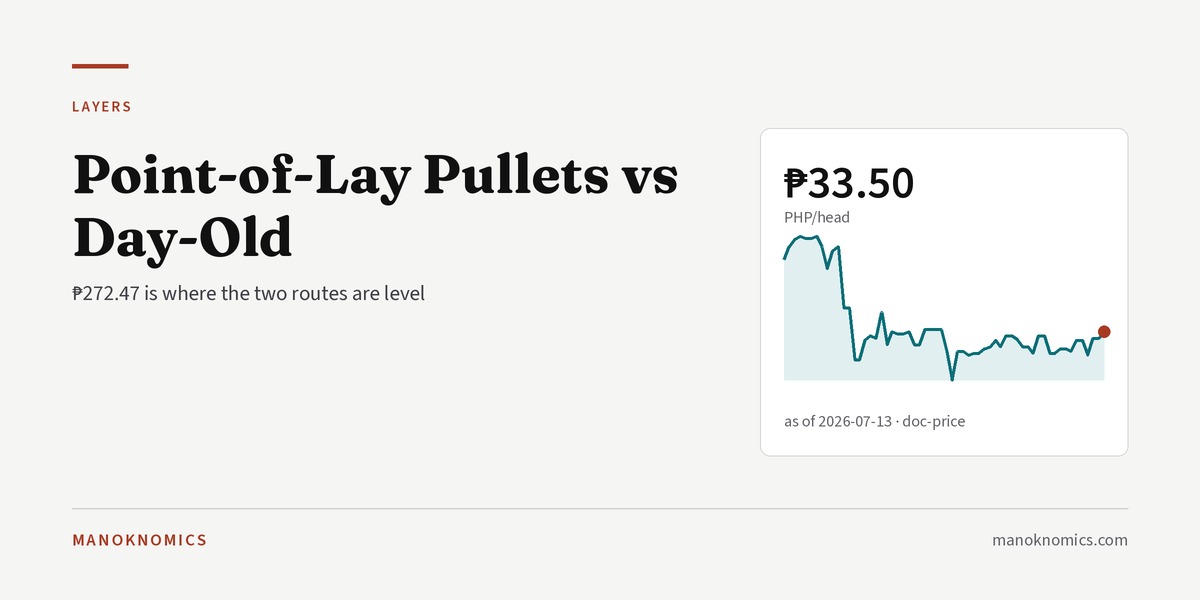
| 50 day-old chicks | ₱1,675.00BAI monitored farmgate, ₱33.50 a head, week of 13 July 2026. Integrator level and broiler, so a floor. |
| Batch total | ₱13,351.09 |
| Birds reaching 17 weeks | 49Hy-Line Brown cumulative mortality at 17 weeks, 2.00%. Cage housing. |
The feed line is a straight lookup and it is the one figure in this whole question that nobody argues about. The Hy-Line Brown guide of December 2025 publishes cumulative feed intake as a band of 5,786 to 6,191 g a bird to 17 weeks, and 5.99 kg as the single summary figure. At ₱1,800 a sack that is ₱215.64 of feed per bird before one egg exists. Palitan mo ng presyo ng dealer mo at gumagalaw ang buong page na ito.
Seventeen weeks is not the end of the feeding either. The same guide puts 50% production at 139 days from hatch, and LOHMANN Brown-Classic puts it at 140 to 145. So the rearing table stops 119 days in and the bird still eats 81 to 98 g a day for another three weeks before the laying is worth the name. That gap belongs to the month-by-month lay curve, which works it out properly. Ang mahalaga dito, gastos mo pa rin ang tatlong linggong iyon at wala pang itlog na naibebenta.
The chick price is the weak line, and it is weak in a specific way. The ₱33.50 a head in the archive is real, dated and national, and it is the broiler farmgate figure from Table 1 of the BAI weekly monitoring, at integrator and wholesale level. It is not a layer chick and it is not a dealer counter price for 50 birds. Gamitin mo lang bilang sahig, hindi bilang presyo.
₱894.09 of Meralco, and nobody puts it in the budget
Three weeks of brooder electricity for 50 chicks is ₱894.09, which is 8.29% of the same batch’s 17-week feed bill. I have not found a single Philippine page on this question that puts a peso figure on brooding heat at all, and it is the one cost the pullet buyer skips completely.
The wattage is not mine. Mississippi State Extension describes a cardboard-box brooder that “will brood up to twenty-five chicks” heated by “a 60-watt incandescent light bulb”, and says supplemental heat is “not usually necessary” after the temperature has been walked down to 70°F “at the end of the third week”. Two boxes for 50 sisiw is 120 W. Run continuously for 21 days that is 60.48 kWh, and at the Meralco overall residential rate of ₱14.7833/kWh announced on 10 August 2026 for the August billing month, down from ₱14.8261 in July, it is ₱894.09. Per chick, ₱17.88.
Now the honest part, kasi Mississippi ang pinagkunan ng wattage at hindi Pilipinas. MSU wrote that for a state that has winters. A brooder in a Philippine bakuran at a mean annual 26.6°C is fighting a much smaller gap between ambient and the 32 to 35°C a day-old chick wants, so it cycles off more, and the honest reading of ₱894.09 is a ceiling rather than an expectation. The brooder-temperature page has the degrees and the reason the American schedules read strangely here.
Two things follow. If you brood on charcoal, kerosene or a hover with a thermostat, this line is not yours and you should replace it with your own. And if you brood in a bakuran in April, your real figure is lower than ₱894.09 and lower by an amount nobody has measured. What it is not is zero, at iyon ang karaniwang nakikita ko sa mga budget online.
₱272.47 is the quote where the two routes are level
Divide the batch by the birds that survive it, not by the chicks you bought. ₱13,351.09 over 49 birds is ₱272.47. That is the number to hold a pullet quote against, because it is what one point-of-lay bird cost you to make.
| Assumption | Sack price | Break-even a pullet |
|---|---|---|
| Breeder livability, 98% | ₱1,600 | ₱248.02 |
| Breeder livability, 98% | ₱1,800 | ₱272.47 |
| Breeder livability, 98% | ₱2,000 | ₱296.92 |
| Ancog et al. brooding loss, open-sided PH | ₱1,800 | ₱279.65 |
Every row carries the same ₱1,675 of chicks at the BAI farmgate figure of 13 July 2026 and the same ₱894.09 of brooder electricity. Only the feed line and the survival rate move. Sack prices are illustrative: no Philippine body publishes one.
The sack price is what moves it, and it moves it by ₱48.90 a bird across a ₱400 spread. That is why the first thing to do with this page is not to trust the middle row but to phone your dealer, kunin ang presyo ng sako at ang bigat nito sa kilo, and run the row yourself.
The 98% is the weaker assumption of the two. It is the Hy-Line livability standard for a cage house in a controlled environment, and the nearest Philippine measurement of anything comparable is Ancog and colleagues at UPLB, whose Table 1 records 18,009 day-old chicks placed and 17,196 alive after brooding in four conventional open-sided houses. Those are broilers, and that is brooding rather than 17 weeks. Applied here anyway it lifts the break-even to ₱279.65, which tells you the direction rather than the answer. Sa bakuran na walang cage at walang controlled environment, mas mataas pa iyan.
Ano ang binibili mo sa pullet: 119 araw, hindi mas murang manok
The pullet is not a discount. It is 119 days of calendar in which the day-old route earns nothing and spends ₱272.47, and the honest way to price that is to ask what the pullet’s owner banked in the same window.
By the time a chick bought on the same day reaches 18 weeks, the pullet is 36 weeks old and has laid 107.6 cumulative hen-housed eggs on the Hy-Line low bound. At the June 2026 PSA household egg farmgate of ₱6.74 a piece that is ₱725.22 gross. Every page I have read that reaches for this figure stops there, and it should not, kasi kumain din ang inahing iyon sa buong 18 linggo.
Take the feed off. Week by week down the Hy-Line intake column at the low bound, weeks 18 to 36 come to 13.88 kg, which at ₱1,800 a sack leaves ₱225.51 net. That is the head start, priced properly. Sold at the retail level of ₱9.07 a piece it is larger, but retail is a number you reach by selling direct sa palengke or to a suki, and it is not the gate.
| At day 126 | Bought day-old chicks | Bought a point-of-lay pullet |
|---|---|---|
| Spent per bird now layingFeed, brooder electricity and chicks at the illustrative ₱1,800 sack, over 49 survivors of 50. | ₱272.47 | whatever the quote was |
| Eggs banked so farHy-Line Brown cumulative hen-housed eggs to 36 weeks, low bound. Cage housing. | 0 | 107.6 |
| Net of feed, so farEggs at the June 2026 PSA farmgate of ₱6.74, less her own feed for weeks 18 to 36. | minus ₱272.47 | ₱225.51 less the quote |
| Age of the birdThe pullet retires 18 weeks earlier in calendar terms, and that is the cost of the head start. | 18 weeks | 36 weeks |
Add the head start to the break-even and you get ₱497.98, and that number is wrong in a way worth naming. It assumes the 18 weeks are free. Hindi po libre ang mga iyon: mas matanda nang 18 linggo ang pullet, kaya mas maaga siyang darating sa dulo ng talaan, at ang mga linggong nawawala sa kanya ang pinakamahina niyang mga linggo. Hy-Line publishes 466.4 cumulative hen-housed eggs at 100 weeks against 378.8 at 82, so those last 18 weeks are 87.6 eggs, worth ₱91.46 net of feed at the same farmgate. Charge that against the head start and the ceiling comes down to ₱406.52.
So the band is ₱272.47 to ₱406.52 a head, at your own sack price. Below the floor the pullet is simply cheaper. Between them you are buying time and the arithmetic still holds. Above the ceiling, sayang ang pera.
Neither price is published, and one of them is inside a picture
The Philippine government has printed exactly one pullet price, ever. It is ₱270 a head, in the 10,000-layer startup model at Table 6, p. 48 of the DA-BAI Philippine Poultry Layer Industry Roadmap 2022-2040, and the table names its own source as a 2018 focus group discussion and key informant interview. The narrative on the facing page corroborates the shape without repeating the figure: a 10,000-layer farm needs at least ₱7.5 million, of which “35% for the poultry stock”. That share is 35.2% of the table’s own total, the second largest line after housing.
Table 6 is a raster image. Run a text extractor over the whole 200-page PDF and the only strings near it are the narrative sentences; every number in the table itself is pixels. That is the mundane reason nobody quotes it, and it is worth saying out loud, kasi hindi naman ito lihim. It has been sitting in a public PDF since 2023.
My bottom-up break-even and that assumption land ₱2.47 apart. Do not read that as agreement. Both are loose in the same direction and for unrelated reasons: mine leans on a broiler farmgate chick price standing in for a layer chick nobody publishes, an illustrative sack price, and a cage-house livability figure. Theirs is a planning assumption for an order of ten thousand birds, made eight years ago. Two loose numbers landing close together is arithmetic, hindi confirmation.
| Broiler day-old chick, farmgate | Weekly, since January 2023BAI monitoring, Table 1. 109 rows in this archive at /presyo/doc-price. |
|---|---|
| Layer day-old chick, any level | NothingThe BAI layer table carries eggs and a Cull column printed N/A. No chicken price at all. |
| Backyard dealer chick price | NothingGap G-16 on the register. |
| Ready-to-lay pullet | One 2018 assumptionDA-BAI Layer Industry Roadmap, Table 6, p. 48. Not a series, not a transaction, not current. |
| Finished feed, per sack | NothingGap G-15. Every sack price on this site is illustrative and says so. |
Three of the five inputs to this comparison are unpublished, and the data gaps page is where that is tracked rather than apologised for. It is also why this article gives you a formula and not a verdict. The register itself is here.
What the band leaves out
The ₱272.47 covers feed, brooding heat and the chick. It does not cover vaccination, litter, drinkers, feeders, the brooder box, water, or the vet you will not be able to reach on a Sunday. That is your own list to make and the total is not small. It also does not cover space, at hindi libre ang espasyo sa ruta ng sisiw.
A pullet arriving at 17 weeks needs adult floor from the first hour. A batch of chicks needs a small warm box for three weeks and then grows into the kulungan you built, which means the coop stands half empty for four months on the day-old route and full from day one on the pullet route. Coop space by bird count has the densities and the standards behind them.
Nor does the band price your time. Feeding, watering, checking the heat and cleaning for 119 days is real labour and it is the input a keeper systematically values at zero. Kung may trabaho ka, ilagay mo iyon sa isang panig ng balanse bago ka magpasya.
One caution on where these curves come from. Both the feed figure and the livability figure are cage-house standards. The one Philippine survey of commercial layer farms reports that 87% of 100 farms run intensive open-sided housing, and only its abstract is readable, so treat that as one fact rather than a source you can go and read. A bakuran is further from a cage house than an open-sided commercial farm is. Take the floor seriously and the ceiling loosely.
What usually goes wrong
The mistake: Holding a 2026 pullet quote against the ₱270 in the DA-BAI layer roadmap.
Do this instead: Run your own rearing cost instead. ₱272.47 a bird at an illustrative ₱1,800 sack, and it moves with your dealer price.
The table names its own source as a 2018 focus group, for an order of 10,000 birds. It is a planning assumption from a different decade at a different market level, not a benchmark.
The mistake: Dividing the rearing bill by the number of chicks you bought.
Do this instead: Divide by the birds that reach point of lay. ₱13,351.09 over 49 survivors is ₱272.47, not ₱267.02 over 50.
The chicks that die still ate, still cost, and still drew brooder heat. Charging their share to the survivors is the whole reason mortality matters to the decision.
The mistake: Quoting the ₱33.50 BAI day-old chick figure as what a backyard keeper pays.
Do this instead: Use it as a floor and phone the agrivet for the real one. It is integrator and wholesale farmgate, and it is a broiler chick.
The BAI layer table carries eggs and a Cull column printed N/A. No Philippine body publishes a layer chick price at any market level, and gap G-16 says so on the register.
The mistake: Leaving brooder heat out of the rearing budget entirely.
Do this instead: Put a number on it even if it is small. ₱894.09 for 50 chicks over 21 days at the August 2026 Meralco rate is a ceiling written for Mississippi, and yours will be lower.
It is 8.29% of the feed bill for the same batch, and it is one of only two costs the pullet buyer avoids outright. A line left blank is not a line worth zero.
The mistake: Treating the pullet head start as free money.
Do this instead: Charge her extra 18 weeks of age against it. ₱225.51 net of feed at the front, less ₱91.46 at the tail she gives up.
Buying an older bird moves eggs forward in the calendar, it does not create them. The ceiling falls from ₱497.98 to ₱406.52 once that is priced.
Work it out for your own flock
Magkano ang gastos ko kada itlog, at kumikita ba ako? Open the calculator
Put in your hen count, your egg price and your feed cost, and see what a laying month actually leaves.
The three phone calls, in order
Call the feed dealer first, not the hatchery. Presyo ng sako at bigat nito sa kilo, this week, in your own town. Divide, multiply by 5.99, and you have the biggest line in the whole comparison at your own prices rather than at an illustrative one.
Call the agrivet second, for what 50 layer chicks actually cost over the counter. That figure does not exist anywhere published, and the ₱33.50 in this archive is a floor from a different market level. Kung ano ang sabihin nila, iyon ang totoong numero, and it is worth more than anything on this page.
Call the pullet seller last, and only then. Ihambing mo ang quote niya sa ₱272.47 na binago mo na ng sarili mong presyo. Under the floor and you buy pullets without thinking about it further. Between the floor and the ceiling, decide on whether you have 119 days to spare and a coop that is doing nothing else. Over the ceiling, sabihin mong hindi, and go back to the sisiw.
The one thing not to do is compare the quote to ₱270. Iyan ang tanging numerong makikita mo sa internet, and it describes a transaction that has not happened for eight years, at ten thousand birds, in a market that publishes nothing about pullets at all. Sarili mong arithmetic ang panukat dito. Wala nang iba.
Questions people actually ask
Is it cheaper to buy day-old chicks or ready-to-lay pullets in the Philippines?
Below about ₱272 a head the pullet is cheaper outright, and that threshold is one you compute rather than look up. Rearing 50 layer chicks to 17 weeks on the Hy-Line Brown December 2025 standard takes 5.99 kg of feed each, which is ₱10,782 at an illustrative ₱1,800 per 50 kg sack, plus ₱894.09 of brooder electricity at the Meralco August 2026 rate and ₱1,675 of chicks at the BAI monitored farmgate. That is ₱13,351.09 for the batch, and 49 birds reach point of lay on the breeder livability figure, so ₱272.47 each. Substitute your own sack price and your own chick price and the threshold moves with them.
How much does a point-of-lay pullet cost in the Philippines? Show the answer
Nobody publishes it. The only pullet price the Philippine government has ever printed is ₱270 a head, inside the 10,000-bird startup model at Table 6, p. 48 of the DA-BAI Philippine Poultry Layer Industry Roadmap 2022-2040, and the table names its own source as a 2018 focus group discussion and key informant interview. That is one planning assumption, eight years old, for an order of ten thousand birds. There is no series, no monthly figure, and no split by age or market level. Whatever a hatchery quotes you this week is the only current number that exists, and this page exists to give you something to hold it against.
How much feed does a layer chick eat before it starts laying? Show the answer
5.99 kg to 17 weeks, on the Hy-Line Brown Performance Standards Guide of December 2025, whose rearing table publishes cumulative feed intake from hatch as a band of 5,786 to 6,191 g a bird. At an illustrative ₱1,800 per 50 kg sack that is ₱215.64 of feed per bird before the first egg. The bird is not laying at 17 weeks either: the same guide puts 50% production at 139 days from hatch, so there are roughly three more weeks of full feed after that. Both figures are cage-house standards from a controlled environment, so read them as a floor.
Does the head start on a pullet pay for the premium? Show the answer
Partly, and less than the gross figure suggests. By the time a day-old chick bought the same day reaches point of lay, a pullet has laid 107.6 eggs on the Hy-Line standard, worth ₱725.22 at the June 2026 PSA farmgate of ₱6.74 a piece and ₱225.51 after her feed for those weeks. But she is also 18 weeks older, so she retires 18 weeks sooner, and her last 18 weeks are worth ₱91.46 net of feed on the same standard. Net of both, the head start adds about ₱134 to what a pullet is worth, not ₱725.