Raising Layers in a Philippine Backyard
The short answer
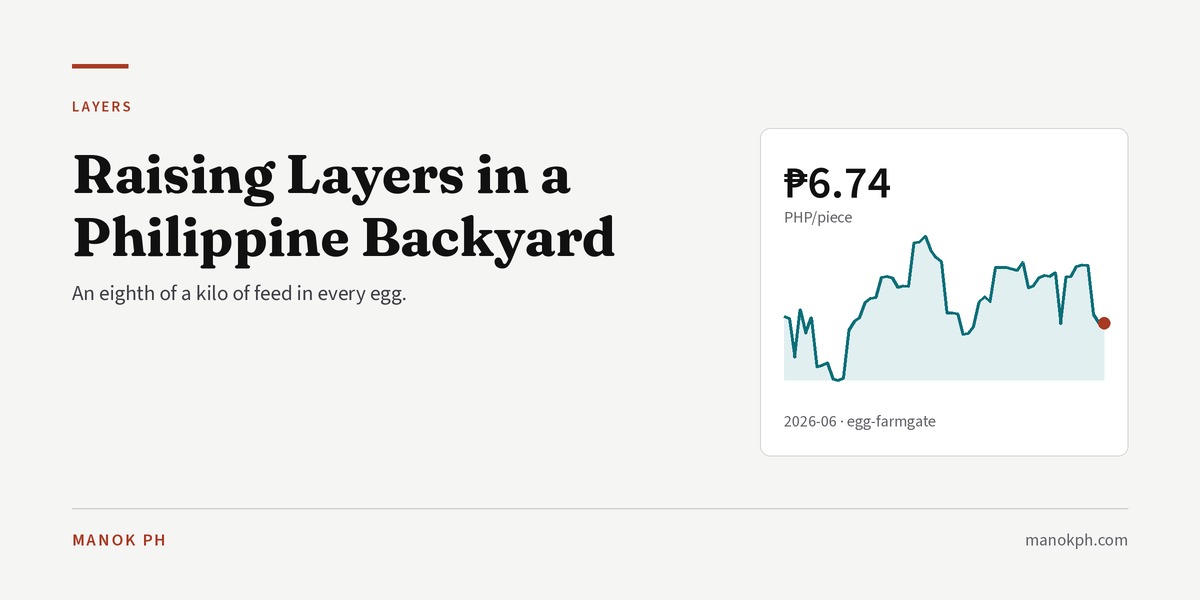
One egg carries roughly an eighth of a kilo of feed, and the June 2026 farmgate pays ₱6.74 for it. Feed alone takes most of that. The hen also eats for about twenty weeks before she lays anything at all. Ganoon ang hugis ng layer flock: a long bill first, then a year of thin daily income.
Source PSA OpenSTAT, farmgate prices of livestock and poultry, households, egg (read on August 13, 2026)
Two breeder companies measured their hens in different units, wrote the results into different tables, and landed on the same answer without meaning to. Hy-Line Brown’s standard is 116.9 grams of feed a day at 93.6% hen-day production, which divides out to 0.125 kilos of feed per egg (Hy-Line Brown Performance Standards, December 2025).
Lohmann publishes nothing of the kind. It publishes a feed conversion of 2.0 to 2.2 kilos of feed per kilo of egg mass, and an average egg weight of 63.9 grams (Lohmann Brown-Classic, cage housing). Work that through and you get 0.128 to 0.141 kilos per egg.
Iyon ang bihirang mangyari sa datos ng manukan: dalawang magkaibang pagsukat, dalawang magkaibang paraan ng pagsulat nito, at nagkasundo pa rin sila sa loob ng mga 10%. Neither figure would be worth much on its own. Together they say the feed inside one itlog is roughly an eighth of a kilo, and almost everything a Philippine layer keeper has to decide follows from putting that against the presyo ng itlog.
An egg sells for ₱6.74 and most of that is feed
The PSA household egg farmgate read ₱6.74 per piece in June 2026. That is what a keeper is paid. Retail was ₱9.07 in the same month, which is what a buyer pays, and the ₱2.33 between them belongs to hakot, the stall and the tray.
Now the part nobody puts on a page. Nobody in this country publishes a finished feed sack price, gap G-15 in the gaps register, kaya hindi ko po masasabi kung magkano talaga ang gastos mo sa feeds. What I can do is run your own number through the arithmetic above. Take an illustrative ₱1,800 for a 50 kg sack, at palitan mo iyan ng quote ng dealer mo ngayong linggo:
| At ₱1,800 per 50 kg sack | Per egg |
|---|---|
| Feed, Hy-Line figure (0.125 kg) | ₱4.50 |
| Feed, Lohmann high figure (0.141 kg) | ₱5.06 |
| Farmgate price, June 2026 | ₱6.74 |
| Left over, before every other cost | ₱1.68 to ₱2.24 |
Sa maraming bakuran, kulang na kulang iyan. That leftover has to cover the pullet, the coop, water, lighting, bakuna, gamot, litter, breakage, and the eggs a hen does not lay.
The same arithmetic run backwards is the number to keep in your head. At ₱6.74 an egg, feed stops paying for itself somewhere between ₱47.94 and ₱53.97 a kilo, which is ₱2,397 to ₱2,698 for a 50 kg sack. Above that price you are paying to produce eggs. Kung malapit ka na doon, alam mo na ang sagot bago pa magsimula ang buwan.
The farmgate fell 10.6% in a year and nobody imports eggs
Two facts about this market that a keeper planning a flock should hold together.
The first: egg farmgate read ₱7.54 in June 2025 and ₱6.74 in June 2026, a fall of -10.6%. Retail barely moved across the same twelve months, ₱9.28 to ₱9.07. Hindi ko po sasabihin kung bakit, because PSA publishes no reason and I am not going to invent one. What matters is the direction, and that the producer end absorbed almost all of it.
The second: the Philippine egg self-sufficiency ratio has read exactly 100.0 every year since at least 2018. Every egg eaten in this country is laid in it. Compare that to chicken meat at 91.9% in 2025, where the balance arrives in a container.
Put those together and the egg price is a purely domestic story. There is no import that undercuts you and no import to blame. What sits on the other side of that price is scale: the Layer line of the national laying flock, 52,103,982 birds on 1 July 2026 (the whole laying flock is 80,525,475), which laid 235,152 tonnes of eggs in the second quarter. Wala kang kalaban-laban doon sa presyo. Freshness, the walk to the buyer’s gate, and being the suki na kilala ka na are what a bakuran is actually selling.
Point of lay is day 139, and it is a cost centre until then
Hy-Line Brown reaches 50% production at 139 days and peaks at 93.6 to 98.5% in week 26. Lohmann gets to 50% at 140 to 145 days. So a day-old pullet eats for roughly twenty weeks before she pays for anything.
That is the single biggest structural difference between layers and broilers, and it decides who should keep them. A broiler batch turns over in 35 days and the whole gamble is short. A layer flock is a five-month bill followed by a year of small daily income. Kung ang puhunan mo ay hiniram, iba ang timpla ng dalawang iyan.
So the first real decision on a layer flock is not the breed. It is whether you buy those twenty weeks or raise them yourself. A day-old chick is cheap and the rearing is yours: feed, brooding, litter, bakuna, and the mortality of the first fortnight, all of it spent on a bird that produces nothing. A point-of-lay pullet costs several times more and the rearing was somebody else’s problem. Neither is the right answer in general, and the thing that decides it is not the price of the bird. Kung may bakanteng kulungan ka at may oras kang mag-brooder, mura ang DOC. Kung may interes na tumatakbo kada buwan sa puhunan mo, ang apat at kalahating buwang walang pumapasok ang pinakamahal na bahagi ng buong flock.
The trouble is that nobody can price that choice for you now. There is exactly one Philippine government figure for a pullet, and it is eight years old: ₱270 a head for ready-to-lay pullets, in the 10,000-bird startup model at Table 6, p. 48 of the DA-BAI Philippine Poultry Layer Industry Roadmap 2022-2040, where the table names its own source as a 2018 focus group discussion and key informant interview. That is one line in one cost model, not a series: no agency publishes a pullet price monthly, or by age, or by market level. So the premium you are being asked to pay for skipping the rearing is not a figure you can look up and hold against last month. It is whatever the hatchery says this week, set against ₱270 from 2018 and a rearing cost you have not run yet.
Both figures come from cage housing in a controlled environment. The one Philippine survey I can find of commercial layer farms reports that 87% of 100 farms surveyed run intensive open-sided housing (De Castro, PJVAS, Batangas) — and that paper is retrievable only as far as its abstract, so treat it as one fact and not as a source you can go and read. Open-sided in Philippine ambient is not a 20°C house. The breeder curves are a ceiling, and for a bakuran they are a distant one.
Notice what I am not doing with that. I am not converting 139 days into a Philippine number, because the conversion factor is the one figure nobody has measured. What the open-sided fact earns is a planning habit rather than an adjustment: treat day 139 as the earliest date rather than the expected one, and do not commit money that has to be back by month five.
Your hen-day rate is the number nobody can give you
Hen-day production is eggs per 100 hens per day. Twenty hens laying 14 eggs is 70%. It is the number every layer costing turns on, and there is no Philippine figure for a backyard flock anywhere. Gap G-1 in the gaps register, still open.
So when a page tells you a bakuran hen lays 280 eggs a year, ask where that came from. It came from a breeder standard measured in a cage house in a temperate country, or from nowhere.
Measuring it yourself is a notebook and thirty seconds a day. Count hens, count eggs, divide, write the date. After a month you have a hen-day rate for your own coop; after three you can see what the hot months do to it. Walang ibang paraan para makuha iyan.
Then do one more thing with the number, because this is where the feed figure at the top of this page stops being a fact about Hy-Line’s hens and starts being a fact about yours. That 0.125 kg is 116.9 grams of daily feed divided by 93.6% production (Hy-Line Brown, December 2025). The hen eats her 116.9 grams whether or not she lays. So divide the same daily intake by your own rate instead. A flock running at 70% is carrying 0.167 kilos of feed per egg, not 0.125, and at the same illustrative ₱1,800 sack that is ₱6.01 of feed inside an egg the farmgate pays ₱6.74 for.
Iyan ang totoong panganib sa layer sa bakuran, at hindi ito presyo ng feeds. A low hen-day rate does not reduce your feed bill in proportion. It divides the same bill over fewer eggs, and the margin closes from the production side while the sack price sits still. Ang isang hen na tumigil sa pangingitlog ay kumakain pa rin.
One measurement discipline worth adopting with it: weigh a tray. Egg size decides what a buyer will pay per piece, and the Philippine grading bands most commonly quoted run from Peewee under 45 g to Jumbo above 70 g. I have not been able to confirm those bands against the PNS document itself, so treat them as trade practice rather than as a standard I can cite. What is not in doubt is that a hen laying 60 g eggs and one laying 45 g eggs are not producing the same product.
Twelve or thirteen eggs from twenty hens is the line
A hen eats her feed whether or not she lays, and that sentence has a threshold hiding inside it. There is a rate at which the eggs a flock still gives you cost exactly what the farmgate pays for them, and it can be worked out instead of guessed at. It comes out as two numbers rather than one, because Hy-Line publishes average daily intake as a band, 109.1 to 116.9 grams over weeks 19 to 100, and a threshold built on a band inherits its width.
Set the two sides equal. At the same illustrative ₱1,800 for a 50 kg sack, feed is ₱36 a kilo. At the top of the intake band, 116.9 grams divided by a hen-day rate of 62.4% puts ₱6.74 of feed inside one egg, which is exactly what the farmgate pays. At the bottom of it, 109.1 grams, the same sum settles at 58.3%. Above that rate an egg covers its own feed and leaves something. Below it an egg does not, and nothing you do with the rest of the budget repairs that, because feed is the biggest line and it has already been spent by the time you find out.
Twenty hens at 62.4% is 12.5 eggs a day; at 58.3% it is 11.7. So the number your notebook is held against is twelve to thirteen, and which end applies to your flock is decided by what your birds actually eat, which is the one input on this page you can weigh yourself. Weigh a week of feed and you have narrowed it. Kapag 11 na lang ang inaani mo kada umaga at hindi na ito bumabalik, ikaw na ang nagbabayad para sa itlog na binebenta mo.
Two things move that line and only one of them answers to you. The sack price moves it hard, so run the arithmetic on your dealer’s quote rather than on ₱1,800, kasi malayo ang lalabas sa ₱1,600 at sa ₱2,100 na sako. The farmgate moves it too, and that one you can only watch.
Then the question underneath it, which is whether a flock gets down there while you still have it. Neither breeder publishes a hen-day column running that far into the laying year, but both publish a cumulative one, and the difference between two of its rows answers the same thing. Hy-Line Brown gives 325.0 to 344.6 eggs per hen housed at 72 weeks and 368.3 to 391.3 at 80 weeks. Eight weeks between them, 56 days, 43.3 to 46.7 eggs: 77.3% to 83.4% per hen housed per day. Lohmann at 320 and 360 across the same two ages gives 71.4%.
One correction before anybody holds those numbers against the 62.4%. Eggs per hen housed is counted against the birds placed rather than the birds alive, so it already carries the deaths (Lohmann puts liveability across the laying period at 93 to 95%), and the hen-day rate for the birds still alive sits a few points above it. So this is not a crossing date. What it gives you is the slope: the last eight weeks either standard publishes are worth roughly seven to eight eggs in ten, against a peak above nine.
Neither figure I have been able to read runs past week 80, at wala rin sa PSA ang sagot. Sa bakuran, where those curves were a distant ceiling from the first day, the flock reaches its own threshold earlier than a cage house would, and by how many weeks is G-1 read from the far end of the laying year rather than the near one. The rate is unmeasured at the start and it is unmeasured at the finish.
Which leaves the retirement decision where the rest of this page keeps leaving things: in your own count. Not a calendar, not week 72, not a figure off this page. When the tally sits under thirteen for a fortnight and does not come back, the flock is telling you what the tables cannot.
What the flock is worth when it stops laying
Every layer costing ends with a bird that no longer pays, and this is where most of them go quiet.
The PSA household layer chicken farmgate series is the answer, and almost nobody uses it. It read ₱117.47 per kilo liveweight in June 2026. That is the spent hen: what a keeper is paid for a bird at the end of her laying life.
Read that series before you plan around it, kasi mailap ang numero. December 2023 read ₱169.90, December 2024 ₱136.25, December 2025 ₱104.17, and June 2026 ₱117.47. A flock retiring in one year is worth a third more than the same flock retiring in another. Hindi iyan linyang pwedeng ipirmi sa spreadsheet.
Two honest limits on it. The series is per kilo, and no Philippine liveweight figure for a spent commercial hen exists to multiply it by, so ₱117.47 does not turn into pesos per bird here. And it is the household frame, which is the right one for a bakuran, the same distinction the two broiler farmgate series are built on.
Native or commercial, and the three-to-one that settles it
The question every Philippine layer article gets asked. It has a clean answer for once.
DOST-PCAARRD’s breed information system publishes eggs per hen per year by native line: Darag 110, ZamPen 105, Camarines 62, Boholano 62. Hy-Line Brown publishes 325.0 to 344.6 eggs per hen housed to 72 weeks. Roughly three to one, and against the two Visayan lines closer to five to one.
The price premium does not close it. A native egg at the farmgate read ₱8.61 in June 2026 against ₱6.74 for a commercial egg, a premium of ₱1.87 a piece. A 28% better price against a 200% production deficit is not a close contest.
Kung itlog talaga ang negosyo, commercial ang sagot, at hindi malapit ang laban. Native chicken earns its place in a bakuran on the meat side and on what the bird costs to keep, never on eggs, and that case deserves to be made with its own figures rather than borrowed from this page.
Space, nests and perches
PNS/BAFS 262:2018 is written for free-range production, and its 6 birds/m² is the figure to use if your hens genuinely go outside. If they do not, there is a closer one. PNS/BAFS 312:2021 § 6.2 sets a cage-free space requirement of 0.14 m² a bird in single-tier housing, written for “a building, room, or enclosed area” and scoped to smallholders. Invert it and you get 7.14 birds/m². So a hen indoors is written at 0.14 m² of floor under the cage-free code and at 0.167 m² under the free-range one.
The two standards do not stop at density, and between them they specify most of the furniture a laying flock needs. They also disagree about one piece of it.
| Indoor density, fixed housing | 6 birds per square metrePNS/BAFS 262:2018 § 6.3.1. Scope is free-range production |
|---|---|
| Indoor density, cage-free single tier | 0.14 m² a birdPNS/BAFS 312:2021 § 6.2, which inverts to 7.14 birds/m² |
| Outdoor range density | 1 bird per square metrePNS/BAFS 262:2018 § 6.3.1 |
| Nest holes | Not more than 5 birds to a holePNS/BAFS 262:2018 § 6.3.1. PNS 312 § 6.5.2 measures the nest in area instead of holes |
| Nest box size | 35 × 35 × 35 cm a henPNS/BAFS 312:2021 § 6.5.2, individual boxes, enclosed and draught-free. PNS 262 gives no dimensions |
| Group nesting, the alternative | 1 m² of nesting substrate per 120 hensPNS/BAFS 312:2021 § 6.5.2, the second half of the same sentence |
| Perch space | 31 cm a hen, or a minimum of 15 cm31 cm is PNS/BAFS 262:2018 § 6.3.1; 15 cm is PNS/BAFS 312:2021 § 6.6.1 |
| Perch diameter | At least 1.9 cm acrossPNS/BAFS 312:2021 § 6.6.6 |
| Litter | 250 cm² a henPNS/BAFS 312:2021 § 6.4.1, over at least a third of the ground floor |
The perch row is the one to read twice. PNS 262 gives 31 cm of perch a bird and PNS 312 § 6.6.1 asks for “a minimum of 15 cm linear perch space per hen”. Two standards from one bureau, three years apart, a factor of two apart, neither withdrawn, and nothing in either document explaining the gap. I am not averaging them and I am not picking one for you, and the coop pillar walks the same collision through for a mixed flock. Build to 31 cm where the wall allows and both are satisfied at once. Kung 15 lang ang kasya sa kulungan mo, sumusunod ka pa rin sa isa sa dalawa, basta alam mo kung alin.
On the nest box, 312 supplies what 262 leaves blank, and it supplies two answers rather than one. § 6.5.2 asks for “a minimum of 35 cm length x 35 cm width x 35 cm height per hens for individual boxes, or 1m² of nesting substrate per 120 hens for group nesting”, enclosed and draught-free whichever route you take, with a curtain overlapping by at least a centimetre under § 6.5.5 so the inside stays dark. The individual box is the bigger of the two figures against what most bakuran flocks are actually laying in, a crate. The group figure is written for a house with hundreds of hens in it and does not survive the trip down: divide it for 20 hens and the whole flock gets 0.17 m² of nesting substrate, a square 41 cm on a side. Kaya kahon ang sundin mo sa bakuran, at ang 1 m² na iyon ay para sa mas malaking manukan. The drawing below is the arrangement the two standards imply rather than a plan you can build from, because neither of them publishes a height for a perch or for a box.
Twenty hens is 3.3 m² of house on the free-range figure, four nest holes, and 6.2 metres of perch. Sa cage-free na figure, 2.8 m² lang ang sahig, pero pareho pa rin ang bilang ng pugad at ang haba ng hapunan. What that exposes is not floor area but wall: 6.2 metres of perch does not fit along one wall of a 3.3 m² house, so the perch has to run in tiers or across the width, and that is a decision to make before the frame goes up rather than after.
Work it out for your own flock
How big should the kulungan be? Open the calculator
The density, nest and perch rows above, worked into a floor area, a nest count and a length of perch for the flock you actually keep.
For a confined backyard coop, which is what most bakuran layer flocks actually are, that second standard is a Philippine answer rather than a substitution. Sundin ang 0.14 m² per bird sa saradong kulungan, at ang 6 birds/m² kung may tunay na labasan ang mga manok mo. What stays missing is the meat side: no Philippine body publishes a density for a broiler or a native bird raised for karne in confined housing, and that gap is logged as G-18 in the gaps register.
The five pages this one keeps leaning on
Everything above assumes the decision to keep layers has already been taken. Two of these pages are about what happens if it has not, the third is the bird this one keeps measuring against, the fourth is what a hen actually lays in a month she is laying, and the fifth is what to do on the morning the baskets go light.
Before the flock
The five decisions before a first flock Read the full guide
Layers or broilers is the third of them, and the page says what actually settles it rather than listing the options. Read it before you buy anything.
Bird, count, housing, feeds, money
The other bird
Native chicken raising in the Philippines Read the full guide
The case for native manok made on its own numbers, meat side and all, including the growth curve that is the whole published Philippine evidence base for the bird.
Day 1 to day 120
The short cycle
Raising broilers in the Philippines Read the full guide
One backyard batch priced line by line. It is the 35-day gamble this page keeps contrasting the five-month layer bill against, done properly.
One batch, harvest at 35 days
The monthly figure
Egg production per hen, month by month Read the full guide
The whole laying year in 28-day months, differenced out of the breeder standard, priced against the farmgate, and set beside the two different annual figures the DA layer roadmap carries nineteen pages apart.
16.7 eggs in month one, 26.1 at peak
When the count drops
Why your hens stopped laying Read the full guide
Nine causes ranked by how long each one takes to reverse, and the arithmetic showing that the day-length explanation everybody reaches for cannot carry the blame at 14.6 degrees north.
Water first, calendar last
₱2,397 a sack is where the itlog stops paying
Ask your buyer what size they want before you settle on a strain, kasi magkaibang negosyo ang palengke buyer na bumibili kada tray at ang suki na bumibili kada piraso, and they want different eggs. Choose between day-old chicks and point-of-lay pullets with the 139-day figure in front of you rather than on price alone, since that gap is four and a half months of pakain na walang balik. And whichever you buy, get three local quotes with the date beside each, because no Philippine pullet price series exists in this archive or outside it.
None of that has a published number under it. The sack of layer feeds does. At ₱6.74 an egg, the Lohmann feed-per-egg figure puts the ceiling at ₱2,397 for a 50 kg sack and the Hy-Line figure puts it at ₱2,698. That is the presyo at which an itlog pays for its own feeds and for nothing else: not the pullet, not the kulungan, not the tubig, not the bakuna, not the tray, and not the eggs na nabasag bago pa marating ang palengke.
So get your dealer’s presyo this week, with the sack weight written beside it, and hold it against ₱2,397 rather than ₱2,698. The lower ceiling is the one that leaves you room to be wrong about your own hens, and on a first flock you will be.
Questions people actually ask
How much feed does one egg take?
Between 0.125 and 0.141 kg. Hy-Line Brown at 116.9 g of feed a day and 93.6% hen-day production works out to 0.125 kg per egg; Lohmann Brown-Classic at a 2.0-2.2 FCR against its own 63.9 g egg works out to 0.128-0.141 kg. Two independent breeder standards, the same answer within about 10%.
What is the farmgate price of eggs in the Philippines? Show the answer
₱6.74 per piece at the PSA household farmgate in June 2026, down from ₱7.54 in June 2025. Retail in the same month was ₱9.07 per piece. Native eggs were ₱8.61 at the farmgate.
When does a pullet start laying? Show the answer
Hy-Line Brown reaches 50% production at 139 days and peaks at 93.6-98.5% in week 26. Lohmann Brown-Classic reaches 50% at 140-145 days. Both figures are from cage housing in a controlled environment, and a Philippine open-sided coop is not that.
What is a spent layer worth? Show the answer
₱117.47 per kilo liveweight at the PSA household farmgate in June 2026. That series is volatile: it read ₱169.90 in December 2023 and ₱104.17 in December 2025, so the terminal value of a flock is not something to plan tightly around.