Native Chicken Raising in the Philippines
The short answer
Native manok is worth more per kilo than broiler at the farmgate, and still brings in less money per bird. The only published Philippine growth curve has it at 735.96 grams on day 120, so the planning horizon is four months and the bird is under a kilo at the end of it. Revenue is published monthly. Feed cost to market age is not published at all.
Source PJVAS, Boholano native chicken, Ubay Stock Farm (read on August 13, 2026)
Almost every Philippine guide to native chicken raising will tell you the bird reaches 1.0 to 1.2 kg by market age. The only published Philippine growth study that actually follows a native flock that far recorded 735.96 grams on day 120 (PJVAS, Ubay Stock Farm, Bohol). Apat na buwan sa bakuran, at wala pang isang kilo ang manok.
Hindi ko po mahanap ang pinagmulan ng 1.0 hanggang 1.2 kg kahit saan. What I can find is 233 birds at a government stock farm, weighed at day 1, 21, 45, 75, 100 and 120, with the last row reading 735.96 grams at a standard deviation of ±151.01. Iyong ±151 ang pangalawang balita doon: the spread is over a fifth of the mean, on one farm and one line. A batch of native manok does not arrive at one size.
Now the good half. Native manok is genuinely worth more per kilo than broiler, and that is not folklore either. PSA publishes both at the same farmgate, in the same month, in the same household frame.
| Series, June 2026 | Figure | What the bird is |
|---|---|---|
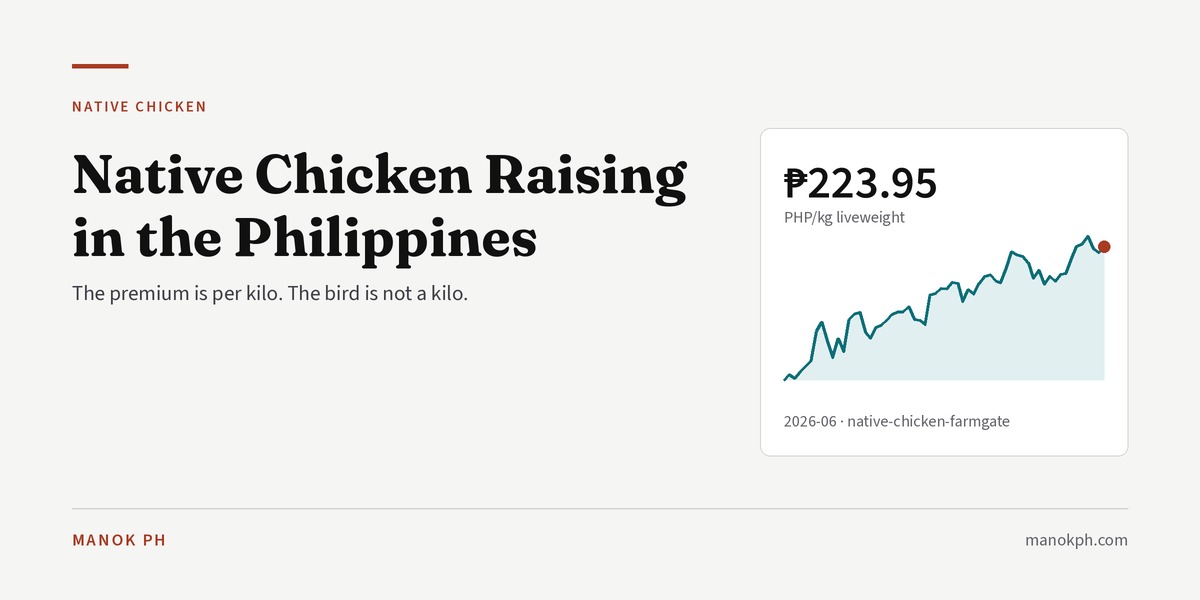
| Native chicken farmgate | ₱223.95/kg | live, at the farm |
| Broiler farmgate | ₱150.31/kg | live, at the farm |
| Native chicken at retail, live | ₱289.37/kg | live, at the market |
| Native chicken at retail, dressed | ₱343.40/kg | dressed, at the market |
| Dressed broiler at retail | ₱213.32/kg | dressed, at the market |
₱73.64 a kilo between the two farmgate figures, which is 49% on top of the broiler price. Malaking agwat iyon. It is also the last number here that anybody can hand you cleanly, and the rest of this piece is mostly about why.
The premium is per kilo, and a native chicken is not a kilo
Ang presyo kada kilo ay nagiging kita lang kapag may nakadikit na timbang ng manok. Run the two together and the ranking flips.
At the June 2026 native farmgate, the Boholano bird at its published day-120 weight is worth ₱164.82. A broiler at the 1.7 kg liveweight Philippine farms target, sold at its own June 2026 farmgate, is worth ₱255.53 on day 35.
Baligtad ang lumalabas. The bird carrying a 49% price premium brings in less money per head, and takes three and a half times as long doing it. Per day of occupancy that is ₱1.37 against ₱7.30, on the native series and the broiler one respectively.
Before anybody writes that off: this comparison is deliberately unfair in one direction and I would rather say so than let it sit. It counts revenue only. A broiler eats commercial feeds for its whole 35 days at whatever the sack costs this week, which nobody publishes, and a native bird in a bakuran is scavenging for much of its four months. Ang gastos ang kabilang panig ng kuwenta, at doon nagtatapos ang datos.
What the comparison does establish is that “native is more profitable” cannot rest on the price premium alone. The premium is real and it is not enough by itself. Anybody quoting you ₱223.95 as the reason to switch has done half of an arithmetic problem.
What a native chicken eats: one trial, 20 birds, and that is the record
This is the load-bearing gap in the whole cluster, and it is narrower than the version you will read elsewhere: the entire published Philippine record of what a native chicken eats is one undergraduate thesis from 2014.
It is worth having. Carpizo’s UPLB trial on the Banaba strain under organic production reports, at 12 weeks, a body weight of 408.12 ± 25.63 g, a cumulative feed consumption of 1,305 ± 386.08 g, and a cumulative FCR of 3.17 ± 0.75 (UPLB Knowledge Digital Repository, read August 2026). That is a Philippine native line, measured, by one of the institutions that ought to be doing this work.
Four limits travel with it and none of them is optional:
| Limit | What it means for your feed bill |
|---|---|
| Abstract only online | The thesis sits in the UPLB Main Library Special Collections. Nobody here has read the full text |
| n = 20, one farm, one season | A flock-sized sample, not a population figure |
| Weeks 4 to 12 only | A native bird sells at four to six months. The window closes six weeks early |
| The birds grazed | The study measured defoliation in the range. So 1,305 g is bought feed only and 3.17 is a floor, not the FCR |
Everything else confirms the hole rather than filling it. DOST-PCAARRD’s breed information system publishes eggs per hen per year, egg weight, fertility and hatchability by line, and no intake figure. The PJVAS Boholano paper publishes body weight by age and no intake figure. It stays logged as gap G-19 in the gaps register, narrowed rather than closed.
So the consequence is unchanged and the reason for it is now stated correctly. You still cannot compute a feed bill to market age, because nothing measures intake past week 12 and the one figure that exists excludes whatever the bird found in the bakuran. No feed bill, no break-even, no margin. Every native chicken profit table on the Philippine internet has closed that hole one of two ways: by borrowing a broiler FCR, which is biologically wrong for a bird that takes four months to reach 700 grams, or by making the number up. Isang thesis lang ang totoong record, at hindi iyon sapat.
Kaya walang native profit calculator sa tools page, at ito ang dahilan. The broiler feed cost tool and the broiler break-even tool both run on a published conversion range. Wala pang katumbas ng range na iyon sa native, kaya walang mabubuong tool na hindi hula.
What you can do instead costs nothing. Weigh the sack of whatever supplementary feeds you buy, write the date, and weigh five birds on the same day each month. Tatlong cycle lang and you own a feed intake figure for your own flock, sa lugar mo, sa klima mo, which is more than PCAARRD currently publishes for the whole country.
What the growth table actually says
Here is the curve, transcribed as published. The SD column is not decoration.
| Age (days) | Mean liveweight (g) | SD |
|---|---|---|
| 1 | 28.26 | ±2.26 |
| 21 | 101.89 | ±26.45 |
| 45 | 227.12 | ±55.64 |
| 75 | 430.91 | ±101.09 |
| 100 | 584.65 | ±126.21 |
| 120 | 735.96 | ±151.01 |
Source: PJVAS, Boholano native chicken, Ubay Stock Farm, read 13 August 2026.
Three things to take from it. The bird roughly doubles between day 45 and day 75 and then slows down hard, so the last 45 days buy you about 300 grams. The spread widens as fast as the mean does, which means a batch does not arrive at market together the way a broiler batch does. And the table stops at day 120, kaya doon din huminto ang alam natin. If you are planning a sale at 1 kg, you are planning at a weight this dataset never reaches, and extending the line on the graph is not evidence.
One honest caveat about scope. This is one line, Boholano, at one government stock farm. Darag, ZamPen, Camarines, Banaba and Paraoakan are different birds and may well grow differently. Walang katulad na published curve para sa kanila. Treat this table as the best available Philippine anchor rather than as the national figure.
A fifth of the batch does not finish
The DOST-PCAARRD industry update of 22 July 2024 puts native chicken mortality at 20% per cycle. That is the programme’s own working figure, from the agency running the national native chicken research effort, and it is the single number most often left out of the profit tables this article keeps complaining about.
Itabi mo iyan sa day-120 weight at hindi na 20 ang 20 sisiw na binili mo. Sixteen finish. At the June 2026 farmgate that is ₱2,637.09 of liveweight revenue for four months of occupancy, before a single peso of cost, and before anybody argues about whether your bakuran does better or worse than a research programme’s average.
Dalawang bagay ang sinasabi ng bilang na iyon. Ang una, hindi ganoon kababa ang panganib sa native flock kumpara sa ibinebenta sa iyo. The bird is hardier than a broiler in the sense that it tolerates heat and scavenges, hindi sa ibig sabihin na hindi namamatay. The second is about timing, and it is the part that hurts. A chick lost on day 100 has already eaten 100 days of feeds and scavenging effort, so a late death costs far more than an early one, and no simple costing charges you for the difference.
Nobody publishes when in the cycle the deaths actually fall, for native or for broiler. That is gap G-1 in the gaps register, still open, and still a thing everybody estimates and nobody measures.
The one published chick price is the wrong bird
There is exactly one Philippine chick price in this archive: ₱33.50 per head at the BAI day-old chick farmgate, week of 13 July 2026. That is a broiler DOC, and what its market level does and does not describe is settled elsewhere. The part that matters here is the bird. No native chick price is published by anybody, in any series, at any market level.
The gaps register carries that as G-16, partial: BAI’s weekly reports closed the farmgate half, and what stays missing is the dealer counter price and any native chick figure at all. Part of the reason is structural. Karamihan ng sisiw na native ay galing sa inahin, sa kapitbahay, o sa dispersal ng LGU, at walang counter doon na may presyo. A monitor cannot observe a transaction that mostly is not one.
Kaya tanungin mo, at tanungin mo pati ang edad. A native bird handed to you at a month old is a different purchase from a day-old chick, in price and in what has already gone wrong before it reached you, and no published figure separates the two.
Which line, and does the choice matter yet
Banaba, Darag, Paraoakan, Camarines, ZamPen, Boholano. The lines get named in every native chicken article in this country, usually with a paragraph of description and no figures.
Here is what PCAARRD’s breed information system actually publishes, and it is a short list: eggs per hen per year, egg weight of 40 to 43.6 g, fertility of 63 to 83%, and hatchability of 70 to 77%. Egg output is where the lines genuinely separate, and the separation is large.
| Line | Eggs per hen per year |
|---|---|
| Darag | 110 |
| ZamPen | 105 |
| Camarines | 62 |
| Boholano | 62 |
On growth there is nothing to choose between. Only Boholano has a published curve. So a keeper deciding between Darag and Camarines can decide on eggs with a source behind them, and cannot decide on meat at all, because that comparison has never been published for any pair of Philippine lines.
There is a practical answer to this that is not a cop-out. Line selection is a second-cycle decision. On a first batch the binding constraint is what you can get locally and alive, and a Darag from a breeder eight hours away, stressed by the trip, is a worse bird than whatever line the LGU or a kapitbahay is already keeping in your municipality. Malapit muna, saka lahi: pick from what a keeper in your own bayan can hand you, run one cycle on it, then argue about breeds once you have your own weights to argue with.
Eggs: three to one against you, and worth doing anyway
The other half of a native flock is itlog, and the ratio there is starker than the meat side.
DOST-PCAARRD’s breed system records eggs per hen per year by line: Darag 110, ZamPen 105, Camarines 62, Boholano 62. A commercial layer strain in a controlled house is published at over 300 to 72 weeks. So a native inahin lays roughly a third of what a commercial hen lays, and the two Visayan lines above lay closer to a fifth.
The price does not close that gap. A native egg at the farmgate read ₱8.61 per piece in June 2026 against ₱6.74 for a commercial egg in the same month. That is ₱1.87 a piece, a 28% premium, against a three-to-one production deficit. Kung itlog lang ang habol mo, native is the wrong bird and the arithmetic is not close.
Two cautions on that ₱8.61 before anybody builds a plan on it. The native egg series is the gappiest price series in this archive: 90 monthly figures where the broiler series has 198, starting only in 2019. Hindi ka makakabuo ng maayos na trend doon. And the egg numbers above are hatchery-condition figures from a breeding programme, not bakuran figures, so read them as a ceiling.
Where native eggs do earn is where they are not sold as eggs at all. A hen laying 110 a year with 63 to 83% fertility and 70 to 77% hatchability (PCAARRD) is producing replacement birds, and a bird is worth ₱164.82 at the day-120 weight above where an egg is worth ₱8.61. Iyon ang totoong silbi ng inahin sa bakuran. The flock is a slow multiplier, not an egg line.
Free-range is a standard with numbers in it
“Free-range” is not a description in Philippine law. It is PNS/BAFS 262:2018, a national standard with figures a keeper can be held to.
| Indoor density, fixed housing | 6 birds per square metre |
|---|---|
| Outdoor range density | 1 bird per square metre |
| Earliest harvest | Day 90 |
| Nest holes | Not more than 5 birds to a hole |
| Perch space | 31 cm per hen |
Basahin mong dalawang beses ang outdoor row. One bird per square metre of range means a 20-bird flock needs 20 m² of actual outdoor space, on top of the 3.3 m² of house the indoor rule implies. Marami sa mga tinatawag na free-range sa Pilipinas ang hindi papasa doon, at ang salitang iyon ang binebenta.
The day-90 floor is the rule most likely to catch an honest keeper by surprise, because it interacts with the growth curve above. A native bird sold at day 90 sits between the study’s 584.65 g at day 100 and its 430.91 g at day 75. A bird harvested before day 90 is ordinary native chicken and not free-range under the standard, whatever the sign at the stall says.
Work it out for your own flock
How big should the kulungan be? Open the calculator
The 6 birds per square metre row above, worked into a floor area for the flock you actually keep, indoors and on the range.
One caveat the standard itself forces. Its shade allowance is 8 to 16 m² per 1,000 birds, which at 20 birds computes to 0.16 m² and is obviously not the intent. PNS 262 was written for commercial units and the small end is where it stops making sense. Use the density rows, ignore the shade row at bakuran scale, at gumamit ng sentido komun sa lilim.
The gap between the gate and the market is not a mystery
One more published pair, because it is the number keepers ask about most after the farmgate itself.
In June 2026 a live native chicken at retail read ₱289.37 per kilo while native farmgate read ₱223.95. Same month, same unit, same live bird. The difference is ₱65.42 a kilo, and it is the clearest published measure of what stands between a bakuran and a buyer: hakot, the stall, the middleman’s own margin, at ang oras ng nagbebenta.
That gap is the argument for selling direct, and it is also a warning. ₱65.42 is what the whole chain earns, not what you would pocket by skipping it. Ikaw na ang maghahakot, ikaw na ang maghihintay ng mamimili. And the figure has barely moved in pesos since 2018 while the bird got 61.1% dearer, which is a different argument from the one a single month makes.
The dressed series sits at ₱343.40 in the same month, and that pair does not subtract. Ang agwat ng buhay at dressed ay hindi dressing yield. No Philippine institution publishes a dressing percentage for native chicken, so converting between liveweight and dressed weight in either direction is guesswork with a decimal point on it. Two published prices for two different products is what that pair is.
The feeding trial nobody has run
An intake figure that runs all the way to market age, on birds confined closely enough that what they eat can actually be weighed, closes G-19 and makes the cost side computable for the first time. Carpizo got roughly a third of the way there in 2014, at 12 weeks, on 20 birds that were also grazing. The rest is one feeding trial at one university, carried past day 120, and it would be the most useful poultry paper published in this country this decade.
A growth curve for a second line would settle whether 735.96 g at day 120 is Boholano or is native chicken, because one government stock farm currently carries the whole national evidence base for how fast this bird grows, at hindi iyon patas sa kahit sino. And a sourced Philippine dressing percentage would connect the live series to the dressed one and let a keeper price a dressed sale honestly. Until then those two rows sit side by side and stay there.
Notice what is not on that list. Not one of the three is a price. PSA already publishes the revenue side of this bird every month, at three market levels, and none of it helps, because what is missing is research and PSA does not do research. The institutions that would have to run these trials are UPLB, CLSU and PCAARRD’s own native chicken programme, and between them they have published this bird’s eggs per hen, its egg weight, its fertility and its hatchability, and its feed intake once, on 20 birds, twelve years ago.
Where the rest of this argument is written out
Six pages carry the parts this one only had room to state. Two of them are about broiler, and that is deliberate: the case for native rests on a comparison, and a comparison is worth exactly as much as the side you looked at least closely. Para sa karamihan, broiler ang panig na iyon.
The free-range claim
What the free-range standard actually requires Read the full guide
Every number in PNS/BAFS 262:2018, the fact that it contains no certification clause at all, and the single route by which its rules become binding on a Philippine keeper.
Day 90, and 1 bird per m² outdoors
Which line
The four lines, and the columns nobody can fill Read the full guide
Darag, ZamPen, Camarines and Boholano compared on everything the government actually publishes, which is eggs and not meat, plus what PCAARRD collects and does not print.
Four lines, one growth curve
The comparison, properly
Native or broiler over one cycle Read the full guide
The one Philippine trial that raised both birds in the same house, the feed conversion that collapses from 2.2 to 8.9 as a native ages, and the unit mismatch that breaks almost every published comparison.
Same house, 15 weeks
The three price levels
Native chicken price, and the gap that did not scale Read the full guide
What sits between the bakuran and the stall, why only one pair of PSA's three native series subtracts, and why the gap behaves like a service charge rather than a share of the manok.
Farmgate, live retail, dressed
The other bird
Raising broilers in the Philippines Read the full guide
One backyard batch from day-old sisiw to harvest, priced line by line. It is the comparison this article keeps making, done properly and with its own blanks marked.
Day 1 to harvest
Which series is yours
The two broiler farmgate prices Read the full guide
Why the broiler figure quoted above is the household one, how far it runs from the commercial series, and why averaging the two gives you a number that describes nobody.
Households against establishments
Questions people actually ask
How much is native chicken per kilo in the Philippines?
₱223.95 per kilo liveweight at the PSA household farmgate in June 2026, against ₱150.31 for broiler in the same month and the same frame. A live native bird at retail read ₱289.37 per kilo and a dressed one ₱343.40, both June 2026.
How long before a native chicken is ready to sell? Show the answer
The only published Philippine growth curve, for Boholano native chicken, records 735.96 grams at day 120. PNS/BAFS 262:2018 separately bars a free-range claim on any native bird harvested earlier than day 90. Four months is the honest planning horizon and the bird is still under a kilo at the end of it.
Is native chicken more profitable than broiler? Show the answer
Nobody can answer that with a source. The revenue side is published for both birds; the cost side is not. The entire Philippine feed intake record for a native line is one 2014 UPLB undergraduate trial on 20 grazing Banaba birds, which reports 1,305 g cumulative intake and an FCR of 3.17 at 12 weeks but counts only bought feed and stops six weeks short of market age. Any article giving you a native profit figure has borrowed a broiler conversion rate for a bird that takes four months to reach 700 grams.
How many native chickens fit in a square metre? Show the answer
Six indoors in fixed housing, and one per square metre on the outdoor range, under PNS/BAFS 262:2018. Those are free-range standard figures. For a confined backyard flock kept for meat no Philippine body publishes a density at all; PNS/BAFS 312:2021 gives one only for cage-free layers, at 0.14 square metres a bird.