Native or Broiler: The Real Economics Over One Cycle
The short answer
Half of this comparison does not exist. A backyard broiler has a published Philippine cost structure: ₱77.90 per kilo liveweight to produce in Pampanga in 2017, against ₱108 at the gate, so ₱30.10 a kilo. Walang katumbas nito para sa native na manok, kahit isa, kahit kailan. What native chicken does have is a same-house trial against a broiler, a feed conversion that degrades from 2.2 to 8.9 as the bird ages, and a survey showing that four in five keepers do not sell by the kilo at all. Iyon ang tunay na kuwenta, at hindi ito ang ipinapakita sa iyo.
Source Briones & Espineli (2022), PIDS Discussion Paper 2022-20, Table 9 (read on August 22, 2026)
Ano ba talaga ang pinagkaiba, sa numero?
Four things separate the two birds, and only the first one is usually discussed:
- Price per kilo. Native runs well above broiler at the farmgate, and this is the part every page leads with.
- Kilos per bird. Three to one against native, measured in one house on one management regime.
- Days of occupancy. Thirty-odd against a hundred-odd. The kulungan is not free while the bird is in it.
- The unit of sale. Broilers are sold by the kilo. Most native chicken is not.
The fourth is the one that breaks the arithmetic, and it comes last here because it needs the first three to land.
The one trial that put both birds in the same house
Almost every native-versus-broiler comparison on the Philippine internet compares a native figure from one study with a broiler figure from a brochure. There is one Philippine trial that did not.
Nerida et al. (2024) placed 100 Darag native chicks and 100 slow-growing commercial broiler chicks in complete confinement, ten replicates of ten birds each, and weighed them weekly from day-old to week 15 under what the paper calls “similar conditions”. Every weekly difference is significant at p<0.01.
| Age | Darag (g) | Slow-growing broiler (g) |
|---|---|---|
| Day-old | 28.93 | 42.60 |
| Week 4 | 174.20 | 642.50 |
| Week 8 | 444.90 | 1,545.00 |
| Week 12 | 734.90 | 2,620.00 |
| Week 15 | 966.70 | 3,066.70 |
Nerida et al. (2024), Table 1, means. The paper states the gain rates plainly: “Darag demonstrated an average daily weight gain (ADG) of 9 grams per day while slow-growing broiler chicken had an ADG of 29 g.” That is 3.22 times, and at week 15 the gap is 2.1 kg of bird.
Read the week-4 row before the week-15 one, kasi doon nangyayari ang totoong desisyon. By the time a commercial broiler batch is nearly ready to go, the Darag is at 174 grams. The native bird is not slower to the same finish line. It is running a different race with a different finish line, four times further away.
Isang bagay ang hindi masasagot ng trial na ito. Darag ang linyang sinukat, at walang inilalathalang timbang ang tatlo pang linya, kaya hindi malalaman kung tipikal ba ang Darag o ang pinakamabilis sa apat.
One flag that works in native chicken’s favour and should be stated: the comparator here is a slow-growing broiler, a Hubbard Redbro raised to eight or ten weeks. A conventional fast broiler is further ahead again. So this trial understates the gap rather than exaggerating it.
Bakit lumalaki ang gastos habang tumatanda ang manok?
Because the feed conversion collapses, and this is the figure almost nobody quotes.
Nagrampa et al. (2016) brooded 100 Philippine native chicks for three weeks and then ranged them to week 12, on a PCARRD-formulation ration. The control group’s numbers, by phase:
| Weeks 0 to 3 | FCR 2.2 · ₱45.30 of feed per kilo of gainAverage daily gain 5.2 g. Brooded. Feed costs are 2016 pesos. |
|---|---|
| Weeks 4 to 8 | FCR 4.5 · ₱93.90 of feed per kilo of gainAverage daily gain 10.8 g. Ranged, with a commercial-type ration. |
| Weeks 9 to 12 | FCR 8.9 · ₱187.60 of feed per kilo of gainAverage daily gain 11.5 g. The phase differences are significant at p<0.01. |
A native chicken converts feed 4.05 times worse in weeks 9 to 12 than it did in weeks 0 to 3, and the feed bill per kilo of gain rises by 4.14 times across the same window. Both are the same trial, the same birds and the same ration, so nothing about the comparison is borrowed.
Three cautions travel with those figures and none is optional. The peso column is 2016 money and is not restated here as current. These are phase conversions, not a whole-cycle FCR, and adding or averaging them would produce a number the paper never measured. And the trial stops at week 12, while the bird sells at four to six months, so the worst phase measured is not the last phase the bird lives through.
What it settles is the claim that native chicken is cheap because it eats little. Per day, it does. Kumakain siya ng mahigit apat na buwan, and the conversion is getting worse the whole time. The pillar sets out why no complete feed bill can be built from the published record at all.
Ano ang alam natin sa broiler, na hindi natin alam sa native?
Cost. Here is the whole asymmetry in one table.
PIDS Discussion Paper 2022-20 publishes a cost-and-returns table for broiler production in Pampanga in 2017, split by scale. The backyard column reads ₱77.90 per kilo liveweight in operating cost, of which feeds are ₱49.40, day-old chicks ₱15.30, labour ₱6.60 and veterinary supplies ₱1.80. Selling price is ₱108 a kilo. So a backyard broiler left ₱30.10 a kilo before investment, or ₱51.17 on a bird at the 1.7 kg big-bird target Philippine growers work to, against ₱132.43 of operating cost per bird.
PIDS says the interesting part out loud: “net returns per kg is much higher for backyard broiler as the farmgate price is much higher than for commercial operators”, because “backyard operators sell locally, for the fresh market for same day consumption, for which consumers are willing to pay a premium.”
Now the native side of that table. It does not exist. No Philippine institution and no Philippine paper publishes a cost of production per kilo for native chicken, at any scale, in any year. The nearest three things are the phase feed costs above, a ZamPen value-chain study reporting percentages rather than pesos, and a papaya-leaf feed trial whose per-bird return assumes a ₱300 per kilo farmgate that no published series supports.
That absence is the answer to the question this article was asked. It is not that native chicken loses the comparison. It is that only one side of it has ever been costed, and the pages that publish a native margin have filled the other side in themselves.
Work it out for your own flock
Ilang buwan bago mabenta ang native, at magkano ang isa? Open the calculator
It runs the one published Philippine growth curve against your own bird count, your own death loss and the price your buyer actually pays. It carries no feed cost, for the reason this section just gave: nobody has published what a native chicken eats to market age.
Ilang manok ba talaga ang bawat isa sa bansa?
Nearly the same number, and that is the fact that reframes the whole question.
PSA counted 80,357,709 native or improved chickens and 79,774,808 broilers in the Philippines on 1 July 2026, a difference of 582,901 head (OpenSTAT chicken inventory). Native or improved is 35.17% of every chicken standing in the country.
The composition is where it gets interesting. 99.86% of those native and improved birds sit in smallhold flocks. 97.42% of the broilers sit in commercial ones. The two birds are not two options on one menu. They are two industries that happen to share a species, and only one of them is mostly kept by people like the reader of this page.
That also explains the missing cost table. Commercial broiler production is surveyed because it is concentrated, contracted and countable. Eighty million native birds spread across bakuran in every province are not, at wala pang gumagawa ng pagbilang na iyon.
Ilan ang natitira sa dulo ng apat na buwan?
The comparison has a third leg and it is the one both sides of it are shy about.
Naldo et al. (2021) surveyed 80 native chicken farmers across six mountain barangays of Ayungon, Negros Oriental, free-range with feed supplementation. Mean flock size 27 ± 16 head. Mean survival rate 71.57% ± 13.30, with a minimum of 33.33% and a maximum of 100%. Cause of death, by farmer report: disease 88%, unknown 10%, predation 3.8%, parasites 2.5%.
Hindi maliit na bagay ang 71.57% na survival. Sa dalawampung sisiw, labing-apat ang aabot sa dulo, at ganoon kalapad ang spread na kaya ng masamang panahon ang kunin ang dalawang katlo.
The losses are also seasonal, which nothing in a broiler batch prepares you for. Dusaran and Pabulayan (2012) surveyed native chicken growers across Western Visayas and found mortality beginning in March at 24.7% of respondents reporting losses, peaking in June at 43.5%, then falling back to 21.0% by August. Aklan runs on a different calendar entirely, starting in November and peaking in December at 44.0%.
Tatlumpong araw lang ang batch ng broiler at nasa loob ito ng isang panahon. Ang native na apat hanggang anim na buwan ay tatawid sa kung anong buwan namamatayan ang lalawigan mo, at walang paraan para iwasan iyon.
Ang kinikita, hindi ang margin
Two Philippine surveys have asked native chicken keepers what the enterprise actually brings in, and both answers are smaller than the discussion usually implies.
Dusaran and Pabulayan (2012) put average income from native chicken at ₱1,002.50 a month, with 43.9% of raisers earning ₱500 a month or below, contributing 24.1% of what the household’s main occupation earns. Their breeding flocks averaged 16.2 hens and 4.4 roosters and they sold about 5.6 pullets, 6.4 cockerels and 3.4 hens a month. Feed spend averaged ₱491.90 a month. Nine years later Naldo et al. (2021) found Ayungon keepers spending ₱199.18 ± 147.09 a month on supplemental feed against a total household income of ₱10,285.80.
Neither figure is a margin and neither should be read as one. What they establish is scale: a backyard native flock in the published Philippine record is a few hundred to a few thousand pesos a month of gross activity on twenty to thirty birds, at hindi ito ang negosyong ipinapangako ng mga profit table sa internet.
The unit of sale is where the comparison actually dies
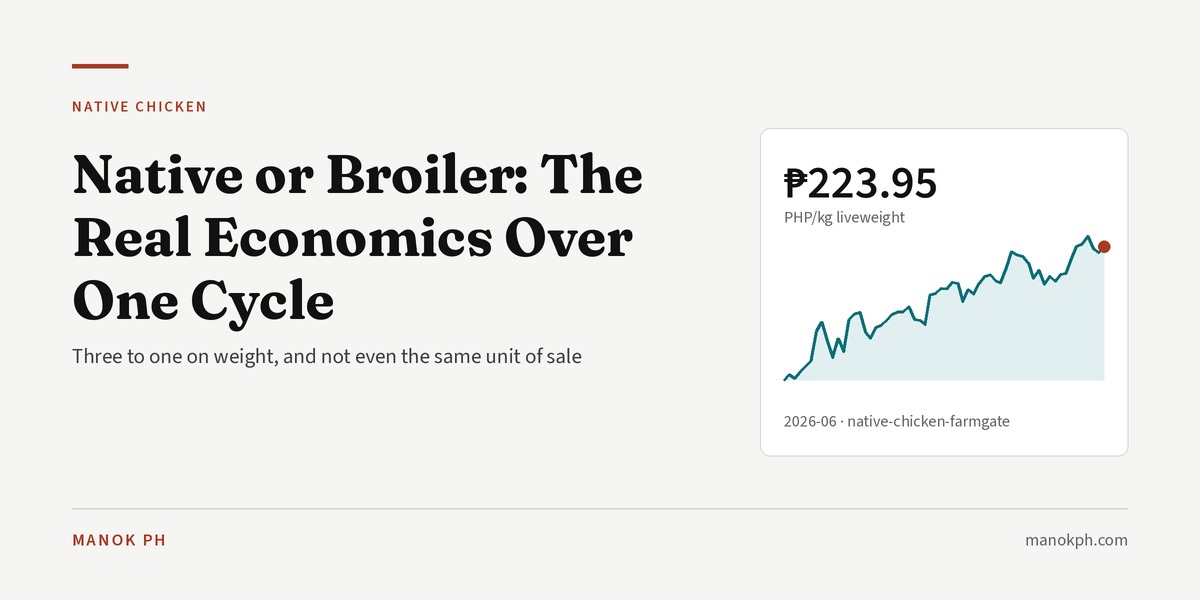
Every price in this article so far has been per kilo. So is every published series, including the PSA native chicken farmgate at ₱223.95 per kilo liveweight in June 2026 and the broiler household farmgate at ₱150.31 in the same month.
Then there is what actually happens at the gate.
Valdez et al. (2025), a 584-respondent survey across Ilocos Norte, Ilocos Sur, La Union and Pangasinan by staff of Mariano Marcos State University, ISPSC and PSU, found that 82% of native chicken raisers price per head rather than per weight. In Pangasinan it was 100%. The regional mean was ₱195 a head, with a range from ₱136 to ₱369, and the four provincial means ran ₱166 to ₱226.
Ilagay mo iyan katabi ng isang manok na 966.7 g at makikita mo ang problema. A bird at the Nerida week-15 weight, sold at the regional mean per head, is transacting at a little over ₱200 a kilo, which is below the PSA farmgate for the same month and nothing like it in method. Naldo et al. (2021) found the same thing from the other direction in Negros Oriental: live native chicken sold at the marketplace for a mean ₱161.97 per kilo, against a national farmgate series that has not read below ₱200 in years.
So when a page tells you native chicken earns a 49% premium per kilo, it is quoting a series that four in five native chicken keepers never transact against. Hindi ito pagsisinungaling. Ibang tanong lang ang sinasagot nito.
What usually goes wrong
The mistake: Comparing the two farmgate prices per kilo and stopping there.
Do this instead: Multiply each by the weight the bird actually reaches, then divide by the days it took.
A Darag at 966.7 g and a broiler at 1.7 kg are not the same product in different colours. The price premium is per kilo and the native bird is fewer kilos over more days.
The mistake: Borrowing a broiler feed conversion for a native chicken.
Do this instead: Use the phase figures that were measured on native birds, and say they stop at week 12.
Nagrampa et al. measured 8.9 in weeks 9 to 12. A broiler target of 1.50 to 1.83 is a different bird in a different house, and using it makes a native costing look four to five times better than the only Philippine measurement.
The mistake: Averaging the three native FCR phases into one number.
Do this instead: Quote them as three phases, or do not quote them.
A mean of 2.2, 4.5 and 8.9 is a figure the trial never measured and never reports. It would also be weighted wrongly, because the phases are not equal in length or in feed volume.
The mistake: Using the PSA per-kilo native farmgate to price a backyard sale.
Do this instead: Ask what the buyer in front of you pays per head, and weigh one bird so you know what that means.
Valdez et al. found 82% of Region 1 raisers sell per head. The series is not wrong; it is measuring a transaction most keepers do not make.
The mistake: Treating a published broiler cost table as if a native equivalent exists somewhere.
Do this instead: Assume it does not until somebody shows you one, and ask what the missing half was filled in with.
PIDS costs backyard broilers at ₱77.90 per kilo liveweight in 2017. Nothing comparable has ever been published for native chicken, so any native margin you are shown is half sourced and half invented.
What a keeper can settle, and what nobody can
Two of the four differences at the top of this page are now measured, and they point the same way. A broiler reaches a saleable weight in about a month; Datuin et al. (2022) records Philippine open-sided growers targeting harvest at 30 to 34 days for a 1.7 kg big bird. A Darag needs fifteen weeks to reach a kilo. And across those fifteen weeks the native bird’s feed conversion goes from good to four times worse.
The third difference, days of occupancy, has a published Philippine figure attached and almost nobody uses it. Datuin et al. (2022) records the commercial planning arithmetic in one sentence: “harvest per year is 8, given the assumption of 30 days growing period and 14 days downtime”, and the farms surveyed actually ran an average downtime of 17.28 days. Walong ikot kada taon laban sa dalawa, sa iisang kulungan. Kahit magkano ang ginastos sa pagpapatayo, hinahati iyon ng broiler sa walong batch at ng native sa dalawa lamang.
One more thing from the same paper, because it stops the broiler side looking too clean. Those 30-to-34-day harvests and 1.50-to-1.83 conversions are targets, not results. Table 6 of the same survey asked whether growers meet them: across all 46 farms, 2% said always, 64% most of the time, 31% sometimes and 2% not at all. The broiler half of this comparison is better documented than the native half. It is not better achieved.
The fourth is the one that will not resolve, and it is not a matter of research effort. Broilers are priced per kilo because they are sold into a weighing trade. Native chicken is mostly priced per head because it is sold at a Friday tabo, to a kapitbahay, for a fiesta, by eye. Dalawang magkaibang unit iyon, at walang published conversion sa pagitan ng dalawa: no Philippine institution publishes a native chicken dressing percentage, and the 0.77 liveweight-to-dressed ratio PIDS borrows from PSA is a broiler figure that would overstate a native bird’s yield, because Nerida et al. measured a higher proportion of bone in the Darag at weeks 14 and 15.
So the honest close is narrow. Weigh five birds before you sell them and write the price you were actually offered beside the weight. That one line converts a per-head offer into a per-kilo figure you can hold against the series, and until you have it, you are comparing a price you receive with a price somebody else received for a differently measured bird. Ang kilo laban sa ulo ay hindi paghahambing, at doon nasisira ang halos lahat ng kuwentang native laban sa broiler.
Questions people actually ask
Is native chicken more profitable than broiler in the Philippines?
Nobody can answer that from published figures, because there is no Philippine cost-of-production table for native chicken at all. There is one for broilers: PIDS Discussion Paper 2022-20 puts backyard broiler operating cost at ₱77.90 per kilo liveweight in Pampanga in 2017, against a ₱108 backyard selling price. Nothing equivalent has ever been published for a native bird, so any native-versus-broiler margin you are shown has had its harder half invented.
How much bigger is a broiler than a native chicken at the same age? Show the answer
About three times, and it is measured. Nerida et al. (2024) raised 100 Darag native chicks and 100 slow-growing commercial broiler chicks in the same house under the same management and weighed them weekly to 15 weeks. At week 15 the Darag averaged 966.7 g and the broiler 3,066.7 g, a gap of 2.1 kg. Average daily gain was 9 g against 29 g. The comparator was a slow-growing broiler, so a Cobb or Ross bird would be further ahead again.
Do native chickens eat less than broilers? Show the answer
Per day, yes. Per kilo of meat, the opposite, and it gets worse as the bird ages. Nagrampa et al. (2016) measured Philippine native chicken feed conversion at 2.2 in weeks 0 to 3, 4.5 in weeks 4 to 8 and 8.9 in weeks 9 to 12. In 2016 pesos the feed alone to add one kilo of bodyweight went from ₱45.30 to ₱187.60 across the same three phases. The bird eats slowly and eats for four to six months.
How do backyard keepers actually sell native chicken? Show the answer
By the head, mostly. A survey of 584 respondents across Region 1 by Valdez et al. (2025) found 82% of native chicken raisers price per head rather than per kilo, at a regional mean of ₱195 per head, and in Pangasinan the figure was 100%. That matters because every published price series, including PSA farmgate, is per kilo. The series is real and it is not the transaction most keepers make.
Are there more native chickens or broilers in the Philippines? Show the answer
Native and improved, narrowly. PSA counted 80,357,709 native or improved chickens and 79,774,808 broilers on 1 July 2026, a difference of 582,901 head. The composition is the interesting part: 99.86% of the native and improved birds are in smallhold flocks, while 97.42% of the broilers are commercial. They are not two options inside one industry.