Philippine Native Chicken Breeds: What Is Published and What Is Not
The short answer
Four lines have government figures behind them: Darag from Panay, ZamPen from the Zamboanga Peninsula, Camarines from Bicol, Boholano from Bohol. On eggs they separate hard, 110 down to 62 per hen per year. On meat they do not separate at all, kasi walang inilathalang timbang kahit isa sa apat. DOST-PCAARRD lists body weight among the traits its breed system collects and prints none of them. So the breed table on every other Philippine page is filled in from somewhere that is not a Philippine source.
Source DOST-PCAARRD, Philippine Animal Breed Information System, native poultry (read on August 22, 2026)
The four lines, with the columns nobody can fill
| Line | Home | Eggs per hen per year | Egg weight | Fertility | Market weight | Days to market | FCR |
|---|---|---|---|---|---|---|---|
| Darag | Panay Island | 110 | 41.36 g | 81–83% | not published | not published | not published |
| ZamPen | Zamboanga Peninsula | 105 | 43.6 g | 81–83% | not published | not published | not published |
| Camarines | Bicol | 62 | 40 g | 69% | not published | not published | not published |
| Boholano | Bohol | 62 | 40 g | 63% | 735.96 g at day 120 | not published | not published |
Everything in the first five columns is from DOST-PCAARRD’s breed information system, read 22 August 2026. The one filled cell in the sixth is from Nombrefia et al. (2023). Hatchability runs 70 to 77% across all four and PCAARRD does not break it down by line. Nagsisimulang mangitlog ang lahat ng apat sa edad na 20 hanggang 22 weeks, ayon sa parehong pinagkunan.
Tatlong walang laman na hanay ang totoong nahanap dito. Hindi ito kulang sa research ng pahinang ito. Kulang po ito sa pambansang tala, at pinupunan ito ng ibang pahina nang hindi sinasabi kung saan nila kinuha.
One thing about that Market weight column is newer than the rest of this page. The only two Philippine native lines with a measured adult weight in print are not among these four. Caraga Black reads 1.9 kg for the rooster and 1,350 g for the hen at twelve months, off 40 birds at a state university. Paraoakan reads 2.3 kg and 1.67 kg, off a Palawan survey covering seven municipalities. Neither figure came from the agency that lists body weight as a trait it collects, at wala ni isa sa dalawang lahing iyon sa apat na dinodokumento nito.
PCAARRD collects the weights. It publishes the eggs
This is the part worth understanding, because it explains why the table above cannot be completed by looking harder.
The breed information system is a project of the UPLB Institute of Animal Science with the UPLB Institute of Computer Science, funded by DOST-PCAARRD. It lists, under “Quantitative Data (Morphometric Characteristics)”, the traits it holds: body weight, height, body length, chest circumference, wing span and shank length. Those are exactly the measurements a keeper choosing a meat line needs.
None of them is published. The public pages carry the reproductive figures and stop. Ang tanging timbang sa buong site ay 1.0 to 1.3 kg at 18 weeks, at hindi iyon manok. That figure belongs to Itik PINAS, which is the duck programme on the same breed system, and putting it on a chicken row is the single most likely error anybody makes from this source.
So the weights exist. They have been measured, by a state university, under a national research programme, and they sit behind a login. Ang bawat pahinang Pilipino na naglalathala ng timbang ng Darag ay hindi sila ang sinisipi, dahil hindi sila kayang sipiin.
The one published growth curve, and it stops at day 120
There is exactly one Philippine native line with a published growth curve, and it is Boholano.
Nombrefia et al. (2023) measured three generations at the DA-7 Ubay Stock Farm in Lomangog, Ubay, Bohol, twelve families of five hens to one cock in 5 m² and 10 m² pens, semi-confinement, fed twice a day and vaccinated against Newcastle disease. Body weight at day 1 came from 885 birds and at day 120 from 809, and the same paper puts the heritability of body weight between day 1 and day 120 at 0.05 to 0.28.
| Age | Mean liveweight | SD | Birds weighed |
|---|---|---|---|
| Day 1 | 28.26 g | ±2.26 | 885 |
| Day 21 | 101.89 g | ±26.45 | 885 |
| Day 45 | 227.12 g | ±55.64 | 884 |
| Day 75 | 430.91 g | ±101.09 | 870 |
| Day 100 | 584.65 g | ±126.21 | 836 |
| Day 120 | 735.96 g | ±151.01 | 809 |
Read the last row against what you have been told a native chicken weighs at market. 264.04 grams short of a kilo, at four months, with a standard deviation of 151 grams. The paper says it plainly: Boholano chickens are “slow growing bird that attain a kilogram of body weight at the age of 20 weeks or more.”
That sentence is an observation and not a measurement, and it is still the most specific days-to-market statement published for any Philippine native line. Doon nagtatapos ang alam natin, at hindi ito extrapolation problem: the table has no row past day 120 and drawing the line further is not evidence.
One thing the paper carries that nothing else does. It cites Lambio (2010) for day-old weights across four lines that have no other published figure at all: Banaba 26.40 g, Bolinao 25.80 g, Camarines 25.25 g, Paraoakan 23.96 g. That is a secondary citation and should be read as one. It is also the entire published growth record for three of those four names.
The improvement figures, and which direction they moved
Two of the four lines have published before-and-after numbers from breeding work, and the ZamPen set is the more detailed of them.
The DOST-PCAARRD project report of 16 February 2023, run with J.H. Cerilles State College at Dumingag and the San Ramon Prison and Penal Farm, reports egg number up 10.26%, egg weight up 5.31%, fertility up 3.20%, hatched eggs up 14.21%, and post-project hens laying 117 eggs annually.
One figure in that set moved the other way and it is worth stating rather than burying. Age at first egg went from 22.3 weeks to 24 weeks. The birds began laying later, not earlier. A breeding programme selecting for egg number can pay for it in age at maturity, and there is nothing dishonest about that trade, but it is not an improvement in every column.
| Egg number | up 10.26%Post-project hens reported laying 117 eggs annually, against the 105 the breed system publishes for the line. |
|---|---|
| Egg weight | up 5.31%ZamPen is already the heaviest egg of the four lines at 43.6 g. |
| Fertility and hatched eggs | up 3.20% and 14.21%Percentage changes with no baseline flock stated in the report. |
| Age at first egg | 22.3 to 24 weeksLater, not earlier. The one column that moved against the keeper. |
The agency’s own average is higher than its own best line
Here is the tension a reader should be handed rather than protected from.
The DOST-PCAARRD industry update of 22 July 2024 states, as achievement rather than target, that the programme has “achieved significant progress by raising the average egg production to 120 eggs per hen per year, cutting mortality rates to 20% per cycle.”
Darag, the best of the four lines the same agency publishes, is 110. So the achieved programme average sits 10 eggs above the best documented single line, and the claim names no line, no flock, no method and no date range.
Both figures are PCAARRD’s. Neither is being called wrong here. What a keeper needs to know is that the two are not interchangeable: 120 is a programme-level statement about improved stock under project management, and 110 is a line-level figure in a breed reference. Quoting the first as though it described a Darag you can buy would be a mistake, and it is one this site would rather flag than repeat.
The 20% mortality figure in the same sentence is, as far as this research goes, the only published mortality number for Philippine native chickens anywhere. It is programme-level too, and attributed to no line. The pillar works through what a fifth of a batch means to a twenty-bird placement.
There is no breed registry, and one project page proves it
A keeper reasonably assumes that a named breed with a government programme behind it is registered somewhere. It is not.
The DA-BAFS register of approved Philippine National Standards carries poultry standards for broilers and layers, free-range chicken, hatchery operations, primal cuts, carcass grading and shell eggs. None of them is a native chicken breed standard, and there is no registry document among them.
The confirmation comes from the other direction, in PCAARRD’s own words. The Darag selection and breeding project page lists as a future outcome that “Darag will be a registered breed of chicken from internationally recognized certifying bodies.” A stated aspiration is proof that it has not happened.
Two further corrections while the subject is open. “Manok Pinoy” is not a programme name and does not appear on PCAARRD’s breed system or its project site; the real programme is the Native Chicken Industry Strategic Plan, and Itik PINAS is the duck programme, which is almost certainly where the confusion starts. And Bisaya does not appear as a distinct registered line anywhere in this research. Treat it as a colloquial term for a bakuran bird, hindi bilang lahi na may sariling numero.
The names with nothing behind them
Six or seven more line names circulate in Philippine native chicken writing, and it is worth being specific about which of them have anything attached.
Banaba, Bolinao, Paraoakan and Joloano return nothing from PCAARRD’s own project site search. They are not in the breed information system either. What exists for three of them is the single day-old weight figure Nombrefia et al. carry from Lambio (2010). Paraoakan stopped belonging in that list on 28 May 2026, and this page said it did until August. Tuquero’s phenotypic characterisation, The Palawan Scientist 18(1):216-228, puts adult body weight in print across seven municipalities: 2.3 kg for the rooster and 1.67 kg for the hen, alongside body length, chest circumference, shank and wingspan. That is a measured weight for a Philippine native line, which not one of the four documented above has. The egg counts in the same paper are a different kind of figure, because they are what 96 raisers recalled about their own birds, and a recalled egg count is not a measured one. The Paraoakan page keeps the two halves of that document apart.
Caraga Black has an active PCAARRD breeding project, and the performance figures for it exist. They are simply not the agency’s. Austral et al. published twice in the Journal of Biodiversity and Environmental Sciences in 2022, on the same 40 birds, 8 roosters and 32 hens: the morphology paper at 21(5):72-78 gives twelve-month weights of 1.9 kg for the rooster and 1,350 g for the hen, and the reproduction paper at 21(6):178-183 gives the laying, fertility and hatchability record. The Caraga Black page reads both, including the annual egg figure that disagrees with itself between the abstract and the results table. This page said until August 2026 that the line had nothing published, and being wrong about it is the pattern rather than an exception to it: the agency’s project pages state objectives, methods and target head counts, the outcomes land in a journal nobody links from the project page, and a reader looking where the programme points finds nothing. Ang ahensiyang nagpapatakbo ng breeding programme ay hindi naglalathala ng resulta ng breeding sa mismong pahina ng programa.
The practical consequence for a keeper is narrow. Kung may nag-alok sa iyo ng Banaba, Bolinao o Joloano at may binanggit na timbang o bilang ng itlog, that figure is not from a Philippine primary source, because none exists. It might still be true. Hindi lang ito matitingnan.
Ang paghahambing ng native at broiler sa isang buong siklo ang nagdadala ng buong bigat nito.
And nothing here has a feed figure. Not one of the four documented lines has a published feed intake or feed conversion, and neither do the undocumented ones. That is gap G-19 and it is the reason no native feed bill can be built at all, in any line, at any age.
Does the line you pick change what you get paid?
Not that anybody can show you, at ito ang pinakamalinis na sagot sa buong pahina.
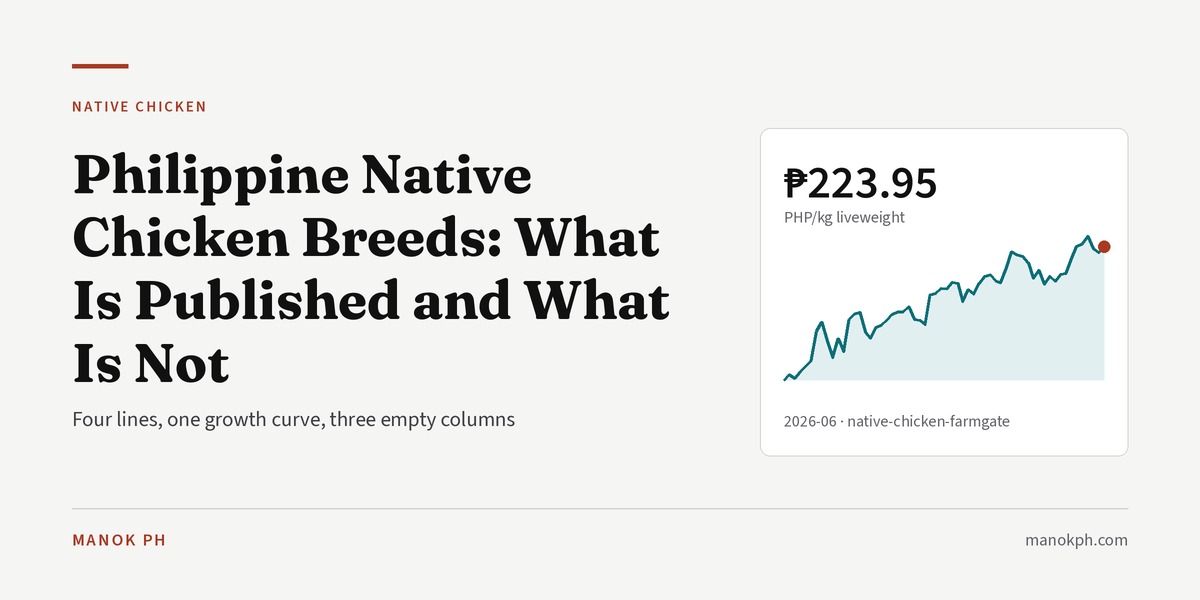
Every published Philippine native chicken price is a single national figure covering all of them together. Farmgate liveweight read ₱223.95 per kilo in June 2026. Live retail read ₱292.47 in July, at ₱341.74 naman ang dressed sa parehong buwan. Isang presyo para sa lahat ng lahi, walang paghahati.
No series anywhere separates Darag from Boholano from whatever bird a viajero picked up in a bakuran. PSA’s classification stops at NATIVE/IMPROVED, and the retail cuts group splits by live against dressed rather than by line. So a keeper choosing between two lines cannot look up whether the choice pays.
Iyon ang buong sagot at maliit lang ito. On present evidence, choosing Darag over Boholano buys you a better published egg figure, no published weight to compare at all, at walang mapapatunayang pinagkaiba sa presyo. Ang lahi ay isang desisyon na wala pang datos.
Where the birds actually are
The lines are named for provinces and the birds are still concentrated in them, which is the practical part of this page.
PSA counted 80,357,709 native or improved chickens in the Philippines on 1 July 2026, 35.17% of every chicken standing in the country. Region VI Western Visayas, Darag’s home, holds 8,636,812 of them. Region IX Zamboanga Peninsula, ZamPen’s home, holds 5,976,147. Region V Bicol, Camarines’ home, holds 6,098,686. Bohol province holds 1,824,871 (PSA OpenSTAT).
Now the number that should be in more places than it is. Across the year from 1 January 2025 to 1 January 2026 the native or improved flock moved -4.44%, from 80,258,943 to 76,696,433, while the whole national chicken flock grew 5.38%, from 206,432,504 to 217,532,251. The bird that is 35% of the country’s chickens is the part of it that shrank.
Which one should you actually get
The honest answer is decided by availability, and availability is the trait with the best evidence attached.
| Darag | WVSU Darag Center, Luna Street, La Paz, Iloilo CityAlongside the Panay Darag Breeders Association, reported by PCAARRD as over 100 local farmers, business owners and former OFWs. |
|---|---|
| ZamPen | WMSU College of Agriculture, San Ramon, Zamboanga CityThe widest network of the four: seven named farms including BUCOR-SRPPF at San Ramon and JHCSC-Dumingag in Zamboanga del Sur. |
| Camarines | Bicol University College of Agriculture and Forestry, Guinobatan, AlbayPlus six private breeders, all of them in Sorsogon province. |
| Boholano | DA VII Ubay Stock Farm, Lomangog, Ubay, BoholOne institutional source. It is also the farm the only published growth curve was measured at. |
ZamPen has seven named breeder farms, Darag has a hundred-member association, and Boholano and Camarines each rest on one institution. Kung malayo sa iyo ang lahat ng iyan, ang lokal na dispersal ng LGU o ang kapitbahay mo ang totoong pagpipilian, and that is not a lesser option: a stressed bird off an eight-hour trip is a worse bird than whatever line is already alive in your municipality.
Work it out for your own flock
Ilang buwan bago mabenta ang native, at magkano ang isa? Open the calculator
It runs the Boholano curve above against your own chick count and your own death loss, and stops where the study stops. There is no feed cost in it, for the reason this page has been making: nobody publishes what any of these four lines eats.
What usually goes wrong
The mistake: Using the 1.0 to 1.3 kg figure from the PCAARRD breed system as a native chicken weight.
Do this instead: Do not use it at all. It belongs to Itik PINAS, which is a duck.
It is the only weight on the whole public site, which is exactly why it gets picked up. No chicken weight appears anywhere on those pages.
The mistake: Quoting a per-breed market weight table for all four lines.
Do this instead: Say that market weight is unpublished for three of the four, and give the Boholano curve for the fourth.
PCAARRD collects body weight, height, length, chest circumference, wingspan and shank length, and publishes none of them. Any four-line weight table is unsourced by construction.
The mistake: Reading PCAARRD 120 eggs per hen per year as a breed figure.
Do this instead: Treat it as a programme-level claim about improved stock under project management.
It exceeds Darag at 110, which is the best single line the same agency documents. The claim names no line, no flock and no date range.
The mistake: Calling Darag a registered breed.
Do this instead: Say it is a government-recognised line with published figures, and that registration is a stated future outcome.
PCAARRD’s own Darag project page lists registration among the things the project will deliver. The BAFS standards register carries no native chicken breed standard.
The mistake: Filing Bisaya, Joloano or "Philippine native" under gamefowl lines.
Do this instead: Keep them separate. PSA does.
PSA classifies GAMEFOWL as an animal type distinct from NATIVE/IMPROVED, at 9,397,075 head against 80,357,709 on 1 July 2026. The national statistical classification already separates them.
What would have to be published for this page to be a real comparison
Right now it is not one, and that is the honest state of it. Four lines separate cleanly on eggs and are indistinguishable on everything a meat keeper buys a bird for.
Closing the gap would not take a new study. It would take PCAARRD publishing the morphometric columns its own breed system already says it holds: body weight by age, for each of the four lines, with the sample size and the housing beside it. That is one page of a database that exists.
Until then, the two figures on this page that a keeper can hold against a bird in front of them are the egg counts and the Boholano curve. Everything else in the market is furniture. And the thing worth sitting with is that the agency’s own achieved average, 120, is higher than the best line it documents at 110, which means the number the programme is proudest of describes a bird nobody can look up.
Questions people actually ask
What are the Philippine native chicken breeds?
Four lines carry published performance figures from DOST-PCAARRD: Darag from Panay Island in Western Visayas, ZamPen from the Zamboanga Peninsula, Camarines from Bicol, and Boholano from Bohol. Several other names circulate, including Banaba, Bolinao, Paraoakan, Joloano and Caraga Black. Two of those now carry measured adult weights, which none of the four PCAARRD lines does: Caraga Black at 1.9 kg for the rooster and 1,350 g for the hen in Austral et al. (2022), and Paraoakan at 2.3 kg and 1.67 kg in Tuquero (2026). Banaba, Bolinao and Joloano still have nothing beyond a day-old weight or nothing at all. There is no official DA or BAI breed registry for Philippine native chickens.
Which native chicken breed lays the most eggs? Show the answer
Darag, at 110 eggs per hen per year on the DOST-PCAARRD breed information system. ZamPen follows at 105, and Camarines and Boholano are both at 62. That is close to a two-to-one spread across four government-recognised lines, and it is the only trait on which all four can honestly be compared.
How much does a Philippine native chicken weigh at market? Show the answer
Nobody publishes it for Darag, ZamPen or Camarines. The only published Philippine growth curve for any native line is Boholano, measured at the DA-7 Ubay Stock Farm in Bohol and reported by Nombrefia et al. (2023): 735.96 g at day 120, with a standard deviation of 151.01 g. The paper adds that Boholano chickens attain a kilogram of body weight at the age of 20 weeks or more. The PCAARRD breed system lists body weight as a field it collects and publishes none of it.
Is Darag a registered breed? Show the answer
Not yet. The DOST-PCAARRD project page for Darag lists registration as a future outcome, stating that Darag will be a registered breed of chicken from internationally recognised certifying bodies. The DA-BAFS register of approved Philippine National Standards carries standards for broilers and layers, free-range chicken, hatcheries, primal cuts, carcass grading and shell eggs, and no native chicken breed standard or registry.
Where can I buy Philippine native chicken stock? Show the answer
Each of the four lines has a named institutional nucleus flock. Boholano is at the DA VII Ubay Stock Farm in Lomangog, Ubay, Bohol. Camarines is at Bicol University College of Agriculture and Forestry in Guinobatan, Albay. Darag is at the WVSU Darag Center on Luna Street, La Paz, Iloilo City, alongside the Panay Darag Breeders Association. ZamPen has the widest network, including WMSU College of Agriculture at San Ramon, Zamboanga City, and the J.H. Cerilles State College campus at Dumingag, Zamboanga del Sur.