Why Your Hens Stopped Laying
The short answer
Not the days getting shorter. That explanation was written at latitudes where the year swings six hours of daylight; Manila swings 104 minutes, and even its longest day is an hour below the 14-hour minimum layer guides ask for. So a bakuran flock is under-lit every month of the year and nothing about November is special. What actually stops manok, in the order worth checking: water, feed calcium, parasites, heat, broodiness, moult, disease, and age. Ang tubig muna, kasi iyon ang pinakamabilis maayos at pinakamadalas makaligtaan.
Source US Naval Observatory, sunrise and sunset for Manila, 2026 (read on August 22, 2026)
The nine, and how long each takes to reverse
| What stopped her | The tell | How long back |
|---|---|---|
| Water, cut off or too hot | Sudden, whole flock, within days | About 14 days (El Sabry et al. 2023) |
| Wrong ration | Thin shells first, then fewer eggs | Weeks, once calcium is right |
| Heat | Lighter eggs, weak shells, low feed intake | Recovers during the exposure (Aryal et al. 2026) |
| Mites and worms | Anaemia, night restlessness, poor condition | Weeks, after treatment |
| Broodiness | One hen, sitting, puffed, will not leave the pugad | About 47 days per episode (Hu et al. 2025) |
| Moult | Feathers everywhere, over weeks | 7 weeks or more, and returns lower (Gickel et al. 2025) |
| Infectious bronchitis | Misshapen, wrinkled, pale eggs; watery albumen | Up to 8 weeks (Merck) |
| Newcastle disease | Can stop the flock outright | Not a recovery question (Merck) |
| Age | Slow, over months, never sudden | Never |
Nine dahilan, at isa sa mga ito ang tumama sa iyo. That list is not ranked by how likely each is, kasi walang nagsukat niyan sa isang bakuran dito at ayaw kong manghula. It is ranked by how long each one takes to come back.
Read the third column before the first. Two of these cost you a fortnight and two of them cost you two months, at ang pagkakaiba ng tama at maling pagkakasunod ng tingin ay halos lahat ng pera sa page na ito.
Manila’s longest day is 13 hours, and the guides want 14
Here is the correction the rest of the article rests on, and it is arithmetic rather than opinion.
Every layer management guide in circulation specifies a photoperiod. Merck puts it plainly: day length “should be increased gradually up to a period of 14–16 hours of light per day at peak production” (Management of Laying Chickens). Hy-Line’s own programme for open-sided housing, which is the housing a Philippine bakuran actually has, steps the birds up in half-hour increments and then holds them at 16 hours for the whole laying period (Hy-Line Brown, December 2025).
Now the sky over your kulungan.
| Where | Longest day | Shortest day | Annual swing |
|---|---|---|---|
| Manila, 14.6°N | 13h 00m (21 Jun) | 11h 16m (21 Dec) | 104 minutes |
| Des Moines, Iowa, 41.6°N | 15h 11m (21 Jun) | 9h 10m (21 Dec) | 361 minutes |
Sunrise and sunset from the US Naval Observatory, read 22 August 2026. Des Moines is not a random comparison: it is where Hy-Line International is. Lohmann says the same thing about its own latitude in its own guide, that in Central Europe natural day length runs “to about 17 hours until late June and then shortens to about 8 hours until late December” (Lohmann Brown-Classic).
Three things fall out of that table and each one matters.
The first is that Manila’s best day of the year is 60 minutes short of the bottom of Merck’s band, and its worst is 164 minutes short. A Philippine flock on daylight alone is never photostimulated to standard, in any month, ever. That is a permanent condition of keeping manok here, not a seasonal event.
The second is that the entire Philippine swing is smaller than the gap between the best Philippine day and the recommended floor. The signal a temperate hen responds to barely exists at this latitude.
The third is the one that closes the argument. Between the equinox and the December solstice, the window when Filipino keepers actually notice the baskets getting lighter, Manila loses 52 minutes of daylight. Hindi kayang ipaliwanag ng 52 minuto ang isang kulungang biglang tumahimik.
One honest caveat, because a sharp reader will find it. Those are geometric sunrise and sunset and exclude twilight, and hens do respond to some twilight light. Counting the full civil twilight, USNO gives Manila 13h 47m on the June solstice. Still below 14. The caveat does not rescue the explanation.
Bakit tumigil ang inahin na mukhang malusog naman?
Because a healthy hen has a production curve, and the curve goes down.
Hy-Line Brown reaches 50% production at 139 days, peaks at 93.6 to 98.5% in week 26, and then declines for the rest of her life. Week 40 is 91.9 to 97.2. Week 60 is 87.4 to 93.2. Week 80 is 79.7 to 86.1. Week 100 is 70.8 to 77.6.
Take the low band from the peak to week 60 and it is 6.2 percentage points across 34 weeks. About a fifth of a point a week. Ang bagal niyan, at iyon ang buong punto.
So age has a signature and it is not the signature you are looking at. A flock that dropped from fourteen eggs to six inside a week did not age. Age looks like a basket that is slightly lighter than last month and noticeably lighter than the month before, over a season, in a flock past its second laying year. Kung bigla ang bagsak, cross age off and keep reading.
Two limits on those figures, stated so nobody holds them against a bakuran unfairly. They are cage-house numbers from a controlled environment, and both breeder standards are calibrated to a house at 20 to 22°C, which is a temperature a Philippine open-sided kulungan does not reach on any day of the year. And there is no Philippine backyard hen-day series to correct them with. That absence is gap G-1 and it is still open, so the curves here are a shape to reason from rather than a target to hit.
Kailan mo huling tiningnan ang loob ng inuman?
Ang inuman muna ang tingnan. Not because it is the most likely, kundi dahil ito ang pinakamabilis suriin, pinakamurang ayusin, at ito ang pinsalang tumatakbo pa ng dalawang linggo matapos matapos ang pagkakamali.
The review by El Sabry et al. (2023) collects what the primary studies measured. Twenty-four hours without water “slightly reduced egg production”. Forty-eight and seventy-two hours “severely decreased” it. The recovery pattern is the part to hold on to: production fell 4% within six days, sat there for seven days, and returned to the previous level 14 days later. Shell quality goes too, with cracked eggs increasing after 24 and 48 hours.
So an empty drinker on a hot Tuesday afternoon is not a Tuesday problem. It is a two-week problem, and by the time you notice the count is down, the mistake is already a week behind you and untraceable.
The volumes are published. Hy-Line Brown drinks 165 to 236 ml per bird per day across weeks 26 to 100. Lohmann gives the mechanism as a ratio: water to feed runs about 1.8 to 2 : 1 at comfortable temperatures and rises to 5 : 1 above 30°C. A Philippine coop at noon is above 30°C, so a bakuran hen sits at the top of that band or past it, and a drinker sized for the Hy-Line figure is undersized here.
Lohmann puts the consequence in one sentence: “If the birds don’t drink enough water for any reason, the feed intake reduces consequently.” Kapag walang tubig, hindi kumakain. Kapag hindi kumakain, walang itlog.
Work it out for your own flock
Ilang litro ng tubig kada araw, lalo na sa tag-init? Open the calculator
It takes the temperature your coop actually reaches rather than a house temperature, and compounds the intake from there. Use it to size the drinker before the dry season rather than after the count drops.
Layer feeds ba talaga ang kinakain nila?
The second thing to check is what is in the sack, and there is one number that decides it.
Hy-Line Brown specifies 0.90 to 1.05% calcium in its rearing and developer diets and 3.33 to 4.70% in its laying diets. Read the narrowest gap between those two ranges and a layer ration carries 3.17 times the calcium of a grower one; read the widest and it is 5.22 times. Merck, citing NRC, lands in the same place from a different direction: a brown-egg layer at 100 g of feed a day needs 4.00% calcium, against 3.30% for a white-egg layer, and 18.0% crude protein at 110 g a day. Merck states outright that “the calcium requirement of laying hens is very high and increases with the rate of egg production and with the age of the hen.”
That is the whole mechanism behind an ordinary bakuran mistake. Feeding the flock grower feed because the dealer had it, or because it was cheaper, or because the birds have been on it since they were sisiw, leaves them short of calcium by a factor of three to five. The first symptom is not fewer eggs. It is thin, soft or misshapen shells, and by the time the count drops the deficit has been running for weeks.
Hy-Line’s own footnote is worth quoting because it catches the version of this mistake that a careful keeper makes: “Do not feed Pre-Lay later than first egg as it contains insufficient calcium to support egg production.” Pre-lay is 2.50% calcium. It is a bridge, not a destination.
| Rearing and developer diets | 0.90 to 1.05% calciumCrude protein 15.00 to 18.52%. What a pullet needs, and what a laying hen is short on. |
|---|---|
| Pre-Lay diet | 2.50% calciumCrude protein 16.30%. Stop it at first egg, in the guide’s own words. |
| Laying diets, weeks 18 to 77 and beyond | 3.33 to 4.70% calciumCrude protein 13.25 to 19.83%, varying with feed intake. Calcium as fine calcium carbonate under 2 mm. |
Parasites: 92.2% of the layer farms sampled in Leyte had them
This is the one item on the page with a Philippine measurement behind it, and the figure is not a small one.
Ybañez et al. (2018) took 243 faecal samples from eight small-scale layer farms in Leyte between April and June 2016 and detected gastrointestinal parasites in 92.2% of them. Strongyloides in 74.1%, Heterakis in 59.3%, Eimeria in 43.2%, Ascaridia in 41.2%, Capillaria in 10.7%.
Be careful what that number is. It is prevalence, not production loss. The paper did not measure eggs, and turning 92.2% into a percentage of lost itlog would be inventing the harder half of the answer. What it establishes is that on small Philippine layer farms, karaniwan ang bulate at hindi ito ang eksepsiyon, so “she might have worms” is not a long shot in this country.
External parasites carry a threshold worth remembering. Merck states that even moderate infestations, more than 100 mites per bird, can cause decreased egg production and worse feed conversion. Hanapin mo sila sa gabi at sa ilalim ng pugad, hindi sa umaga, dahil doon at ganoon sila nagtatago.
Broodiness costs about 47 days and the hen looks fine throughout
A broody hen is not sick, not stopped, and not a mystery. She has decided to sit.
The measured figures come from a Chinese indigenous breed, the Jiangxi Taihe Silky, and I am naming the breed because it is not your bird: the review by Hu et al. (2025) reports a broody period of 29.71 ± 3.09 days and a further 17.44 ± 1.00 days before laying resumes. Add them and one broody episode is about 47 days off lay. Daily feed drops from 80 g to 20.81 ± 1.41 g while she sits, so she costs less to keep and produces nothing.
Two things follow. Egg-type breeds show what the review calls a “relatively low level of broodiness” and meat-type breeds a higher one, so a native inahin in a bakuran is a much better candidate for this than a commercial layer. And if a single hen has stopped while the rest of the flock is laying normally, this is where to look first, kasi walang sakit na tumatama sa isang manok lang at hindi sa katabi niya.
Nagpapalit ba siya ng balahibo, o tapos na siya?
There is a real gap in the record here and it is worth naming before the figures.
I could not source the number every backyard page repeats, that a hen moults at around eighteen months and stops for eight to twelve weeks. Merck has no moulting page, and the extension articles that carry the figure do not cite it to anything. So I am not going to print it.
What is measured is induced moult, which is a different thing done deliberately to a commercial flock, and the shape it gives is still useful. A German on-farm study by Gickel et al. (2025) followed a Lohmann Brown flock at 89% production in week 79, measured 0% two weeks after moult onset in week 84, and 65% seven weeks after it completed in week 92. The authors put the recovery about 24 percentage points below where the flock started.
Zero is the part to sit with. A moulting flock does not slow down; it stops. And it comes back below where it was, kaya ang naghintay sa isang moult ay dapat umasa sa mas maliit na kita afterwards rather than the old one restored.
When it is not management, it is a virus
When a stopped flock is a call to the LGU vet
- Any stop that comes with dead birds, respiratory signs, or anything neurological is a veterinary call, not a management question. The LGU Veterinary, Agriculturist or Health Office is the nearest office to most keepers.
- Unexplained mortality or an unusual cluster of signs is reportable in its own right, before anybody has named a disease. The Newcastle disease page carries the twenty-four-hour rule and the three offices that discharge it.
- Walang dose na nakasulat dito, at hindi ako beterinaryo. No dosage, dilution or volume for any poultry vaccine or treatment appears on this page, kasi sa lisensyadong beterinaryo iyon galing.
- Bring what you counted: ilang inahin, ilang itlog kada araw noong nakaraang linggo, at kung may namatay na sa kapitbahay sa loob ng parehong mga araw.
This page is not veterinary advice. A bird that is sick needs somebody who can look at it.
Three diseases account for most of the sudden, flock-wide stops that are not water.
Infectious bronchitis. Merck states that egg production “can drop by up to 70%” and that recovery of both production and egg quality “can take up to 8 weeks.” The eggs give it away before the count does: “often misshapen, with thin, soft, wrinkled, rough, and/or pale shells,” with watery albumen.
Newcastle disease. Merck states that it “can cause egg production to be interrupted or to stop completely” and, in the line that matters most to a keeper who vaccinates, that in fully vaccinated hens decreased egg production may be the only clinical sign. There is a Philippine article on it here with the reporting obligations set out.
Egg drop syndrome ‘76. Merck puts the loss at 10% to 40% of usable eggs, opening with pale shells and moving quickly to thin, soft or shell-less ones. Production usually returns to normal.
I am not a vet and none of the above is a diagnosis. If a stop comes with dead birds, respiratory signs, or anything neurological, that is a call to the LGU veterinarian and not a page on the internet. The disease pillar covers what is reportable to BAI and how.
What usually goes wrong
The mistake: Adding a light bulb to the coop because the days are getting shorter.
Do this instead: Fix water, ration and parasites first. Only then consider light, and if you do add it, add it to reach 14 hours, not to extend a swing that never happened.
Manila loses 52 minutes of daylight between September and December. That is not the size of effect that empties a basket, and a bulb hung to solve a problem the flock does not have leaves the real cause running.
The mistake: Calling a sudden stop old age.
Do this instead: Cross age off if the drop was sudden. Hy-Line publishes about a fifth of a percentage point of hen-day decline per week from the peak.
Age is the one cause on this list that cannot be reversed, so blaming it ends the investigation. Blaming it wrongly ends the investigation while the fixable cause is still running.
The mistake: Keeping laying hens on grower or broiler feed to save money.
Do this instead: Move to a layer ration at first egg, and stop pre-lay there too.
A grower diet is 0.90 to 1.05% calcium against 3.33 to 4.70% in a layer diet. The birds pay for the saving in shells before they pay for it in eggs.
The mistake: Treating one broody hen as a flock problem.
Do this instead: If one hen stopped and the rest are laying, look at what she is sitting on.
No disease and no ration error hits one bird and skips the one beside her. Broodiness is worth about 47 days per episode, and it is invisible if you only count the tray.
The mistake: Judging your flock against the breeder curve.
Do this instead: Compare this month against your own last month.
Hy-Line and Lohmann measure cage housing at 20 to 22°C. No Philippine backyard hen-day figure exists at all, which is gap G-1, so the breeder number is a ceiling from a different climate rather than a target you missed.
A fortnight on the wrong cause costs ₱1,321.04
Put the money on it, because the money is what makes the order matter.
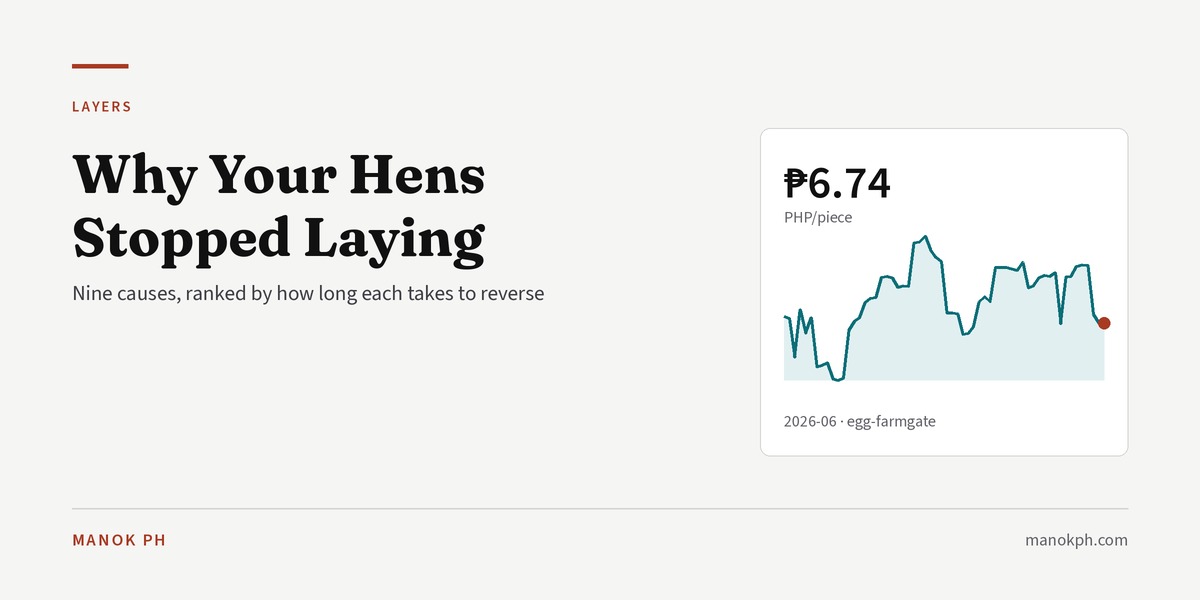
Twenty inahin running at a 70% hen-day rate is fourteen eggs a morning. At the June 2026 household egg farmgate of ₱6.74 a piece that is ₱94.36 a day, and across fourteen days it is ₱1,321.04. That is the gross, not the margin, and the hens eat either way.
Now set that against the third column of the table at the top. Water costs about a fortnight to reverse and about a minute to check. Infectious bronchitis costs up to eight weeks and you cannot shorten it. Moult costs seven weeks and gives you back a smaller flock. Age costs everything and gives nothing back.
So the order is not a matter of taste and it is not about likelihood. Check in the order of what reverses fastest, because that is the order in which delay is most expensive relative to effort. The drinker, then the sack, then under the pugad at night, then the calendar of the flock, and only then the things you cannot undo. A keeper who works the list backwards, starting with age or with a light bulb, spends the two weeks and the ₱1,321.04 finding out the thing that was free to fix.
Ang huling bagay, at ito ang pinakamahirap tanggapin. There is no Philippine hen-day figure to tell you whether your flock is doing badly at all. G-1 in the gaps register has been open since this archive started, at wala pa ring naglalathala nito. Which means the question “is this normal?” cannot be answered from anything published, and the only honest comparison available to a Philippine keeper is the same coop a month ago.
Questions people actually ask
Why did my chickens stop laying eggs in the Philippines?
Almost never because the days got shorter. Manila sits at 14.6 degrees north, where the whole year swings 104 minutes of daylight, so the seasonal signal that stops a temperate flock barely exists here. The realistic causes, in rough order of how often they are missed, are age, an empty or hot drinker, a feed that is not a layer ration, external parasites and worms, heat, broodiness, moult, and disease. Check water first, because a dry afternoon is a two-week production event and it is the only cause on the list that is entirely yours.
How long does it take a hen to start laying again? Show the answer
It depends on what stopped her, and the spread is enormous. A flock deprived of water for a day or two recovers in about a fortnight, on the figures El Sabry et al. (2023) collect. Infectious bronchitis takes up to 8 weeks to return to normal, on the Merck Veterinary Manual. A moult can take a flock to zero and bring it back below where it was: a German on-farm study measured a Lohmann Brown flock at 89% before an induced moult and 65% seven weeks after it. Age reverses never.
Do chickens stop laying in the cold season in the Philippines? Show the answer
The Philippines has no photoperiod winter worth the name. Manila reaches its longest day at 13 hours 00 minutes in June and its shortest at 11 hours 16 minutes in December, and layer guides ask for 14 to 16 hours of light at peak production. So a Philippine backyard flock on natural light is below the recommended photoperiod in every month of the year, including June, and the amount it loses between September and December is 52 minutes. If your flock stopped in November, the calendar is not what did it.
Is my hen too old to lay? Show the answer
Hy-Line Brown publishes 93.6 to 98.5% hen-day production at its week-26 peak and 87.4 to 93.2% at week 60, so a standard flock loses about 6.2 percentage points across 34 weeks. That is roughly a fifth of a percentage point a week, and it is far too slow to be what you noticed this morning. A sudden stop is not age. A slow fade over months, in a flock past its second year, probably is.
Can the wrong feed stop a hen from laying? Show the answer
Yes, and calcium is the usual mechanism. Hy-Line Brown specifies 0.90 to 1.05% calcium in its rearing diets and 3.33 to 4.70% in its laying diets, so a layer fed a grower ration is short by a factor of 3.17 to 5.22. Merck, citing NRC, puts a brown-egg layer at 4.00% calcium and 18.0% crude protein. A hen short of calcium lays thin-shelled eggs first and fewer eggs after.