Chicken Feeds in the Philippines: Starter, Grower, Finisher
The short answer
Walang naglalathala ng presyo ng sako sa Pilipinas. What is published is fifteen feed ingredients, weekly, priced by BAI; the starter, grower and finisher tiers, keyed to a bird’s growth stages by a 2008 issuance; and 24,120 registered feed products carrying no price at all. The switching day and the sack price are both your dealer’s to tell you.
Source BAI: Weekly Prices of Livestock, Poultry and Feed Ingredients, week of 13 July 2026 (read on August 13, 2026)
Feeds is the largest recurring cost in any Philippine flock, and this country does not publish its price.
Not the Bureau of Animal Industry, not PSA, not the millers. I have been through them one at a time: BAI’s own weekly report category, USDA GAIN, PIDS, LGU procurement postings, and the corporate sites of B-MEG, Vitarich and Pilmico. Walang sako. It is logged here as gap G-15 in the gaps register and it is the single largest hole in Philippine poultry data.
What a keeper can actually check turns out to be a longer list than the missing price makes it look:
- What is in the sack costs money at wholesale, and BAI publishes 15 of those ingredients every week.
- What the sack must tell you is set by law, down to the minimum crude protein, and the tiers are named in a BAI issuance.
- What is legally allowed on the shelf is a 383-page public register with 2,453 chicken products in it.
- How much a bird eats is published by both breed companies, day by day.
- What that adds up to is arithmetic on your own dealer’s quote, which is the one number only you can get.
None of those is the sack price. Together they are enough to know whether the presyo you were quoted this morning is reasonable, at iyon naman talaga ang tanong.
Fifteen ingredients, every week, since January 2023
The Bureau of Animal Industry publishes wholesale prices in pesos per kilo for feed ingredients, weekly, and this archive carries 109 of those vintages running from 20 January 2023 to 13 July 2026. It is the only official Philippine series for feed ingredient prices that exists.
Here is the current week, all fifteen on one page.
| Ingredient, week of 13 July 2026 | Wholesale ₱/kg |
|---|---|
| Copra meal | ₱14.60 |
| Molasses | ₱17.85 |
| Rice bran D1, the darak | ₱21.50 |
| Feedwheat | ₱21.25 |
| Pollard, hard | ₱22.30 |
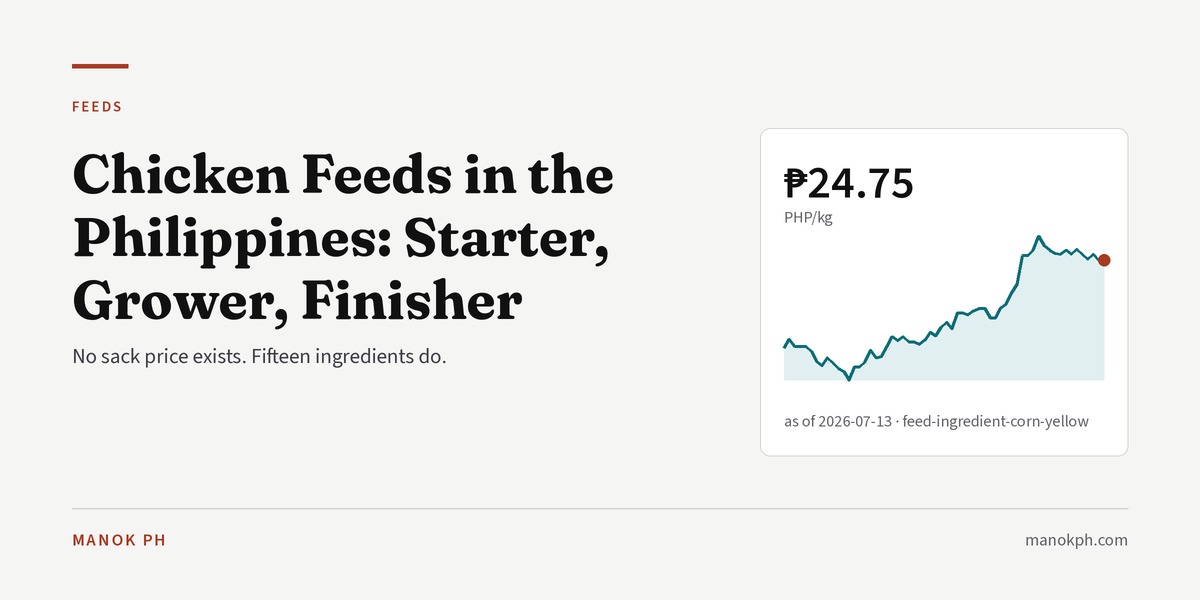
| Yellow corn | ₱24.75 |
| DDGS | ₱25.75 |
| Soybean meal, US | ₱29.38 |
| Soybean meal, full fat | ₱46.40 |
| Palm olein | ₱87.30 |
| Crude palm oil | ₱82.80 |
| Coco oil | ₱106.00 |
Every row: BAI feed ingredient series, week of 13 July 2026, wholesale pesos per kilo.
Three more series are still printed in that same report and carry N/A in every column, so they are not in the table above with the current week’s date on them: soybean meal from Argentina, last printed 20 October 2025 at ₱27.10; feedwheat others, last printed 12 August 2024 at ₱18.50; and local fishmeal, last printed 18 May 2026 at ₱93.00. All three are still on the group page with their own dates attached. Datos pa rin ang lumang numero basta may petsa. Walang petsa, walang datos.
One thing about the freshness of that week, because it is not what a weekly series implies. The report carrying it, BAI’s number 756, has a document date of 5 August 2026, so the newest figures on this page were published 23 days after the week they describe. And nothing has followed them: as of 15 August 2026 the week of 13 July is still the last one BAI has put out. The cadence of that record, holes and all, is a separate question with its own page.
Say clearly what this table is not. It is wholesale raw material. A sack of finished feed is a formula, plus milling, plus the bag, plus a margin at every hand it passes through, and not one of those four is published anywhere. You cannot add these rows up and get a sack price. Anybody who tries is inventing three numbers to explain one.
The oils nearly doubled. The protein meals went both ways.
Run the same fifteen series from their first week to their last and the pattern is not the one most keepers expect.
| Ingredient | Jan 2023 | Jul 2026 | Change |
|---|---|---|---|
| Coco oil | ₱55.50 | ₱106.00 | +91.0% |
| Local fishmeal (to May 2026) | ₱62.00 | ₱93.00 | +50.0% |
| Crude palm oil | ₱56.00 | ₱82.80 | +47.9% |
| Palm olein | ₱63.25 | ₱87.30 | +38.0% |
| Yellow corn | ₱23.00 | ₱24.75 | +7.6% |
| Rice bran D1 | ₱24.00 | ₱21.50 | -10.4% |
| Feedwheat | ₱24.75 | ₱21.25 | -14.1% |
| Copra meal | ₱18.10 | ₱14.60 | -19.3% |
| Soybean meal, US | ₱38.75 | ₱29.38 | -24.2% |
Every row: BAI feed ingredient series, week of 20 January 2023 against week of 13 July 2026.
Every oil and fat went up, several of them hard. The plant proteins went the other way, soybean meal by nearly a quarter and copra meal by a fifth, and so did the two mill by-products. But local fishmeal, the one animal protein on the board, is +50.0%, so it moved with the oils and not with the meals it competes against. Corn went up too, modestly. That is three and a half years of official weekly monitoring saying something quite specific, at hindi ko ito nakitang naisulat kahit saan.
Neither PSA nor BAI publishes a cause for any of it, so what follows is what those movements mean at a dealer’s counter rather than why they happened.
Ang pangunahing sangkap ng feeds ay mais at soybean meal, and those two have not moved together. Soybean meal is a quarter cheaper than it was in January 2023 and yellow corn is 7.6% dearer, so between them the largest share of the sack sits roughly where it did three and a half years ago. If your sako has climbed steadily through those same years, the raw material side is not the whole explanation, at may karapatan kang magtanong kung ano pa ang nasa loob ng presyo. Milling and fuel and packaging and margin are all real, and none of them are published. Kaya may laman ang tanong sa dealer mo ngayong linggo.
The other reading is for anybody mixing their own. Copra meal at ₱14.60 and darak at ₱21.50 are the two cheapest local ingredients on the board and always have been, which is exactly why bakuran feeding in this country has been built on them for generations. Their relative advantage got bigger, not smaller.
Corn and soybean meal are most of the sack, and one of them is 99% imported
The composition no Philippine agency publishes turns out to be published by an American one. USDA’s Manila post prints a major feed composition table in its 2026 oilseeds annual, and it puts a Philippine broiler ration at 50 to 60% corn and 25 to 30% soybean meal (USDA FAS GAIN RP2026-0011, Table 14, p. 18). Between 75 and 90% of the weight in a sako is two ingredients BAI already prices every week, on the group page.
That is the bridge between the table above and the bag on your shoulder, and it is a share of weight rather than a share of price. Milling, the bag, hauling and every margin between the mill and your barangay still sit in between, so the two rows explain the direction of a sack price and never its level.
Magkaiba ang pinanggagalingan ng dalawang sangkap na iyon, at doon din nagkakaiba ang kilos ng presyo nila.
Corn is largely grown here. USDA puts MY2025/26 production at 8,270 thousand metric tons against imports of 1,950, rising toward 2,000 the year after. Of the 10,150 thousand tons the country consumes, feed and residual takes 5,750, which is 56.7% (Grain and Feed Annual RP2026-0007, Table 7, p. 15). That share is the reason a corn harvest and a feed sack move together: most of the corn in this country is already going to animals, so anything that shortens the crop reaches the sack before it reaches a dinner table. Those volumes are PSA’s own, relayed by USDA, and that is how they are cited here: the PSA site answers a browser and returns 403 to anything else, so this page read them in the American document. What does come in arrives from Brazil at 42%, Vietnam and Argentina at 19% each and Myanmar at 18%, with the United States under 1% (Fig 12, p. 19).
Soybean meal is a different story entirely. Imports ran 3,255 thousand metric tons against 22 thousand tons made here, which is 99.3% imported, and USDA notes that the output of the country’s lone soybean crusher is used internally (Table 10, p. 16, and p. 18). Of the 2025 import volume, 95% came from the United States (Fig 3, p. 19). Ang mais sa sako mo ay tanim dito. Ang soybean meal ay galing sa labas, halos lahat, kaya presyo ng ibang bansa ang binabayaran mo doon.
Duty rates decide part of what that costs, and both are already written down. Soybean oilcake under HS 2304 enters at 0% through 2028 under Executive Order 62 (2024) (p. 20). Yellow corn sits at 5% in-quota and 15% out-of-quota under the same order, with a minimum access volume of 216,940 metric tons, and on 1 January 2029 those two rates revert to 35% and 50% (Grain and Feed Annual, Table 8, p. 20). Isulat mo iyang petsa sa kalendaryo mo. A tariff step of that size on the single largest ingredient in the ration is exactly the kind of thing that moves a sack price, and it is scheduled rather than speculative.
The demand chasing all of it is not small. Philippine feed production ran 12.36 million metric tons in CY2024 with broiler feed at 4.06 million of that (Table 12, p. 17).
One boundary on all of the above. That composition is a commercial broiler ration, so it describes the sack a broiler keeper buys and not what a scavenging bird in the bakuran actually eats. A native flock on kitchen scraps, darak and whatever it finds in the yard is on a different diet entirely, and what one of those birds eats between hatching and market age is gap G-19, narrowed this month but not closed.
What the price movement does not tell you
Three limits on that table, and they matter more than the percentages.
Wholesale is not what you pay. The BAI figure is the level feed millers and traders trade at. A backyard keeper buying a sack of darak at the local store pays above it, and nobody publishes the spread. Same structural problem as the day-old chick price, where the monitored ₱33.50 per head is integrator level and the dealer counter is higher.
National is not your province. Every figure here is one national number a week. Regional spread on input prices is gap G-7 in the gaps register, and it is logged partial rather than open, which is a distinction worth carrying: BAI publishes these 15 ingredients and the day-old chick price as single national figures with no regional split, while PSA does give all 18 regions for farmgate. The output side has a geography. The side you buy on does not.
Ingredients are not brands. Whether B-MEG, Sarimanok or Vitarich passed any of these movements on to their sack price, and when, is gap G-3. It cannot be answered from this table or from anywhere else.
Those three gaps are why the rest of this article is a method rather than a number. A method survives the next PSA release. Ang presyong tinandaan mo ay luma na sa linggo pagkatapos mong tandaan.
Starter, grower, finisher: read the sack
The three-tier feeding programme is real trade practice and every Philippine feed brand sells it. It is also, in part, regulation, and that is the half most guides on this subject get wrong.
The tiers exist in a BAI issuance, keyed to the stages of a bird’s growth. The minimum crude protein of the bag in front of you is a legal declaration printed on its label. The switching day is the miller’s own call, and no Philippine issuance sets one. B-MEG and Vitarich each publish their own feeding programme, and the day they tell you to move from starter to grower is not the same day across the brands. Hindi ko po masasagot iyon para sa iyo, at hindi rin kaya ng kahit anong pahina sa internet. Nasa tag ng sako mo ang araw na iyon, at doon lang.
Two things about that drawing. The cuts carry a question mark rather than a day number, at hindi iyon kakulangan sa pananaliksik: it is the state of the record, and the drawing declines to invent the day. And there is no peso anywhere in it, kasi bilang ng sako lang iyon at hindi pa resibo.
The next section is why reading the sack is worth the trouble. The sack in front of you is legally obliged to declare several of the things nobody else publishes about it.
Two practical consequences. Get three quotes from your dealer, not one: starter, grower and finisher are three products at three prices, and a batch buys all three. And write the sack weight beside each, kasi may 25 kg at may 50 kg sa merkado.
Take ₱950 for a 25 kg sack against ₱1,850 for a 50 kg one. Both figures are illustrative and neither is observed, because nobody publishes a sack price to observe; they are here to be divided. Magkalayong-magkalayo ang tingin sa dalawa habang buo pa, halos doble ang agwat. Hatiin mo sila sa bigat ng sako at doon lalabas ang totoo: they land at ₱38.00 and ₱37.00, 2.7% apart, which is the same feed at nearly the same price.
The division is the only thing that tells you that, and skipping it is where the money goes. Read a 50 kg quote onto a 25 kg sack and your feed cost per kilo halves on paper while doubling at the counter. Convert once to pesos per kilo and stay there. That is the most common arithmetic error in Philippine backyard poultry and it is entirely avoidable.
What the law makes the sack tell you
Republic Act 1556, the Livestock and Poultry Feeds Act, is an old statute and it is still the one in force. Its section 5(2) says every container of commercial feed shall bear a tag, and it sets out what that tag has to certify (RA 1556 as amended, § 5). Eight things, and you can hold the list against a sack in a store.
| Crude protein | Minimum percentageA floor the miller is bound to, not a target and not a typical value |
|---|---|
| Crude fat | Minimum percentage |
| Crude fibre | Maximum percentage |
| Ash | Maximum percentage |
| Moisture | Maximum percentageWater, bought by the kilo like everything else in the sack |
| Ingredients | The official name of every one of them |
| Registration number | Present, or the feed is unlawful to sell§ 4 bans the manufacture, import, advertising and sale of an unregistered feed outright |
| Batch number | With its date of manufactureThe only line on the tag that tells you how old the sack is |
Section 2 puts the Bureau of Animal Industry in charge of the whole arrangement. Nasa tag po iyan, hindi sa patalastas at hindi sa sinabi ng tindera, kaya doon ka tumingin.
Which changes what the protein figure on the sako is. It is not marketing copy. It is a minimum declared to a regulator, on a product carrying a registration number, in a batch carrying a date, and a bag that arrives with no tag and no number is not a cheaper version of the same thing. Hindi iyon murang feeds. Feeds iyon na walang pananagutan.
The tiers come from the newer issuance. BAI Administrative Order No. 01, series of 2008, the Revised Nutrient Standards for Animal Feeds, states at § 4.1 that all commercial feeds to be manufactured, distributed and sold shall comply with the nutrient standard, and § 2.16 defines those standards as keyed to “the different stages of growth of animals” (AO 01, s. 2008, published in the National Administrative Register Vol. 19 No. 1; the e-library host serves an incomplete certificate chain, so a plain fetch of that link fails and it wants a browser). Starter, grower and finisher are that one sentence in commercial form.
Then § 4.2 routes the actual numbers to Annexes 1 through 5, and the AO’s own annexes have still not been located. What is published is a table one step removed from them, and this page said for four months that no such table existed. It does. PNS/BAFS 382:2024 carries at Annex A a table titled Nutrient standards for Chicken (Broiler and Layer), under an annex heading that credits “Nutrient standards per species (DA-BAI, 2008; PHILSAN, 2010)”. Chick booster reads 21.50% crude protein NLT, broiler starter 19.50%, broiler finisher 18.00%, layer No.1 17.00% and layer No.2 15.50%.
Read what that document is before you hold a sack against it. Annex A is marked (Informative), not normative. It sits inside a standard whose § 1 scope is organic feeds, which is not the ordinary sako sa agrivet. It carries no ash column, so the maximum ash the tag declares under § 5(2)(g) still has nothing to be checked against. There is no backyard, no native and no free-range row anywhere in it, only commercial broiler and egg-type layer phases. And its own footnote says crude protein “can go lower than the standard if formulation is based on digestible amino acids”, which makes the floor conditional rather than flat. Nor is it a certified reprint: nothing in the PDF says it reproduces Annexes 1 through 5, and PHILSAN, 2010 does not appear in the bibliography at all, so which rows came from the Bureau and which from the nutritionists’ society cannot be told apart from inside the document.
So gap G-20 in the gaps register narrows rather than closes, and it is still a different shape from most of what sits alongside it. G-15 is a price nobody collects. G-20 was a legal standard that exists, binds every sack in the country, and could not be read; what is left of it is the AO’s own annexes and the ash floor. Nabasa mo na ngayon ang tier, hindi pa ang buong sukat.
The figures that circulate on Scribd and Studocu, 21% crude protein for chick booster and 19% for broiler starter, still have no primary document attached, and they are still not what this page prints. Annex A reads 21.50 and 19.50. Those are different numbers from a file anybody can download, which is the whole distinction this section is about. Closing what remains of G-20 needs one Freedom of Information request to BAI’s Animal Feeds, Veterinary Drugs and Biologics Control Division rather than a survey or a trial.
One more date is worth carrying out of the AO. Section 3.9 makes a feed registration expire every 31 December, so registration is annual and a product listed in March is not automatically listed the following January. Walang serye rito sa archive na ito. Batas ito, at hindi lahat ng mahalaga ay may presyo.
Twenty-four thousand registered products, and not one published price
Because registration is compulsory, BAI publishes what is registered, and the resulting document is the most complete public picture of the Philippine feed market that exists. Registered Feed Products as of March 2026 runs to 383 pages and carries a document date of 1 April 2026 (BAI).
Counted out of it here, one row per validity date: 24,120 registered products, every one valid to 31 December 2026, which is § 3.9 doing its work. 2,453 of them carry the sub-classification “Poultry Feeds (Chicken)”, or 10.2% of the register, and they come from 109 distinct companies under 214 distinct brand strings. Those are this site’s counts made from BAI’s document. BAI publishes the list; it does not publish the totals.
| Brand string, chicken feeds | Registered products |
|---|---|
| Sarimanok | 223 |
| B-Meg Essential | 192 |
| B-Meg | 78 |
| B-Meg Integra | 64 |
| Vitarich Premium | 55 |
Counted on this site from BAI, Registered Feed Products as of March 2026, rows sub-classified “Poultry Feeds (Chicken)”.
B-Meg’s three strings come to 334 between them, more than any single brand name on the list. Sorted by registrant instead of brand, UNAHCO leads at 272, then San Miguel Foods at 191, Foremost at 121 and Vitarich at 80, with Cargill appearing under three separate registrant names at 165, 97 and 83, and Pilmico under two at 81 and 78.
Two brand names are worth checking against that same list. Thunderbird has one registered chicken product. Santeh has six. Both get named in Philippine feed conversations as though they stood beside B-MEG and Vitarich on the chicken shelf, and by registration count they do not stand anywhere near it. Kung ang tatak sa sako mo ay wala sa listahan, magtanong ka bago ka bumili.
The tier names are in there too, as registered product names rather than as a standard:
| Tier name as registered | Chicken products |
|---|---|
| Chick Booster | 203 |
| Broiler Starter | 165 |
| Chick Starter | 149 |
| Broiler Finisher | 141 |
| Chick Grower | 120 |
| Pullet Developer | 82 |
| Broiler Grower | 70 |
Same source and same count method as the brand table above. “Layer” appears in 679 of the chicken product names, more than any broiler tier by a distance, which tells you which bird this industry registers feed for and nothing at all about which bird is worth keeping in a bakuran.
Broiler starter registrations outrun broiler grower registrations better than two to one. The register counts products rather than sacks sold, so that ratio describes what mills chose to register and not what anybody bought.
And the thing that is not on any of the 383 pages: a price. No ceiling, no suggested retail, no range, not once. Every product is named, classified, numbered, dated and tied to a company, and none of them is priced. Gap G-15 checked at a fresh government surface and still open. Ito na ang pinakamalapit na listahan sa totoong merkado ng feeds, at wala pa rin doon ang presyo.
How much a bird actually eats
Both breed companies publish cumulative feed intake per living bird, day by day, and they disagree with each other.
| Day | Ross 308 AP | Cobb500 |
|---|---|---|
| 21 | 1,167 g | 1,320 g |
| 28 | 2,083 g | 2,359 g |
| 35 | 3,268 g | 3,635 g |
| 42 | 4,674 g | 5,100 g |
Sources: Aviagen Ross 308 AP Performance Objectives (2022) and Cobb500 Performance & Nutrition Supplement (2022). The two are kept apart rather than averaged, dahil ang average ng dalawang hindi magkasundo ay isang sagot na walang nagsabi.
At an illustrative ₱1,800 for a 50 kg sack, which is your number to replace, that is ₱117.65 of feed in one Ross bird to day 35 and ₱130.86 in one Cobb bird. The feed cost tool runs that across a range of sack prices so you can find your own row.
Per bird is not the only way to read that bill, and the other way is the more useful one. Charged against the kilo you actually sell rather than the head you raise, the feed cost stops moving with the harvest day altogether: the same figure comes out at day 28, day 35 and day 42, and what changes is how many sacks you have to buy before any of it comes back.
Datuin collected targets, not outcomes
Both of those tables describe a controlled house at a chosen temperature. Walang bakuran na ganoon. The correction usually reached for is a single survey of 55 commercial broiler farms, and what that survey actually asked is not what it gets quoted for.
The numbers everybody lifts from it are 1.50 to 1.83 feed conversion for open-sided housing on big birds, and 1.50 to 2.00 for lechon manok. Read at the document, they sit in Table 5 on page 66 under the heading “Broiler production performance targets of growers based on type of housing” (Datuin et al., 2022, pp. 57 to 69). Growers were asked what they were aiming at, and that is what the table holds.
Table 6 and the prose on page 65 then say what happened to the aims: 33% of growers said they meet their targets only sometimes or not at all. Poor chick quality, extreme weather, disease outbreaks and late delivery of inputs were the reasons they gave.
That is the stronger reading rather than the softer one. Real open-sided feed conversion sits at or above a target band whose top is 1.83, and a third of the growers holding that band miss it. Kapag may nagbanggit sa iyo ng ganitong numero, itanong mo kung sinukat ba iyon o target lang. Ross’s day-28 row is 1,657 g at a cumulative 1.257, which is the closest published row to the weight we actually harvest at, and against it 1.83 puts the feed bill 45.6% above the breed table. That is the figure the feed cost article runs too. You will also see this comparison made against 1.20, which returns a larger 52.5%, and this page made it that way until August 2026. The larger number was the wrong one: 1.20 is a rounding of Aviagen’s promise rather than a row in anything, and Ross does not reach it until about 1,375 g, lighter than either market class the survey defines.
Before borrowing anything else from that survey, know the group it describes. Of the 55 farms, 48 were contract growers and 7 were integrators, so the technical support and the feed both arrived from somebody else. Only those growers were split by housing, and the open-sided ones among them number 16. Their smallest size band is “5,000 and below” and exactly one farm sits in it, 6.25% of the group. The smallest commercial farm in the Philippine study that gets quoted at backyard keepers is still around 100 times a 50-bird batch. Kaya kung 20 o 50 manok lang ang alaga mo sa bakuran, wala kang kinatawan sa pag-aaral na iyon.
Their conditions are worth the same look: 68.75% of them on rice hull litter, 93.75% feeding by hand, 6 to 7 harvests a year. The same target table puts big birds out at 30 to 34 days with livability at 94 to 95%, and Philippine target liveweight at 1.6 to 1.7 kg where the same genetics abroad are taken to 2.1 to 2.5 kg. A bird sold lighter and younger is a different feed bill from the one the breed table is describing.
Nobody has published a Philippine backyard feed conversion figure at all, gap G-1 in the gaps register, still open. So the planning range for a bakuran flock sits above the breed table, probably above 1.83, and the only person who can close that for your flock is you.
What a sack has to cost before the batch stops working
This is the arithmetic worth carrying in your head, and it runs backwards from the price you sell at rather than forwards from the price you pay.
A broiler sold into the household farmgate series at its June 2026 reading of ₱150.31 per kilo liveweight, at 1.7 kg, brings in about ₱255 a bird. That is the household series and not the commercial one, and the two are far enough apart to change this sum. If your feed conversion is at the top of that target band, 1.83, that bird ate 3.11 kg of feed. Divide and you get the feed price at which the bird pays for its feed and nothing else at all, which is a floor no batch should ever approach.
The break-even tool does this properly across the whole Datuin target range rather than at one FCR, and it charges you for sisiw as well as feeds, which the paragraph above does not. The price a broiler has to fetch is the same arithmetic run from the other end. Use it with your own sack price rather than with mine. Ang punto lang dito ay ganito: kapag alam mo ang FCR mo at ang presyo mo kada kilo, ang presyo ng sako ay hindi na basta gastos, kundi isang linyang may hangganan.
What the ingredient table is genuinely good for
Two uses, and I want to be careful not to oversell either.
The first is a sanity check on a quote. You know from USDA which two rows carry three quarters or more of the weight, and both are on the group page with a weekly date on them. If corn and soybean meal have been flat and your sack has moved 15%, the movement came from somewhere else and it is a fair question to ask. Pick the window before you check, though: the year says one thing and the quarter says another.
The second is for the keepers already mixing their own. Copra meal, darak and pollard are the local ingredients, and the archive prices all three weekly. What the archive cannot give you is how much of each belongs in a mix, kasi walang published na Philippine inclusion limits para sa backyard formulation, and getting that wrong is not a small mistake in a bird that grows this fast. I am not going to publish an inclusion table I cannot cite, and what a home mix actually holds and where it stops sets out what can be cited instead: the ceilings that do exist, every one of them foreign, and the one sentence in the Philippine standard that mentions inclusion without putting a number next to it. What I can say here is that the price signal favours those ingredients more now than it did in 2023, and that this is the beginning of a question rather than an answer.
What to do this week
Three things, and the first one is the only one that cannot be skipped.
Walk to your dealer and get the presyo of a sack of starter, grower and finisher, with the sack weight and the date written beside each. Until you have done that you do not have a feed plan, you have the shape of one. Put those three numbers into the feed cost tool and the break-even tool, both of which ask you for that presyo rather than assuming one.
Then open the ingredient group page and look at corn and soybean meal against the date on your last receipt. You are not checking whether your dealer is honest. You are checking whether the story you have been told about why feeds went up is the story the official data tells, at magkaiba minsan ang dalawa.
And read the tag before you read the presyo. RA 1556 § 5(2) makes the sack certify eight things, and the two worth most at the counter are the two nobody looks at: the registration number, without which that feed is unlawful to sell at all, and the batch number with its date of manufacture, which is the only line on the bag that tells you how old it is. Neither costs anything to check. Neither appears on any price list either, not the agrivet’s and not BAI’s own 383 pages. The 50-bird batch cost shows what a feed figure changes, and raising broilers in the Philippines is the wider picture this sits inside. Every peso figure here lives in the price archive with its source and its date, which is the whole of what this country publishes about chicken prices, and downloads as CSV from the data page.
A registration expires every 31 December under § 3.9, so the number printed on that tag is a claim about this year and not a permanent property of the brand. Tanungin mo ang petsa ng batch bago mo tanungin ang tawad. Libre ang tanong na iyon, at nasa harap mo na ang sagot habang hawak mo pa ang sako.
Questions people actually ask
How much is a sack of chicken feed in the Philippines?
Nobody publishes it. There is no official Philippine series for finished feed at sack level, by brand or by tier. BAI, USDA GAIN, PIDS, LGU procurement postings and the manufacturers own sites were each checked. Any page quoting you a confident national figure is quoting a memory. Get your dealer price this week and write the date beside it.
What feed ingredients does the Philippines publish prices for? Show the answer
Fifteen, weekly, from the Bureau of Animal Industry: yellow corn, soybean meal from the US and Argentina, full-fat soybean meal, copra meal, rice bran D1, pollard, feedwheat, DDGS, molasses, local fishmeal, coco oil, crude palm oil and palm olein. All are wholesale pesos per kilo for raw material, not a sack price.
Have feed prices gone up in the Philippines? Show the answer
It depends entirely which ingredient. Between January 2023 and July 2026 soybean meal from the US fell 24.2% and copra meal fell 19.3%, while coco oil rose 91.0% and crude palm oil rose 47.9%. Yellow corn moved up 7.6%, and local fishmeal was up 50.0% before it stopped reporting in May 2026. The plant meals fell; the oils, the fats and the one animal protein rose.
How much feed does a broiler eat to day 35? Show the answer
3,268 grams per living bird for Ross 308 AP and 3,635 grams for Cobb500, on the breed companies own published objectives. Those are controlled-house targets. The one Philippine survey of commercial open-sided farms recorded grower feed conversion targets of 1.50 to 1.83 against the Ross 308 AP day-28 cumulative of 1.257, and a third of those growers said they meet their targets only sometimes or not at all, so a real bill runs above both.
What has to be printed on a sack of chicken feed in the Philippines? Show the answer
Republic Act 1556 section 5 requires every container of commercial feed to carry a tag certifying the minimum percentage of crude protein, the minimum crude fat, the maximum crude fibre, the maximum ash and the maximum moisture, plus the official name of each ingredient, the registration number, and the batch number with the date of manufacture. Manufacturing, importing, advertising or selling an unregistered feed is prohibited, and a feed registration expires every 31 December.
Which chicken feed brand has the most registered products in the Philippines? Show the answer
Counted from the Bureau of Animal Industry list of registered feed products as of March 2026: Sarimanok carries 223 chicken products under a single brand name, and B-Meg carries 334 across three brand strings (B-Meg Essential 192, B-Meg 78, B-Meg Integra 64). Vitarich Premium has 55. Registrations count products, not sacks sold, and no Philippine source publishes feed market share by brand.