Feed Prices: Is the Rise Real, or Is It Just Your Dealer?
Tumaas ba talaga ang feeds? The answer moves with the month you start counting from, and one ingredient in the official record shows how far it moves.
| Coco oil at BAI wholesale, ₱/kg | Change |
|---|---|
| Three and a half years, January 2023 against July 2026 | +91.0% |
| One year, week of 21 July 2025 against week of 13 July 2026 | -32.8% |
| One quarter, week of 13 April 2026 against week of 13 July 2026 | -15.3% |
One series, wholesale pesos per kilo, on the feed ingredient group page. The endpoints are ₱157.80 in BAI report 504, ₱125.15 in report 693 and ₱106.00 in report 756.
The long window belongs to the feeds pillar, which runs it against every other ingredient. Until somebody names the period, “did feeds go up” is a question with no answer in it.
There is no sack price to settle the argument either. Nobody publishes one nationally, gap G-15 in the gaps register, and nothing below closes it. What exists is 15 ingredient series from the Bureau of Animal Industry, weekly, in wholesale pesos per kilo of raw material.
Which window is your dealer talking about?
| Ingredient | 21 Jul 2025 | 13 Jul 2026 | Change |
|---|---|---|---|
| Pollard, hard | ₱12.55 | ₱22.30 | +77.7% |
| DDGS | ₱20.25 | ₱25.75 | +27.2% |
| Yellow corn | ₱19.75 | ₱24.75 | +25.3% |
| Rice bran D1, the darak | ₱17.50 | ₱21.50 | +22.9% |
| Soybean meal, US | ₱23.95 | ₱29.38 | +22.7% |
| Palm olein | ₱72.21 | ₱87.30 | +20.9% |
| Feedwheat | ₱18.60 | ₱21.25 | +14.2% |
| Soybean meal, full fat | ₱41.84 | ₱46.40 | +10.9% |
| Molasses | ₱16.20 | ₱17.85 | +10.2% |
| Copra meal | ₱15.00 | ₱14.60 | -2.7% |
| Coco oil | ₱157.80 | ₱106.00 | -32.8% |
Wholesale pesos per kilo. The 21 July 2025 column is BAI report 504; the 13 July 2026 column is report 756, which is also the newest week on the group page.
Nine of the eleven series carrying a reading on both dates went up. Hard pollard did it hardest, ₱12.55 to ₱22.30 a kilo at wholesale, 77.7% in twelve months. Mais at darak, ang dalawang pinakapamilyar sa kahit sinong nag-aalaga ng manok, are up 25.3% and 22.9% over the same twelve months.
A dealer describing the past year as mahal is describing something the official record also shows on the raw material side. Hindi ibig sabihin noon na sumunod ang sako niya sa galaw na iyon, at walang published na makakapagpatunay noon.
The year also does not split the board the way the longer stretch does. Measured from January 2023 the oils nearly double while the protein meals split, the plant meals down and local fishmeal up. Fishmeal is the exception that matters, +50.0% across that stretch, so the one animal protein in the BAI record moved with the oils rather than against the meals it competes with. Its own row stops in May 2026, which is a separate problem further down this page. Over these twelve months the grains, the by-products and both soybean meals climbed together, and palm olein climbed with them at +20.9%. Copra meal barely moved at -2.7%, and coco oil is the only large fall in the column.
Crude palm oil sits out of that table for lack of a reading in the week of 21 July 2025. It is the gappiest of the series still reporting, 83 rows against the 109 weekly vintages this archive held on 13 August 2026. Three others are missing because they stopped reporting altogether, which is the more dangerous kind of absence.
Two windows, one picture. Here are four of the rows a backyard ration is actually built out of, every BAI reading this archive holds, on one peso-per-kilo axis. The twelve-month column above is a climb for all four. Widen it to the whole record and two of them are lower than they started: rice bran D1 opened at ₱24.00 in January 2023 and reads ₱21.50, feedwheat opened at ₱24.75 and reads ₱21.25. Hard pollard is the line that shows why the window decides the answer. It fell to ₱9.00 a kilo in the week of 28 April 2025, less than half where it began, then climbed back past its own starting point. Pick the year and it is the fastest riser on the board. Pick the record and it is a recovery.
Axis starts at ₱5, not ₱0.
109 monthly observations from BAI: Weekly Prices of Livestock, Poultry and Feed Ingredients, as of 2023-01-20 to as of 2026-07-13. Pollard, hard starts at PHP 20.10 per kg in as of 2023-01-20 and ends at PHP 22.30 in as of 2026-07-13. Highest PHP 23.30 in as of 2026-06-22, lowest PHP 9.00 in as of 2025-04-28. Yellow corn starts at PHP 23.00 per kg in as of 2023-01-20 and ends at PHP 24.75 in as of 2026-07-13. Highest PHP 26.00 in as of 2026-04-20, lowest PHP 18.50 in as of 2025-05-05. Rice bran D1 starts at PHP 24.00 per kg in as of 2023-01-20 and ends at PHP 21.50 in as of 2026-07-13. Highest PHP 24.90 in as of 2023-01-27, lowest PHP 12.00 in as of 2025-04-28. Feedwheat starts at PHP 24.75 per kg in as of 2023-01-20 and ends at PHP 21.25 in as of 2026-07-13. Highest PHP 24.75 in as of 2023-01-20, lowest PHP 18.00 in as of 2024-09-23. No figure was published between as of 2024-03-15 and as of 2024-05-24. No figure was published between as of 2024-11-04 and as of 2025-01-27. No figure was published between as of 2025-03-03 and as of 2025-04-28. One period has no published figure: as of 2026-03-23. Every value, with its source, is on the Presyo page for each of these series.
See every observation on the Presyo pages →The four share an axis because they share a unit and an order of magnitude. Palm olein and coco oil are off it for the same reason they cannot honestly join it: at ₱87.30 and ₱106.00 a kilo in the same week they would press these four into a band at the bottom, and the distance between the four is the whole picture.
Did anything come down in the last three months?
Nine of the twelve series with a reading on both dates fell between the week of 13 April 2026 and the week of 13 July 2026.
| Ingredient | 13 Apr 2026 | 13 Jul 2026 | Change |
|---|---|---|---|
| Rice bran D1, the darak | ₱19.15 | ₱21.50 | +12.3% |
| Molasses | ₱16.05 | ₱17.85 | +11.2% |
| Pollard, hard | ₱21.00 | ₱22.30 | +6.2% |
| Crude palm oil | ₱84.15 | ₱82.80 | -1.6% |
| Yellow corn | ₱25.25 | ₱24.75 | -2.0% |
| Soybean meal, full fat | ₱47.50 | ₱46.40 | -2.3% |
| Palm olein | ₱89.80 | ₱87.30 | -2.8% |
| Soybean meal, US | ₱30.25 | ₱29.38 | -2.9% |
| DDGS | ₱26.75 | ₱25.75 | -3.7% |
| Feedwheat | ₱22.33 | ₱21.25 | -4.8% |
| Coco oil | ₱125.15 | ₱106.00 | -15.3% |
| Copra meal | ₱19.10 | ₱14.60 | -23.6% |
Wholesale pesos per kilo. The 13 April 2026 column is BAI report 693; the 13 July 2026 column is report 756, on the group page.
Copra meal is the row to check before you buy, kasi mas malayo at mas mabilis ang galaw nito kaysa sa mais. It went from ₱19.10 in the week of 13 April 2026 to ₱14.60 in the week of 13 July, per kilo at wholesale, -23.6%, the deepest fall on the board.
Corn barely moved over the same twelve weeks, ₱25.25 to ₱24.75 per kilo. Soybean meal of both origins slipped by under 3%. Darak went up 12.3%, molasses 11.2% and hard pollard 6.2%, kaya ang mga lokal na by-product ang umakyat habang kumakalma ang mga imported.
Local fishmeal is not in that table even though it read ₱93.00 per kilo at wholesale in the week of 13 April 2026. It stopped reporting inside the quarter, kaya wala itong kapareha sa kabilang dulo.
Two coconut rows fell in both windows, three mill by-products rose
Hard pollard, darak and molasses rose in the year and again in the quarter. Coco oil and copra meal fell in both. Only eleven of the 15 series carry a reading on all four anchor dates, so that is five rows out of eleven testable ones, not five out of 15.
The split runs along the mill each row comes out of. Darak comes off a rice mill, pollard off a flour mill, molasses off a sugar central, and what a Philippine mill turns out went up on both windows. Parehong niyog naman ang dalawang bumaba, ang langis at ang copra meal na natitira pagkatapos, at magkasabay silang gumalaw sa kahit aling window.
Which puts a keeper at the counter in a specific position. A dealer saying everything went up is usually right about the ingredients over the year, and usually wrong about them over the last three months. Hindi ito paratang. Isang tanong na may petsa.
The practical form of this is short enough to do standing up. Alamin mo muna kung kailan tumaas ang sako mo. Sunod na lang ang kung magkano. Then read the same ingredient across the weeks either side of that date rather than across a year, because weeks are the only resolution this record has. The group page carries the last twelve weeks, and the full weekly record downloads as CSV from the data page, so a check on an older week starts there.
What a match proves is less than it looks. Corn and soybean meal carry most of the weight in a commercial broiler formula, but how much of each is the miller’s own number and nobody publishes it, and whether a brand passed a raw material move into its sack price is gap G-3. A row that moved with your sack is consistent with the dealer’s story. It is never a confirmation of it.
Local fishmeal has not printed a price since 18 May 2026
Its last row reads ₱93.00 per kilo at wholesale, week of 18 May 2026, and nothing follows it. Copy that as a current figure and you are eight weeks behind the newest report in this archive.
Anybody pricing one protein source against another is doing it with one row where there were two. Soybean meal of Argentine origin last printed ₱27.10 per kilo in the week of 20 October 2025, nine months of nothing on a line that sits directly beside the US-origin row in the same report.
Here is the protein board week by week, the fourteen BAI reports from 13 April to 13 July 2026 with all three rows beside each other. The fishmeal column prints six times and then nothing for the eight weeks after 18 May. The Argentine column prints not once in the whole stretch. The US-origin column prints every week without a break. That line was already unsteady before it went quiet: ₱75.00 in the week of 11 May 2026, between two weeks at ₱93.00, kaya hindi rin matino ang huling figure na naiwan niya.
| Week | Local fishmeal | Soybean meal, Argentina | Soybean meal, US |
|---|---|---|---|
| April 13, 2026 | ₱93.00/kg | not published | ₱30.25/kg |
| April 20, 2026 | ₱93.00/kg | not published | ₱30.10/kg |
| April 27, 2026 | ₱93.00/kg | not published | ₱30.50/kg |
| May 4, 2026 | ₱93.00/kg | not published | ₱30.35/kg |
| May 11, 2026 | ₱75.00/kg | not published | ₱30.63/kg |
| May 18, 2026 | ₱93.00/kg | not published | ₱30.48/kg |
| May 25, 2026 | not published | not published | ₱29.88/kg |
| June 1, 2026 | not published | not published | ₱29.88/kg |
| June 8, 2026 | not published | not published | ₱29.25/kg |
| June 15, 2026 | not published | not published | ₱28.50/kg |
| June 22, 2026 | not published | not published | ₱28.88/kg |
| June 29, 2026 | not published | not published | ₱28.88/kg |
| July 6, 2026 | not published | not published | ₱24.25/kg |
| July 13, 2026 | not published | not published | ₱29.38/kg |
Wholesale pesos per kilo, national, from the BAI weekly report. A cell that says the figure was not published is a row the report carried with nothing in it, which is not the same as a row that was taken out. Every week's source and read-date sits on the feed ingredient group page linked above.
Feedwheat others stopped earlier still, at ₱18.50 per kilo in the week of 12 August 2024. Old enough that anyone quoting it is quoting from before the one-year comparison above begins. Eleven rows out of 15 is what that comparison can be built from at this vintage, and a fourth going dark would thin it again. A row that stops is not replaced. It just leaves less to compare.
Basahin mo ang petsa sa hilera mismo at huwag ang nasa cover ng report. None of the three is deleted from the file, and that is the trap: they sit in the same report as the rows that did print, in the same column, in the same order they have always been in.
May pangalawa pang dapat malaman bago ka kumopya ng row. BAI printed two different “This Week” prices for local fishmeal in 13 separate weeks, and printed ₱0.00 for crude palm oil in 2 more, reports 262 and 263 in September and October 2024. All of them arrive in this archive as blanks rather than as numbers.
Two weeks in five are missing from what this archive holds
Between 20 January 2023 and 13 July 2026 there are 182 weeks. This archive holds 109 BAI vintages inside them, read on 13 August 2026, which is 59.9% of the weeks in the record’s own range. That is the archive’s count of what it has, not a statement BAI makes about its own coverage. Whether a week is missing because BAI never published it or because this archive has not found it is not something either of us can tell from here, so the count is stated as what it is.
The year comparison at the top of this page anchors on 21 July 2025 for a reason that has nothing to do with analysis: there is no reading at all between 9 June and 21 July 2025, a 42-day hole, so that is simply the nearest week with data. Kung may linggo doon na may datos, iyon sana ang ginamit. Holes that long have happened repeatedly, and the longest ran 84 days, from November 2024 into January 2025.
Since 5 January 2026 the record has run unbroken, 28 consecutive weekly vintages to the week of 13 July 2026 on the same archive count read on 13 August 2026. A comparison anchored inside that run does not have to hunt for the nearest week with data.
Bago mo gamitin ang buwanang average galing dito, tingnan mo kung ilang linggo ang nasa likod nito. It can be four weeks, or three, or one, depending which month it is.
No arithmetic on these rows gets you a sack price
A sack of finished feed is a formula that its maker does not publish, plus milling, plus the bag, plus hauling, plus a margin at every hand between the mill and your barangay. Eight routes to a Philippine sack price were checked on 13 August 2026, and two came back with a published, dated peso figure at sack-equivalent level: a provincial tender ceiling, which authorises spending up to an amount nobody had yet spent, and a per-ton figure for 2018 quoted inside an argument about corn tariffs. Neither is a record of a transaction. The other six held no sack price at all, only ingredient and commodity charts, catalogues with the price left off, undated marketplace listings, and blog numbers with nothing under them. Route by route is a page of its own, and G-15 is still open in the gaps register. Adding these rows together would produce a number that looks like a sack price and answers to nothing.
Both of the pillar’s further limits apply here. These are wholesale prices, not what the agrivet charges per sako, and nobody publishes the spread. Every figure is also one national number a week, the same limitation the day-old chick series carries, logged as gap G-7 in the gaps register.
The feed cost tool takes the quote you get from your own dealer, kasi sa iyo lang manggagaling ang numerong iyon.
The rows to carry to the counter
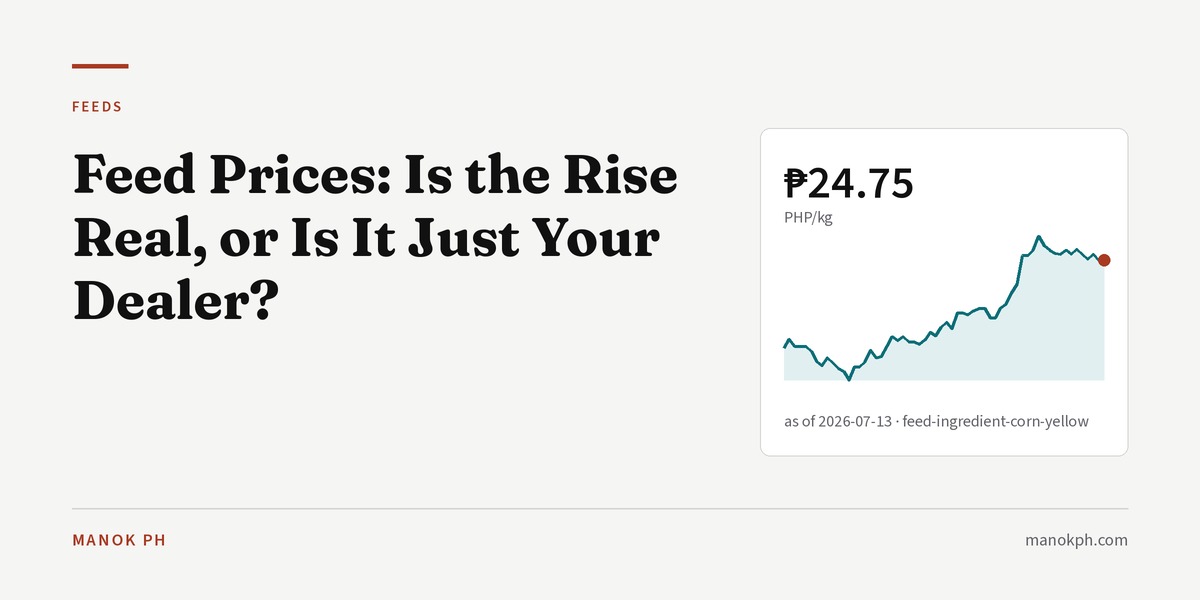
Yellow corn read ₱24.75 a kilo at wholesale and soybean meal of US origin ₱29.38 in the week of 13 July 2026, the newest week in this record (BAI report 756). Those are the two rows to have in your head when a new sack price gets quoted at you.
Heto ang mais na hilera mismo, carrying the report it came out of and the day this archive read it. Neither of those two things fits inside a bold figure in the middle of a sentence, and both are what a dealer’s quote gets checked against.
Yellow corn, BAI wholesale, national
₱24.75/kg
BAI: Weekly Prices of Livestock, Poultry and Feed Ingredients (read on 2026-08-13)
Kung ikaw mismo ang naghahalo sa bakuran, darak at copra meal ang bantayan mo. Rice bran D1 read ₱21.50 a kilo in that same week and copra meal ₱14.60, one up 12.3% across the quarter and the other down 23.6%.
Neither pair settles what the sako should cost. All four are raw material at wholesale, and what a mill did with them between the silo and your dealer’s price list is written down nowhere. Ang dala mo sa counter ay isang linggo na may numero, and a dealer who cannot say which week he means has not yet described a rise.
Cite this page
Every figure here carries the source it came from and the date it was read. If you use one, this is the line that says where it came from.
A backyard poultry keeper. "Feed Prices: Is the Rise Real, or Is It Just Your Dealer?". Manoknomics. Published August 22, 2026. https://manoknomics.com/articles/feed-price-rise-real-or-your-dealer
Select the text to copy it.
Questions people actually ask
How much is chicken feed in the Philippines right now?
No Philippine agency publishes the price of a sack of finished commercial feed, by brand or by tier. What the Bureau of Animal Industry publishes weekly is the wholesale price of the raw materials: yellow corn at ₱24.75 per kilo and soybean meal of US origin at ₱29.38 per kilo in the week of 13 July 2026. Those are raw material at wholesale, not a sack. The only sack price that exists is the one your dealer quotes you, so get it this week and write the date and the sack weight beside it.
Did feed prices go up in the Philippines? Show the answer
Over twelve months, yes for most of the raw material. Hard pollard ran from ₱12.55 a kilo in the week of 21 July 2025 to ₱22.30 in the week of 13 July 2026, +77.7% and the largest one-year move in the Bureau of Animal Industry record, with DDGS at +27.2% and yellow corn at +25.3% behind it. Nine of the eleven series carrying a reading on both dates rose. Measure from the week of 13 April 2026 instead and the direction flips: copra meal is down 23.6%, coco oil down 15.3%, and nine of the twelve series with a reading on both of those dates fell. All of it is wholesale raw material in pesos per kilo.
Why did my feed dealer raise prices? Show the answer
Nothing published in the Philippines can answer that for a specific sack, because the pass-through from raw material to a branded sack price is not published by anyone. The Bureau of Animal Industry prices 15 feed ingredients every week in wholesale pesos per kilo, so a keeper can see whether corn, soybean meal and rice bran moved during the period the dealer is talking about. Whether a mill passed that movement into its own price list, and by how much, is not published by the mill, the dealer or any agency.
Where can I check feed ingredient prices in the Philippines? Show the answer
The Bureau of Animal Industry publishes a weekly report titled Weekly Prices of Livestock, Poultry and Feed Ingredients, listed at https://www.bai.gov.ph/Reports/GetSpecific?id=19. It carries 15 feed ingredients in wholesale pesos per kilo, including yellow corn, soybean meal, copra meal, rice bran D1, pollard, feedwheat, DDGS, molasses, coco oil and palm olein. Three of the 15 stopped at different times and are still printed in the file, so the report date on the cover is not the date of every row underneath it.