Homemade Feed: What Works and What Does Not
The short answer
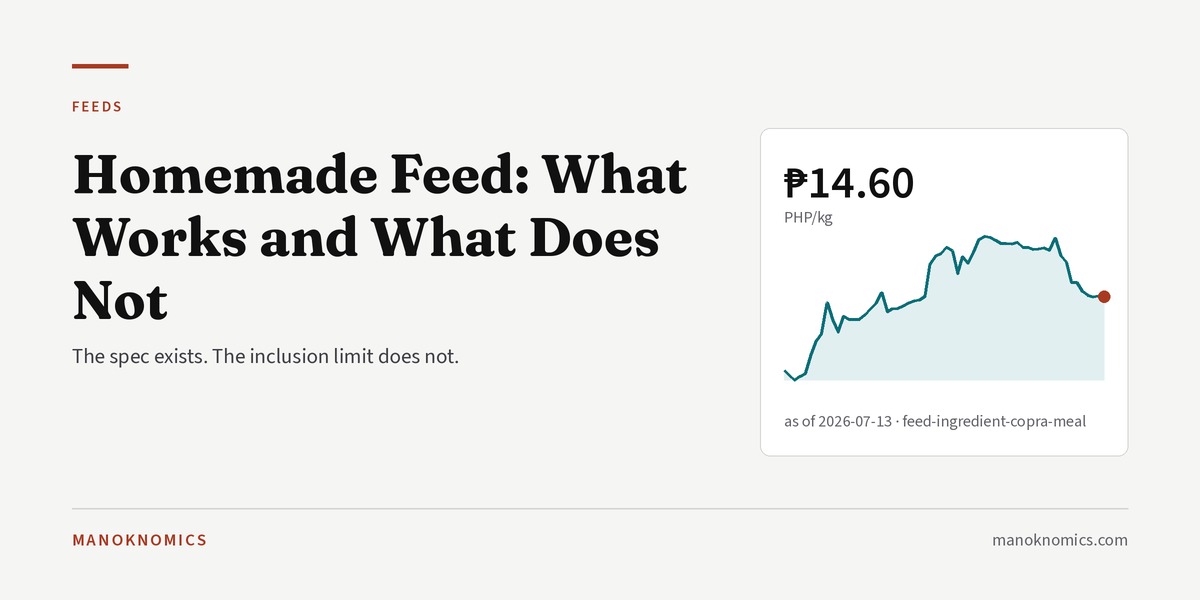
Copra meal works and is the biggest saving on the list: ₱14.60 per kilo against soybean meal at ₱29.38, BAI wholesale for the week of 13 July 2026. Darak works. Cassava works if you buy it to spec. Ipil-ipil and kitchen scraps are where a home mix stops being a formula. Ang mahirap dito ay hindi ang paghahalo, kundi ang alamin kung saan huminto.
Source BAI, weekly wholesale price of feed ingredients, Table 5, as of 13 July 2026 (read on August 22, 2026)
What each swap saves, and where it stops
Four substitutions carry most of the saving a bakuran mix can make, and every one of them has a ceiling that comes from somewhere other than a Philippine document. Ang tanong sa harap ng sako ay hindi kung mas mura, kundi kung hanggang saan.
| Swap | Price, 13 July 2026 | Published ceiling | Where the ceiling comes from |
|---|---|---|---|
| Copra meal for soybean meal | ₱14.60 vs ₱29.38 per kilo | 10% of a broiler diet, 5% for young birds | Feedipedia, from Daghir (2008) |
| Darak (Rice Bran D1) for corn | ₱21.50 vs ₱24.75 per kilo | about 15% full fat in broilers, under 10% in layers | Feedipedia, from Vieira and others |
| Cassava meal for corn | no BAI series | 30 to 50 percent of the corn | DOST-PCAARRD |
| Ipil-ipil leaf meal for protein meal | no BAI series | 5% broilers, 6% layers, about 15% roasted | Feedipedia |
Prices from the BAI feed ingredient series, wholesale, PHP per kilo, week of 13 July 2026. Ceilings from Feedipedia and DOST-PCAARRD.
Now the thing that column four is quietly telling you. PNS/BAFS 163:2015, the Philippine standard for animal feed ingredients, describes 126 numbered ingredients and gives most of them a purchase spec with real numbers on it. Across the whole document the word inclusion appears once. It is in section 5.4.5, on copra cake and meal, and it reads: “This is unpalatable at high inclusion rates and has imbalanced amino acid profile.” No percentage follows it.
So every ceiling in the table above was set abroad, by researchers working on other flocks, and imported here by people quoting each other. That is not a reason to ignore them. It is a reason to know that when somebody tells you 20% copra meal lang, they are not quoting anything Philippine, kasi walang Philippine number na sipiin.
Darak is two ingredients and the sack rarely says which
Rice bran is not one product, and the two grades are not close. Section 5.4.13 of PNS/BAFS 163:2015 covers Rice Bran D1, the cono grade. Section 5.4.14 covers Rice Bran D2, the kiskis grade. D2 carries more hull, at hindi kayang gamitin ng manok ang ipa.
| Spec | Rice Bran D1, cono | Rice Bran D2, kiskis |
|---|---|---|
| Crude protein | min 11.0% | min 9.0% |
| Crude fibre | max 7.0% | max 12.0% |
| Crude fat | min 12.0% | min 9.0% |
| Moisture | max 10.0% | max 12.0% |
| Weekly BAI price | ₱21.50 per kilo, 13 July 2026 | none published |
Both specs from sections 5.4.13 and 5.4.14 of the same standard; the price from the BAI feed ingredient series.
Half the weight of the DA-ATI Cordillera grower example is darak. At that share the choice between the two grades is worth 1.0 point of crude protein in the finished ration, before anything else in the mix has been argued about. Only D1 has a weekly BAI price, at ₱21.50 per kilo on 13 July 2026 against yellow corn at ₱24.75, so the swap saves ₱3.25 per kilo at wholesale (feed ingredient series). Kaya bago mo itanong ang presyo ng darak, itanong mo muna kung anong grado ito.
Two things about darak that the price does not show.
The first is that it is the ingredient that moved. BAI’s own year-on-year column puts Rice Bran D1 up 30.30% against the same week of 2025, while copra meal fell 1.02% and yellow corn rose 3.34% (BAI, 13 July 2026). A mix that leans on darak because darak is cheap is leaning on the line with the steepest recent slope, and whether a rise is real or local is a question worth asking before you commit a season to it. Ang mura ngayong buwan ay hindi laging mura sa susunod na taon, at ang darak ang patunay niyan.
The second is fresh weight. Rice bran carries a lipase that goes to work the moment the bran leaves the grain, and Feedipedia reports free fatty acid content climbing at about 1% per hour in unstabilised bran (rice bran and other rice by-products). Notice which grade that hurts more: D1 is the grade with the higher fat floor, min 12.0% against min 9.0%. The better darak is also the one with more to go rancid. Sariwa ang bilhin, at huwag mag-imbak ng sako para sa susunod na buwan.
Copra meal is the cheapest protein here and the one you can use least of
Copra meal is the biggest single saving available to a Philippine home mix and it is capped low. On 13 July 2026 it was ₱14.60 per kilo at BAI wholesale against ₱29.38 for soybean meal (US), a gap of ₱14.78 per kilo (feed ingredient series). Swap a tenth of the ration weight from one to the other and you save ₱73.90 on 50 kg of mix, before labour.
Then read what you bought. The standard gives copra cake and meal crude protein min 18.0% expeller and min 20.0% solvent, against min 43.0 to 46.0% for soybean oil meal. It is roughly half the protein per kilo, so a straight kilo-for-kilo swap is not a swap at all; you are trading protein for price and the finished ration has to absorb it somewhere. Kalahating protina kada kilo, kalahating presyo. Hindi libre ang palit na iyan.
Feedipedia’s poultry section carries the numbers the standard withholds: limit copra meal to 10% of the diet, with no more than 5% in the diets of young animals, on Daghir (2008), with more restrictive readings at 3% and 2%. Layers tolerate more, 15%, extended to 20% for good quality expeller copra meal. The reasons given are the ones PNS names without quantifying: the amino acid profile lacks lysine and the sulphur amino acids, and the energy value is low because the fibre is high.
That is the trap in the cheapest ingredient on the list. The saving is real, the ceiling is low, and pushing past the ceiling forces you to buy lysine and methionine, which is the one part of a ration nobody in this country publishes a price for. Doon uli napupunta ang natipid mo, at hindi mo iyon makikita sa timbangan.
Ipil-ipil, and the one number the standard puts on a poison
Here the Philippine standard does put a number on a plant toxin, and it is the strangest figure I found in the whole document. Section 5.2.2.3 gives ipil-ipil leaf meal a protein floor of min 20.0% and a fibre ceiling of max 14.0%, then caps mimosine at max 2 ppm (PNS/BAFS 163:2015).
Now the plant. Ghosh and Bandyopadhyay (2007), reviewing mimosine toxicity, report that in leucaena leaf meal and hay mimosine “varies from 1.02 to 5.56% of DM”, reaching up to 12% in the growing tips of the leaves and 3 to 5% in pods. One point zero two percent of dry matter is 10,200 ppm. Against a 2 ppm ceiling that is a factor of 5,100 at the bottom of the published range, and far more at the top.
I cannot reconcile those two numbers and I am not going to pretend to. Either the spec means something other than what it says, or no ipil-ipil leaf meal dried in a bakuran can meet the Philippine standard for ipil-ipil leaf meal. BAFS has published no note explaining it that I could find, and the same standard uses ppm sensibly elsewhere, capping histamine in fishmeal at max 500 ppm. It is not a stray unit.
What survives is the practical guidance, and it is foreign. Feedipedia gives 5% of a broiler diet, citing Natanman and others (1996), and 6% for laying hens on Sekhar and others (1998), rising to about 15% if the leaf meal is roasted. At that 5%, leaf meal at the PNS protein minimum contributes 1.0 point of crude protein to the ration. That is the whole nutritional case for it, and it is small. Isang puntos ng protina kapalit ng tanong na wala pang sagot. Sa akin, hindi sulit iyan.
Cassava is settled if you buy it and open if you dry it
Buying cassava meal to the Philippine spec closes the cyanide question almost completely. Section 5.1.4 caps hydrocyanic acid in peeled cassava meal at max 15.0 mg/kg and section 5.1.5 caps unpeeled at max 30.0 mg/kg. Tewe reports for FAO that poultry performance on cassava diets is satisfactory “as long as the total HCN content in the final ration does not exceed 100 ppm”. mg/kg and ppm are the same unit, so a ration made entirely of unpeeled meal at the ceiling would still sit 70 ppm under Tewe’s figure.
DOST-PCAARRD puts the practical share at about 30 to 50 percent of the corn, and adds two warnings worth more than the headline. Too much cassava, or too much processing, makes the mixed feed unpalatable. And using cassava raises the need for feed additives, whether amino acids or the vitamin and mineral mix. Kaya kung kamoteng kahoy ang papasok sa halo, may dalawang bagay na dapat sumabay dito, at parehong binibili.
The open half is the peelings drying on a sheet in your bakuran. Those carry no spec, no batch and no test. The cyanogenic glycosides are released when the plant tissue is crushed and exposed to beta-glucosidase, which is the Merck Veterinary Manual’s description of the mechanism, and Tewe’s own comparison is that sun drying loses more total cyanide than oven drying at 60°C because it is slower. Sun drying is on your side. It is still not a measurement.
There is also no BAI series for cassava meal or for ipil-ipil leaf meal. Table 5 lists fifteen ingredients, and neither is among them, so neither has a dated Philippine price on this site or anywhere else I could find. Wala rin akong maipapakitang presyo sa palengke para sa dalawang iyan.
Two of the four are toxicology questions, not feeding questions
- Mimosine and cyanogenic glycosides are plant toxins, and nothing on this page is a dose. Every figure above is a published inclusion ceiling or an ingredient spec, and neither is veterinary advice.
- The mismatch between the 2 ppm mimosine ceiling in the standard and the 1.02 to 5.56% of dry matter measured in leaf meal is unresolved here. Treat it as a reason to ask a licensed veterinarian before feeding ipil-ipil at all, not as a licence to guess a safe level.
- Never feed the young growing tips of ipil-ipil. Ghosh and Bandyopadhyay put mimosine there at up to 12% of dry matter, the highest concentration in the plant.
- If birds go off feed, salivate, breathe rapidly or show bright red mucous membranes after a ration change, stop the feed and call the LGU veterinarian or the municipal agriculture office. Merck gives death within about 2 hours of onset in cyanide poisoning.
This page is not veterinary advice. A bird that is sick needs somebody who can look at it.
Kitchen scraps are not an ingredient and the standard does not pretend they are
Scraps are the only input here with no spec at all. PNS/BAFS 163:2015 names 126 ingredients and none of them is table leftovers, so there is no crude protein figure, no moisture ceiling and no salt limit to work against. That is not an oversight in the standard. It is what an unformulatable input looks like. Walang spec, walang bilang, at walang paraan para ihalo ito nang may katiyakan.
The practical consequence is arithmetic rather than opinion. A ration is a weighted sum of ingredient specs, and one input with no spec makes the sum unsolvable no matter how carefully you weighed everything else. Scraps thin whatever the rest of the mix was aiming at, and by an amount nobody can state. So they belong where a scavenging bird already puts them, as forage on top of a ration rather than as a share of it. A native flock in the bakuran eats this way by default, and what one of those birds actually consumes between hatching and market age is still an open gap on this site. Pandagdag ang tira sa hapag, hindi bahagi ng timpla.
Salt is the specific thing to watch, because it is the one component of a Filipino kitchen that is concentrated rather than dilute, and the DA-ATI example adds only 1 kg of salt to a 200 kg batch. Rice water, tuyo trimmings and cooking liquid are not neutral. Sayang naman kung ang tirang ulam pa ang pumatay ng sisiw.
The five percent you cannot price, and the labour nobody counts
Every complete ration ends in a fraction that a bakuran cannot make and a Philippine price list does not carry: vitamin premix, limestone, dicalcium phosphate, DL-methionine and lysine. BAI’s Table 5 runs to fifteen ingredients and not one of them is any of those. Corn, three soybean meals, feedwheat, copra meal, DDGS, rice bran D1, pollard, molasses, local fishmeal and three oils. That is the list (week of 13 July 2026).
The DA-ATI Cordillera page does price its own version, and the shape of that pricing is the point. Its additives are ₱50.00 for 200 g of ACES Nutri-balancer and ₱6.00 for 1 kg of salt, plus ₱200 for 10 litres of concoctions. The balancer is a proprietary product from one named college, which is a supplier rather than a market, and there is no series behind it. Isang tindahan lang iyon, hindi isang presyo.
Then the line every tipid post leaves out. That same worked example charges ₱500 for 2 man days against a 200 kg batch, which is ₱2.50 per kilo of finished feed before you have bought anything. Against the illustrative ₱36.00 per kilo of a ₱1,800 sack, labour alone is about a fourteenth of what you were trying to beat. Whether that ₱2.50 is a real cost depends on what your afternoon is worth, and that is your call rather than mine. It is a cost that exists either way. Ilang oras ang isang hapon mo, at ilang sako ang kayang gawin doon?
One more caution on borrowing that page’s economics wholesale. Its own peso column charges ₱9.60 per kilo for the Rice Bran D1 that is half its batch, against BAI’s ₱21.50 on 13 July 2026. The leaflet carries no date on that column, so this is not a measured price change and I will not present it as one. What it does mean is that anyone costing a home mix straight off that table is working from a figure the price archive cannot support, and the ₱1,800 sack it would be compared against is itself an illustration, logged as gap G-15 in the gaps register rather than a published figure.
What actually works
Buy to the spec, not to the name. Ask for Rice Bran D1, min 11.0% crude protein and max 7.0% crude fibre, and take it fresh rather than stored. Take copra meal to a tenth of a broiler ration and no further, and less than that for sisiw. Treat cassava meal as a corn substitute up to about half the corn, bought rather than dried at home. Leave ipil-ipil alone until somebody explains the 2 ppm line, and leave scraps out of the arithmetic entirely. Apat na desisyon iyan, at nasa label ng sako ang tatlo sa kanila.
What a home mix actually buys you is the two cheap ingredients, at a wholesale price you probably will not get, minus your own labour, minus a premix fraction you cannot quote. Whether that is worth it is a real question with a real answer, and the answer changes with the sack price you are actually offered. What a sack costs across brands and tiers is the number to put on the other side of it, and the feeds pillar has the rest of the picture: what is in a commercial sack, what the law makes it tell you, and how much a bird eats. If you already buy sacks, the same feed bill charged against the kilo you sell is the more useful reading of it, and a 50-bird batch shows what one peso of feed price does to a whole cycle.
Ang totoo, ang pinakamalaking bilang sa page na ito ay hindi presyo. It is 5,100, and it sits between a national standard and the leaf growing in half the barangays in this country.
Work it out for your own flock
Magkano ang feeds to get a broiler to market? Open the calculator
It costs finished sacks rather than ingredients: your own quote per sack, then sacks and pesos to the day you sell. Put your home mix in at whatever it really costs you per 50 kg and the kilo count does not move.
Cite this page
Every figure here carries the source it came from and the date it was read. If you use one, this is the line that says where it came from.
A backyard poultry keeper. "Homemade Feed: What Works and What Does Not". Manoknomics. Published August 22, 2026. https://manoknomics.com/articles/homemade-chicken-feed-philippines
Select the text to copy it.
Questions people actually ask
Is homemade chicken feed cheaper in the Philippines?
Per kilo of raw ingredient, usually yes. Per kilo of finished ration, less than the tipid posts claim, and the reason is that three costs never appear in them. BAI publishes wholesale prices at miller and trader level rather than the counter price at your agrivet, and nobody publishes the spread between the two. The DA-ATI Cordillera worked example charges 2 man days against a 200 kg batch, which is ₱2.50 per kilo of labour before a single sack is opened. And a small fraction of every complete ration is premix, limestone and synthetic amino acids, which have no published Philippine price at all.
How much copra meal can I put in chicken feed? Show the answer
The published guidance is 10% of a broiler diet and no more than 5% for young birds, with 15% and up to 20% tolerated in layer and pullet diets for good expeller meal. Those figures come from Feedipedia, which compiles them from Daghir and others, not from any Philippine document. PNS/BAFS 163:2015 describes copra cake and meal, sets its crude protein at min 18.0% expeller and min 20.0% solvent, and says it is unpalatable at high inclusion rates with an imbalanced amino acid profile. It attaches no number to that sentence, and it is the only sentence in the whole standard that mentions inclusion at all.
Is ipil-ipil safe for chickens? Show the answer
Ipil-ipil leaf carries mimosine, and the honest answer is that the Philippine spec and the plant do not agree. PNS/BAFS 163:2015 section 5.2.2.3 caps mimosine in ipil-ipil leaf meal at max 2 ppm. Ghosh and Bandyopadhyay (2007) report 1.02 to 5.56% of dry matter in leaf meal and hay, which is 10,200 ppm at the low end. Feedipedia recommends 5% of a broiler diet and 6% for laying hens, rising to about 15% if the meal is roasted. Ask a licensed veterinarian before feeding it at all, and never feed the young growing tips, which carry the most.
Can chickens eat cassava in the Philippines? Show the answer
Cassava meal bought to the Philippine spec is a settled question. PNS/BAFS 163:2015 caps hydrocyanic acid at max 15.0 mg/kg for peeled cassava meal and max 30.0 mg/kg unpeeled, and Tewe reports for FAO that poultry perform satisfactorily as long as total HCN in the final ration stays under 100 ppm. Even a ration made entirely of unpeeled meal at the spec ceiling would sit 70 ppm below that. DOST-PCAARRD says cassava can replace about 30 to 50 percent of the corn, and warns that too much cassava or too much processing makes the mix unpalatable. Peelings you dried in the bakuran carry no spec and no test.
What is the difference between D1 and D2 darak? Show the answer
They are two products with two specs. PNS/BAFS 163:2015 section 5.4.13 sets Rice Bran D1, or cono, at crude protein min 11.0%, crude fibre max 7.0% and crude fat min 12.0%. Section 5.4.14 sets Rice Bran D2, or kiskis, at crude protein min 9.0%, crude fibre max 12.0% and crude fat min 9.0%. D2 carries more hull. If darak is half your mix, the choice between them is worth 1.0 point of crude protein in the finished ration, and only D1 has a weekly BAI price.