Culling a Layer Flock: Which Hen Goes
The short answer
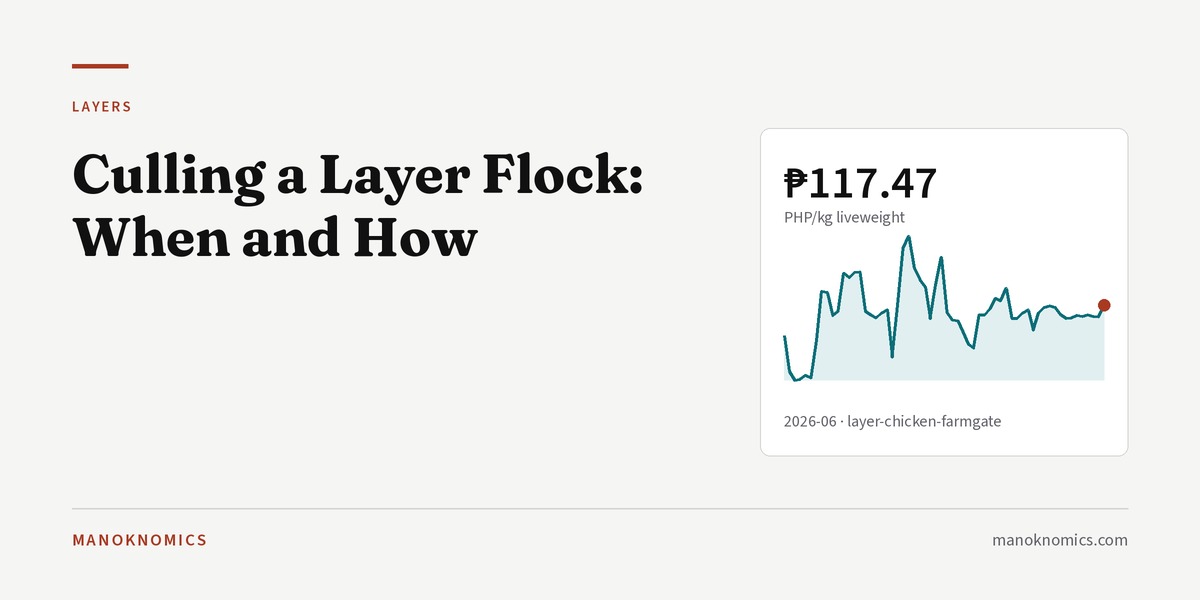
Hawakan mo siya. Two finger widths or more between the pubic bones, flexible, with a deep soft abdomen: nangingitlog pa ang inahin na iyan. One finger width or less, stiff, over a shallow tight abdomen: tapos na siya. Then read the beak, kasi ibang tanong ang sinasagot nito: “A hen whose beak is fully pigmented has not laid for at least four weeks.” Gawin mo ito sa gabi, at huwag mong gawin habang nagmomolt o may sakit ang flock. ₱117.47 per kilo liveweight ang PSA layer chicken farmgate noong June 2026, at doon nagtatapos ang presyo niya.
Source Mississippi State University Extension Service, Publication 358, Culling Hens, Dr Tom W. Smith (read on August 23, 2026)
Aling inahin ang aalisin mo ngayong gabi?
- Pubic bones. A laying hen carries them “flexible and wide apart, with at least two finger widths between them (one finger width = ¾ inch)”. A hen out of lay measures “one finger width or less”, and they feel stiff (MSU Extension Publication 358).
- Abdomen depth, keel to pubic bones. Three or four finger widths on a layer, which the same sheet puts at 2½ to 3 inches. About two finger widths, or 1½ inches, on a pullet and on a hen who has stopped.
- Vent. Large, moist and bleached on a bird in lay. Small, dry, puckered and yellow on one out of it.
- Beak and eye ring. Bleached on a layer, yellow on a non-layer, and slower to move than either bone or abdomen.
- Comb and wattles. “Large, bright red, glossy” on a layer, “small, dull, shriveled” on one out of lay. The same table sets her head at refined against beefy and her eye at bright and prominent against dull and sunken.
Magkaibang tanong ang sinasagot ng dalawa sa listahang iyan, at huwag mong paghaluin. Ang buto at ang lalim ng tiyan ang nagsasabi kung ano ang ginagawa niya ngayong linggo. Ang kulay naman ang nagsasabi kung gaano na siya katagal tumigil, kasi unti-unting nauubos ang dilaw sa katawan ng isang nangingitlog na inahin, at may sinusunod itong ayos.
Every measurement above comes from an extension sheet published by Mississippi State University, written by Dr Tom W. Smith. Six Philippine documents were opened looking for the same test and all six stop short of the bird. PNS/BAFS 184:2016 mentions culling four times in 22 pages, one of them a table-of-contents echo, and every mention concerns what happens to her afterwards. PNS/BAFS 312:2021 and PNS/BAFS 262:2018 return zero hits on cull, spent hen and end of lay. AO 12, AO 5 and the DA-BAI layer roadmap each legislate on her, cost her and move her, and all three leave the handling to somebody else.
Dalawang bagay pa bago ka pumasok sa kulungan. Sa gabi ito ginagawa, “since the birds are less likely to be frightened and reduce egg production”, with “a flashlight with the lens covered with blue cellophane” so you can see the bird without waking the rest. At may petsa rin: in a small flock the hens “should be culled about eight to ten weeks after being placed in the laying house” (Publication 358).
One rule in Publication 358 outranks the rest, and it sets when to leave the flock alone. “Delay culling if a significant portion of the flock is suffering or recovering from a minor disease or molt. Culling a diseased or molting flock often removes some of the better laying birds.” Read the molt page first if the feathers are going. It carries the other half of this: the scruffy hen shedding primaries in groups is your good layer, so appearance selects the wrong way. Cull once the moult has finished. And if the flock simply slowed down, the diagnosis page ranks the nine causes by how fast each one reverses, kasi baka tubig o parasites lang pala at ang edad ang huling titingnan.
One limit on the pigment half, in the sheet’s own words. Bleaching “is easily seen in yellow-skinned breeds such as the white leghorns and birds on diets containing sources of the coloring agents”, and in white-skinned breeds it is “less pronounced and more difficult to detect”. Ang manok sa bakuran ay kumakain ng darak, tira sa hapag at kung ano ang matuka niya sa lupa, kaya hindi kontrolado ang kulay ng pagkain niya. Hawakan mo muna siya bago ka tumingin.
| Body part | Time after the first egg |
|---|---|
| Vent | 4 to 7 days |
| Eye ring | 7 to 10 days |
| Ear lobes (white leghorn) | 14 to 21 days |
| Base of beak | 4 to 6 weeks |
| Tip of beak | 6 to 8 weeks |
| Bottom of feet | 8 to 10 weeks |
| Front of shanks | 15 to 18 weeks |
| Rear of shanks | 20 to 24 weeks |
| Hock joint | about 24 weeks |
The colour comes back in the same order it left, vent first and shanks last, and “it usually returns in about half the time required to bleach” (Publication 358). So a yellow eye ring on a bird with a bleached vent is a hen who stopped and started again, kaya hintayin mo munang matapos ang moult niya.
The state has a name for her and no test for her
PNS/BAFS 184:2016 § 4.6 defines culled animals as “Undesirable animals eliminated from the herd or flock; these include non-performers, old, and injured chicken.” Three categories. Old is an age and injured is visible, and the non-performer is the bird the list above is for. § 4.6 names her and then changes the subject.
The same standard builds her a room. § 5.1.6, headed Holding pen for culled chickens, asks for sufficient pens and floor space to prevent overcrowding, construction that protects the birds from adverse weather with sufficient ventilation, and “proper facilities for chickens to feed and drink”. Read the verb before you plan around it: a voluntary code written in should throughout, the same standing the deworming page gives it. Its scope reaches a bakuran anyway: § 4.3 defines a backyard farm as “Any farm or household raising at least one head of animal or bird” that falls short of commercial, and § 4.4 puts commercial at 500 layers or 1,000 broilers, or at 100 layers and 100 broilers on the same farm.
Then the transport rules give her a name of their own. DA AO 5 s. 2019 § 5.5.2 D lists the avian commodities needing a veterinary health certificate for local movement, and the last entry on that list reads “Spent Hens/Chicken/Culls from Commercial and Backyard/Smallholder Farms”. That is the mirror image of what the broiler selling page found in the same document: § 5.9 has a row for broilers from commercial farms and a row for free range and native chickens raised in the backyard, and a broiler raised in a bakuran falls between them. She appears twice in the one order, and both entries name the bakuran without being asked: the § 5.5.2 D commodity heading that governs her health certificate, and § 5.9.10, her own species row in the additional-requirements section.
Four documents define her, pen her, price her and restrict where she goes. § 4 of AO 5 defines twenty-five terms, from accreditation through to zoonotic, and spent hen and cull are absent from all twenty-five.
What is she worth at the gate?
₱117.47 per kilo liveweight, in June 2026, on the PSA household layer chicken farmgate series. She is priced there once, on the day she leaves.
The published surface downstream of her is short. PSA’s poultry retail table carries fifteen commodity codes, covering breast, fully dressed broiler, legs, native, native dressed, a branded whole bird, wings, four offal lines and four egg lines, and a layer row is absent from all fifteen. The wholesale series has one poultry table, and it holds chicken egg and duck egg only. The DA Bantay Presyo weekly for NCR markets, 10 to 16 August 2026, lists one chicken line, “Whole Chicken, Local, Fully Dressed” at ₱199.76 per kg, beside ten egg lines.
Bago mo gamitin ang ₱117.47: per kilo iyan, kaya timbangin mo muna siya. The layer pillar states the limit and it still holds. PSA’s farmgate and retail tables, the DA-BAI layer roadmap and PNS/BAFS 184:2016 were each opened for a spent-hen liveweight to pair with it, and none carries one. Ang timbangan sa bakuran mo ang sasagot niyan.
May peso figure kada manok na galing sa Pilipinas, at nasa isang column ito na halos walang bumubuklat. Table 6 of the DA-BAI layer roadmap, printed p. 48, is a six-year cost and return model for 10,000 ready-to-lay pullets, and its returns block reads like this.
| Income from Culled layers | ₱455,000Booked in Year 2, Year 4 and Year 6. Years 1, 3 and 5 carry a dash. |
|---|---|
| Income from sales of rejects | ₱147,000Every one of the six years, unchanged. |
| Income from feed bags | ₱40,040Every one of the six years, unchanged. |
| Income from manure | ₱14,300Every one of the six years, unchanged. |
Every other revenue line in that block is flat. The culled-layer line is the only income in DA’s model that arrives in a rhythm, and the rhythm is the replacement interval the same roadmap states in prose on printed p. 47, where commercial replacement pullets are described as “being replaced every two years”. Two years of prose on one page, and three payments on the next: ₱1,365,000 across the model. The table’s own assumptions block does carry a row for Selling price of culled layer, pesos/bird, but its amount cell reaches the published PDF as a 611 by 533 pixel raster.
Hatiin mo ang ₱455,000 sa 10,000 na inahin na inilagay ng table at ₱45.50 per bird placed ang lalabas. Per bird placed iyan, kasama na ang mga namatay bago pa dumating ang cull. At the June 2026 gate price that buys 0.387 kg of hen. Iba ang unit at iba ang taon, kaya huwag mong ibawas ang isa sa isa: a DA-BAI roadmap assumption against a 2026 PSA month, and a per-bird-placed figure against a per-kilo price.
Three birds in twenty, and nobody counts them separately
Table 10 of the same roadmap, printed p. 54 and captioned 2009, benchmarks Philippine layer parameters against four ASEAN neighbours. Its depletion rate row reads 15 percent for small Philippine farms and 10 for medium and large, against Indonesia at 16, 15 and 14, Malaysia at 15 throughout, Thailand at 10, and Vietnam at 15. On a bakuran flock of 20 inahin that is 3 birds a year.
Depletion in layer-industry usage covers mortality and culls together, and this table fuses them by construction. It also disagrees with its own page. Recovery rate and depletion rate both carry footnote marker 3, whose text reads “Saleable eggs”, while footnote 4, “Mortality Report”, hangs off no row at all, and the prose alongside calls the Philippines both lowest in depletion and highest in mortality in two consecutive sentences. So 15 in a hundred left a small Philippine layer farm in the year that table describes, 2009, and the split between the ones you decided about and the ones you found dead stays inside that one figure.
The month she leaves is worth more attention than the week. June readings on the farmgate series run ₱152.42 in 2022, ₱192.73 in 2023, ₱71.00 in 2024, ₱109.15 in 2025 and ₱117.47 in 2026. Between two adjacent Junes that is a factor of 2.71, on the same month of the same series.
Kung ang buong flock naman ang tanong mo, the monthly egg page sets the pay line at 16.32 to 17.48 eggs per 28 days per hen, at nasa pullet page ang presyo ng papalit sa kanya. Bago mo siya alisin, tingnan mo muna kung ang pugad ba o ang ilaw ang dahilan: the nest box and lighting page sets out what the laying environment does to a hen before her age does.
How long may she lie tied at the palengke?
Three hours. DA AO 12 s. 2002 § 21.5 states that “In public markets and other areas of commerce, the tying of the legs of the chickens shall not be more than three (3) hours. They shall not be kept upside down.” § 21.3 caps holding in sale yards at 24 hours, and § 21.4 caps time without water at eight hours, which is where the water page reads it.
The prohibited acts sit earlier in the order and carry no volume threshold. § 2.4.3 forbids “Hanging them upside down for long periods of time” and “Crossing the wings of the chicken”, and § 2.4.4 forbids carrying a chicken “in such a manner or position as to cause it unnecessary pain or suffering”. Both describe how a bird is normally carried to a market.
§ 22.1 will surprise anybody who read the culling sheet first: “Dim lights or blue lights shall be used when catching to reduce the struggling of the birds.” An extension office in Mississippi asks for a blue-covered flashlight so the culler can see the bird. A Philippine welfare order asks for blue light so the bird stays calm. Two documents written a hemisphere apart, opposite reasons, same instruction.
Then the clause that runs the other way from everything else here. § 2.4.5 makes it a prohibited act to commit “Keeping alive any chicken which is in a condition that is cruel/inhumane to keep it alive”, and § 14.6 states that “Chickens with incurable disease, zoonotic diseases or significant deformity shall be removed from the flock and humanely destroyed immediately”. So the Philippine rules do more than permit culling in a defined case. They forbid the alternative.
Whether a particular bird has reached that condition is a veterinary judgement and belongs with your LGU or Provincial Veterinary Office, and the disease pillar covers what is reportable. Hindi po ako beterinaryo, at sa beterinaryo po dapat itanong iyan.
Two thresholds look like an exemption. § 2.2 requires an attending veterinarian at 30,000 layers and § 2.5 requires BAI registration at 5,000, and a bakuran sits far under both. Sections 2.4, 14.6 and 21 carry no threshold at all, and § 1 scopes the order to chickens “raised ranging from backyard to large commercial enterprises”. § 23 says violations “shall be penalized in accordance with the law” and stops there.
Where she may not go
Quoted
No spent hens/chickens or culls from Luzon shall be allowed for movement to Visayas and Mindanao. No movement of spent chickens in between major islands.
§ 5.9 runs twenty species rows, 5.9.1 to 5.9.20, opening on hatching eggs, day-old chicks and ready-to-lay pullets, then broilers, native chickens, game fowl, racing pigeons, quails, ducks, grazing ducks, pet birds, swine, cattle and carabao, animals for show and trade fairs, goats and sheep, animals for slaughter, dogs and cats, horses and wild animals. Other rows restrict too: § 5.9.18.2 admits dogs and cats only from “3 ½ -4 months and above”, and § 5.9.17 sends slaughter animals straight to an NMIS abattoir, killed within 24 hours. Across all twenty, hers is the row that shuts a geographic route between island groups.
The rest of her row is ordinary. § 5.9.10.1 and § 5.9.10.2 want a livestock handler’s licence and a registered transport carrier, and § 5.9.10.3 wants a veterinary health certificate attesting “that the source farm has no reported cases of ND during the last 21 days”. § 5.9.10.6 repays a second reading in a bakuran: culls intended for slaughter “shall come from an accredited source farm, if not, AI test is required”. A backyard flock holds BAI accreditation only by exception, so the second branch is the default.
Scope decides how much of this reaches you, and the broiler selling page established that boundary. § 1 applies the guidelines to shipments that “shall depart from seaport or airport and/or pass through established interregional veterinary quarantine checkpoints within the Philippines”. A load carried down the highway to the municipal palengke passes no pier and no checkpoint, so what governs it is your LGU, which the permits page covers. § 5.9.10.5 governs interisland movement, squarely inside that scope.
BAI’s own copy of AO 5 is an EPSON scan with no text layer, so the clauses above were read as page images. Malapit lang naman ang bibili sa kanya. Ang tanong ay kung sino, at ilang oras siyang nakatali bago iyon mangyari.
What usually goes wrong
The mistake: Culling on looks, in daylight, while half the flock is in moult.
Do this instead: Handle every bird after dark with a blue-covered flashlight, and wait out the moult or the illness first.
MSU Extension Publication 358 says to delay culling if a significant portion of the flock is suffering or recovering from a minor disease or molt, because culling a diseased or molting flock often removes some of the better laying birds.
The mistake: Reading a pale beak as proof she is still laying.
Do this instead: Take today from the pubic bones and the abdomen. Take the last month from the pigment.
Bleaching is a carotenoid effect on a clock, and Publication 358 sets the base of the beak at 4 to 6 weeks after the first egg. It also warns the effect is harder to detect in white-skinned breeds.
The mistake: Turning ₱117.47 per kilo into a peso figure per bird by guessing her weight.
Do this instead: Use the per-bird figure that needs no weight: ₱45.50 of culled-layer revenue per layer placed, in DA-BAI's own model.
The PSA series is per kilo liveweight, and neither the PSA tables, the DA-BAI layer roadmap nor PNS/BAFS 184:2016 carries a spent-hen liveweight to multiply it by. Weigh the bird in front of you if you want a peso figure for her. The layer pillar and the molt page both stop at the same line, and a guessed weight would put a number on this page that no source stands behind.
The mistake: Arranging a load of culls for a buyer on another island.
Do this instead: Sell inside your island group, and settle the paperwork question with the Provincial Veterinary Office before anything is loaded.
DA AO 5 s. 2019 § 5.9.10.5 allows no movement of spent hens or culls from Luzon to Visayas and Mindanao, and no movement of spent chickens between major islands. Among the twenty species rows in § 5.9, the geographic restriction falls on hers alone.
The mistake: Tying her legs the night before and leaving her under the bench until the market fills.
Do this instead: Tie her at the market, sell her inside three hours, and keep her upright the whole time.
DA AO 12 s. 2002 § 21.5 caps leg-tying in public markets at three hours and forbids keeping birds upside down. § 21.4 caps time without water at eight hours.
What would change any of this
Two publications would move the whole picture, and both are ordinary work for an agency.
The first is a price. PSA prices her at the farm gate and the series stops there, so a keeper choosing between a buyer at the bakuran and a stall at the palengke has one figure to work from. A single retail or wholesale row for spent or culled layer chicken, alongside the poultry codes the same table already carries, would close it, and it is absent from the gaps register, which carries no spent-layer row of any kind.
The second is the test at the top of this page. § 4.6 calls her a non-performer, § 5.1.6 builds her a pen with feed and water in it, AO 12 governs how she is caught and carried, and AO 5 says which islands she may not cross. A Philippine institution publishing what Mississippi published in Publication 358, measured on Philippine birds on Philippine diets where the pigment reading is weakest, would put a keeper standing in her kulungan at night on her own country’s sheet.
Until one of those lands, the Philippine state’s last word on a spent hen names only the islands she may not cross.
Questions people actually ask
How do I know if a hen has stopped laying?
Handle her and read three things. Mississippi State University Extension Publication 358 puts a laying hen at two finger widths or more between the pubic bones, flexible, with a deep soft abdomen measuring three or four finger widths from keel to pubic bones. A hen out of lay measures one finger width or less between stiff pubic bones and about two finger widths of abdomen. Her vent turns small, dry and puckered where a layer's is large, moist and bleached. The beak answers a different question, which is how long she has been out: the sheet states that a hen whose beak is fully pigmented has not laid for at least four weeks.
When should I cull my laying hens? Show the answer
After dark, and never during a moult or an illness. Publication 358 recommends culling at night because the birds are calmer, using a flashlight with the lens covered in blue cellophane, and it puts the first pass at eight to ten weeks after the pullets go into the laying house. It also says to delay culling if a significant portion of the flock is suffering or recovering from a minor disease or moult, because culling a diseased or moulting flock often removes some of the better laying birds. For the flock-wide replacement date rather than the individual bird, the DA layer roadmap records commercial replacement pullets as being replaced every two years, on printed p. 47.
How much is a spent hen worth in the Philippines? Show the answer
The PSA household layer chicken farmgate read ₱117.47 per kilo liveweight in June 2026, and that is the last price anybody publishes for her. It is per kilo, and neither the PSA tables, the DA-BAI layer roadmap nor PNS/BAFS 184:2016 publishes a spent-hen liveweight to multiply it by, so it does not become a peso figure per bird without weighing the bird in front of you. The one per-bird Philippine number is DA-BAI's own cost model: Table 6 of the layer roadmap books ₱455,000 on a row headed Income from Culled layers against 10,000 layers placed, which is ₱45.50 per bird placed.
Can I sell spent hens to another island in the Philippines? Show the answer
No. DA Administrative Order No. 5 s. 2019, clause 5.9.10.5, states that no spent hens, chickens or culls from Luzon shall be allowed for movement to Visayas and Mindanao, and that there shall be no movement of spent chickens in between major islands. Of the twenty species rows in clause 5.9, hers is the only one that bars a geographic route between island groups. Clause 5.9.10.6 adds that culls intended for slaughter must come from an accredited source farm, and where they do not, an AI test is required. Clause 1 scopes the order to shipments departing by seaport or airport or passing an interregional quarantine checkpoint, so an intramunicipal run to the palengke sits outside it.
Is it legal to cull a chicken in the Philippines? Show the answer
It is, and in one defined case the alternative is what the rules prohibit. DA Administrative Order No. 12 s. 2002, clause 2.4.5, makes it a prohibited act to keep alive any chicken which is in a condition that is cruel or inhumane to keep it alive, and clause 14.6 states that chickens with incurable disease, zoonotic diseases or significant deformity shall be removed from the flock and humanely destroyed immediately. Whether a bird is past treatment is a veterinary judgement and belongs with the LGU or Provincial Veterinary Office. Clause 23 says only that violations shall be penalised in accordance with the law, and names no penalty of its own.