Free-Range Egg Price in the Philippines: Two Standards, One Tray
The short answer
Two Philippine standards authorise the words free-range and cage-free on an egg, and they do it on opposite terms. PNS/BAFS 262:2018 § 6.7 says that only chicken and chicken products from farms “complying with the above stated requirements may be labeled as ‘free-range’”, and compliance is the whole condition. PNS/BAFS 312:2021 § 6.16.2 restricts the cage-free label to farms “certified by the competent authority”, and § 1 of that same standard describes the certification scheme in the future tense. Magkaibang bahay po ang dalawa: 1 bird per m² of outdoor range ang hinihingi ng free-range sa bawat inahin, at ang cage-free ay sinusukat sa loob lang. Ang presyo naman ay sa merkado sasagutin, at ang pinakamalapit na bilang ay isang listing: ₱15.47 per piece ang isang organic tray noong August 2026, laban sa PSA retail na ₱9.03 per piece noong July 2026.
Source PNS/BAFS 262:2018 § 6.7 and PNS/BAFS 312:2021 § 6.16.2 (BAFS, Department of Agriculture) (read on August 23, 2026)
Anybody pricing a free-range egg in this country arrives holding two assumptions. The first is that free-range and cage-free are two words for one tray. The second is that a peso figure for the claim sits in the published record, waiting to be looked up. Both come apart on the documents.
Two standards, two conditions, and one of them names a checker
The free-range side is the older one, and its scope reaches further than most people quoting it realise. PNS/BAFS 262:2018 § 1 covers “the methods of production, harvesting and marketing of chicken and chicken products labeled as free range”, and § 3.5 defines layer hens as “domestic chickens reared for consumption of their eggs.” An egg from a complying layer flock is a free-range egg under that standard, and the clause authorising the words runs two lines.
“Only chicken and chicken products coming from farms or production units complying with the above stated requirements may be labeled as ‘free-range’.”
Read the verb twice. May be labeled, conditioned on compliance alone: the farm meets the numbers in §§ 6.2 to 6.6, and the farm writes the words on the tray. The certification page walks that standard clause by clause with the meat bird as its subject, so § 6.7 and the egg half of PNS 262 sit one clause past where it stops.
The cage-free side reads differently in the one place it matters. PNS/BAFS 312:2021 § 1 covers “marketing of eggs labeled as cage-free eggs” and applies to “smallholder poultry farmers including native chicken farmers”, so a bakuran flock is squarely inside it. Then § 6.16.2: “Only eggs coming from farms or production units certified by the competent authority should be labeled as ‘cage-free’.”
The standard defines that authority and leaves law to appoint it: § 3.4 calls it “an entity/agency who has the knowledge, expertise, and authority as designated by law.” § 1 is franker still about where the scheme stands. This standard “may be used in the succeeding certification scheme for cage-free egg production of the competent authority.” Succeeding: the route to a certificate sits in the future tense in a standard published in 2021.
The verbs repay a side-by-side reading, kasi doon lumalabas kung alin ang tunay na hinihigpitan. § 6.16.2, the certification condition, is written in should. § 6.16.3 is written in shall and points at RA 7394 and RA 10611, the Consumer Act and the Food Safety Act. The soft verb carries the cage-free condition; the hard verb carries two laws that reach any label on any food.
One line in the same clause points at a document that has since closed. § 6.16.1 sends cage-free labels to the provisions of “PNS/BAFS 35:2005”. The foreword of PNS/BAFS 321:2021 states that it “cancels PNS/BAFS 35:2017”: the edition PNS 312 cites had been revised once by 2017 and was cancelled outright in 2021, the same year 312 was published, by the same bureau. Each standard is silent about the other, and the defect belongs to the paperwork alone.
Both claims end up in PNS 321, the standard for the tray itself: shell eggs “sold by wholesalers and retailers.” Its § 10 requires eight fields, and the selling page prints them as a table: product name, weight class and grade, the address of the producer, packer or distributor, “Product of the Philippines”, the production date, a best-before date, storage conditions, and a lot identification. Eight fields describing the egg, the packer, the date and the lot. Doon po nagsisimula ang tanong tungkol sa premium: sa pangalan ng brand, at sa sinasabi ng tindera.
Free-range and cage-free describe two different houses
The two standards disagree about the most visible thing anybody does to a laying flock. PNS 262 § 6.6.1 puts beak trimming under a flat prohibition, “strictly prohibited”. PNS 312 § 6.12 is headed “Beak Trimming (Optional)” and gives it a protocol: a quarter of the beak at most, 2 mm at most, and § 6.12.1 permits the procedure up to 10 days old. Same bureau, same bird, opposite answers.
Outdoor area splits them the same way. PNS 262 § 6.4.3 caps outdoor stocking at one layer per square metre and § 6.4.4 asks for pasture access “all throughout the laying period”. PNS 312 § 3.17 defines usable space so that it “excludes nest areas and any outdoor area, if applicable”, and § 4 describes cage-free rearing as taking place “in a building, room, or enclosed area … providing the animal the freedom to roam.” So a Philippine cage-free hen may spend her whole laying life under a roof and satisfy the standard, while a free-range layer has a square metre of range to herself.
| What the standard asks | Free-range, PNS/BAFS 262:2018 | Cage-free, PNS/BAFS 312:2021 |
|---|---|---|
| Condition on the labelThe first is a self-declaration. The second names an authority that § 3.4 defines and law has yet to designate. | Complying with the requirements (§ 6.7) | Certified by the competent authority (§ 6.16.2) |
| Outdoor rangePNS 262 § 6.4.4 asks for pasture access all throughout the laying period. | ✓ 1 bird/m² for layers (§ 6.4.3) | ✗ Excluded from usable space (§ 3.17) |
| Indoor floor per henThe standard written for a closed building is the tighter of the two indoors. | 0.167 m², from 6 birds/m² (§ 6.3.1) | 0.14 m² single-tier, 0.1 m² multi-tier (§ 6.2) |
| Beak trimmingPNS 312 § 6.12 allows up to a quarter of the beak and at most 2 mm, and § 6.12.1 permits it *"prior to 10 days of age"*. | ✗ Strictly prohibited (§ 6.6.1) | ◐ Optional, protocol at § 6.12 |
| Written recordsPNS 262 § 6.4.6(b) asks for that plan annually, every flock size included. The waiver for batches under 50 birds sits at § 6.4.6(c) and covers the one-month rest between batches. | An annual pasture management plan (§ 6.4.6) | Records through the cycle and 24 months after (§ 6.17.2) |
Two houses, two claims, one tray in the buyer’s hand. Sa bakuran, ang cage-free ang mas maabot at ang free-range ang mas mahal, kasi lupa ang binabayaran doon.
What PSA actually prices, and it is five things
PSA slices an egg five ways: species, breed type, size class, operation scale and market level. Here are the five, with the table addresses, so anybody can walk the same afternoon.
The household farmgate table, 0032M4AFN10, carries 21 commodity types and three egg rows: Chicken egg, Layer, Chicken egg, Native and Duck egg. The establishment table, 0032M4AFN11, carries 14 types and the same three. The retail table carries 15 commodities and four egg rows, each quoted per piece and three of them for a medium egg. The one poultry wholesale table holds chicken egg and duck egg. PNS 321 § 5.1.1 classes a shell egg by shell colour and § 5.1.2 by weight, with the grades set out at § 5.3 Table 7, and DA’s Bantay Presyo sheets monitor egg lines by size and shell colour.
Five slices, and husbandry is the sixth. Ang tanong na magkano ang free-range na itlog ay sa merkado po sasagutin, sa bumibili at sa nagtitinda.
One of those five gets mistaken for husbandry every time. PSA’s farmgate Type value reads Chicken egg, Native and its retail commodity reads FRESH EGG, CHICKEN, NATIVE, MEDIUM, 1 PC, which name the bird’s breed type and, at retail, a size class. Ang native na inahin sa loob ng hawla ay nangingitlog pa rin ng Chicken egg, Native, at ang commercial layer na nasa damuhan buong araw ay nangingitlog ng Chicken egg, Layer. The native premium is a breed premium, and the egg price page owns the account of how it moved: ₱1.87 at the gate over the ordinary egg’s ₱6.74 and ₱0.55 at retail in June 2026, having started in 2019 with the extra sitting mostly at the stall.
A third market level sits in the same archive. PSA’s establishment table surveys commercial operations rather than households, and for June 2026 it puts Chicken egg, Native at ₱7.56 per piece against Chicken egg, Layer at ₱6.38. That is a native premium of ₱1.18 per piece at a commercial farm gate, in the same month the household gate paid ₱1.87.
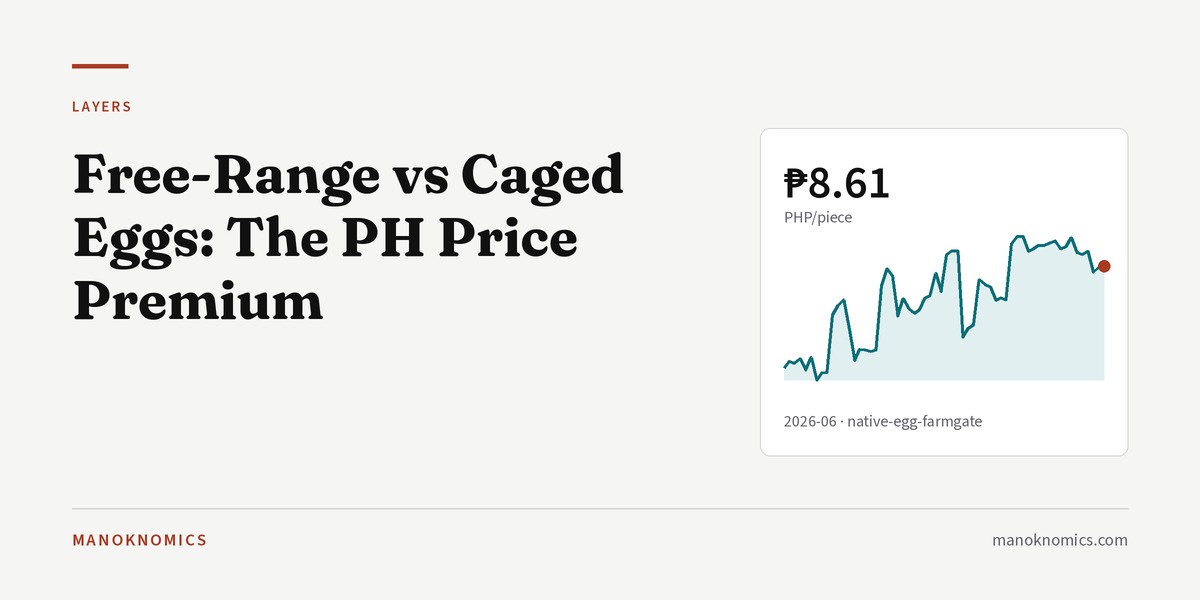
| Household farm gate | ₱1.87 per piece₱8.61 native against ₱6.74 layer, PSA household farmgate survey, table 0032M4AFN10. |
|---|---|
| Establishment farm gate | ₱1.18 per piece₱7.56 native against ₱6.38 layer, PSA establishment farmgate survey, table 0032M4AFN11. |
| Retail | ₱0.55 per piece₱9.62 native against ₱9.07 layer, PSA retail, both quoted for one medium egg. |
The premium is largest where the flock is smallest and shrinks at every step towards the shelf. The native meat page reads three PSA levels the same way. One caution travels with the table: household and establishment are survey frames describing the operation, and each frame holds caged hens and ranging hens alike. This site’s gaps register runs from G-1 to G-23, and an egg price by production system is a candidate for a number rather than an entry holding one.
Two named Philippine retail SKUs exist for the two claims at one supermarket chain, a cage-free brown 30-piece tray and a free-range 10-piece pack. Both product pages returned HTTP 403 on 23 August 2026, so their shelf prices stay unread here.
The nearest thing to an observed premium is one listing. A Philippine online grocer lists a 30-piece tray of organic white eggs at ₱464, which is ₱15.47 per piece, read on 23 August 2026. Against PSA’s national retail medium egg at ₱9.03 per piece in July 2026, that is 1.71 times the price. Grade it for what it is: one seller’s price on one day against a national monthly average. The claim on the tray is organic, a different claim from free-range and the one with a penalty behind it, as the certification page sets out. The listing describes a vegetarian diet and antibiotic-free eggs, and leaves its certifying body unstated.
A dated Philippine study carries both halves of a premium, in two separate places. Villareal and colleagues (2025), on organic egg production in San Jose, Occidental Mindoro, report in their narrative that the town’s public market and groceries sell regular table eggs at ₱7.50 to ₱10.00 per piece “depending on the size” (p57). Six pages later, Financial Assumption (2) sets a year-one selling price of ₱12 per piece (p63). The ₱12 is a business plan’s assumption; the ₱7.50 to ₱10.00 is what the authors saw on the stalls. Their spent-hen line assumes ₱100 per kg after a two-and-a-half-year lifespan, which sits below the ₱117.47 per kg liveweight PSA carried for a layer chicken in June 2026 and the culling page works from. They also asked 372 people in San Jose whether they would patronise organic eggs and 367 said yes, a 99% collected with the price omitted, so it votes for a free good.
Against PSA’s ₱9.03, a national retail average, the bearings on the table are these: one Metro Manila online organic listing at ₱15.47, a Mindoro business plan assuming ₱12 at its own farm gate, San Jose stalls at ₱7.50 to ₱10.00 for regular table eggs, and a 2024 consumer survey band of 10 to 25% more, which applied to the national average puts the egg at ₱9.93 to ₱11.29. Every one of them measures something adjacent to a free-range egg, and that is the range you are pricing inside.
What the free-range claim costs a bakuran keeper
Land is what the claim costs, and the sum is one line. At one layer per square metre of range (PNS 262 § 6.4.3), a bakuran running 20 inahin owes 20 m² outdoors before the kulungan itself enters the count. The native chicken pillar runs that sum for meat birds. Sa inahin, mas matagal ang bayad: § 6.4.4 asks for pasture access all throughout the laying period, so the range is a standing cost for as long as she lays, where a grow-out cost ends at harvest.
Everything else in that specification has the same shape. Popholes at least 46 cm by 100 cm, two per 500 birds, with every bird within 10 m of one (§ 6.3.2). Shade of 8 to 16 m² per 1,000 birds, with natural cover over at least 5% of the range (§ 6.4.2). A diet at least half cereal or grain (§ 6.6.3). One written record, an annual pasture management plan (§ 6.4.6(b)), and that one is asked of every flock size. What a batch under 50 birds skips is the one-month rest between batches at § 6.4.6(c).
Cage-free asks for a different bill. Indoors, PNS 312 § 6.2 wants 0.14 m² per bird single-tier and 0.1 m² multi-tier, which the layer pillar works through for a 20-hen flock. Then the paperwork: records kept through the laying cycle and for at least 24 months after it (§ 6.17.2), made available to the competent authority when required (§ 6.17.3). Isang standard ang humihingi ng lupa, at ang isa ay talaan na itatago mo ng dalawang taon pagkatapos ng huling itlog.
Both budgets leave the certificate line empty in the same way, and the certification page has the whole survey: the fee range BAFS publishes is an organic fee range, the two accredited certifying bodies in the country are organic bodies, and the one route by which the free-range housing rules bind a Philippine keeper runs through organic certification.
Who checks a tray that says free-range
The buying side has moved faster than the paperwork. Lever Foundation published its 2026 Philippine retailer cage-free progress report in July 2026, announced through a press release Mindanao Times carried on the 10th. It scores 26 retail brands, seven of them carrying a timeline for ending caged-egg sales. Heyday, Healthy Options and FreshStart are at 100%; MetroMart at 90%; EveGrocer at 50% with a 2028 target; METRO Retail at 26% with a 2033 target; SM Retail’s supermarkets at 20 to 40% of egg SKUs. Lever Foundation is an NGO that campaigns for these commitments and the figures are its own compilation from the retailers, counted here off the report itself. The press release version that ran in the Philippine papers says 23.
What happens when the premium is asked for is on the record too, from the organisation that proposed the cage-free standard. PNS 312’s foreword records that BAFS developed it “following the proposal of the Animal Kingdom Foundation”, and its drafting group was chaired by AKF’s Atty. Heidi Caguioa, with BAI, the Philippine Egg Board Association and the Philippine College of Poultry Practitioners at the table. Five years later AKF put a billboard on NLEX at Apalit, Pampanga reading “Bugok! Stop Lying” and “Get your eggs from certified cage-free farms” (AKF’s own press release, carried by Philstar on 29 December 2025 outside its editorial guidelines).
In the same release AKF says a government-endorsed certification scheme is still awaited, and reports what farms tell it: “Some farmer claims that some of the large buyers are pushing for cage-free sourcing, only to back out when it came to pricing.” Iyan po ang buong kuwento ng premium dito sa isang pangungusap: hinihingi ang claim, at ang presyo ay pinag-uusapan pa. So AKF now runs “an independent cage-free auditing program” of its own, under which farms “must meet requirements on space, nesting areas, perches, litter, and hen behavior before receiving certification.”
A consumer survey is usually quoted on the other side of this. A GMO Research survey relayed as a press release by SunStar in May 2024 put 76% of Filipino consumers as willing to pay 10 to 25% more for cage-free eggs at a supermarket. That release is Lever Foundation’s too, quoting its Robyn Del Rosario, so it and the retailer report above are one line of evidence. The release prints percentages and leaves the sample size, the field dates and the method unstated. A stated willingness to pay is a survey answer, and the one dated Philippine account of the transaction says the buyers stepped back at the price.
The circulating figures deserve the same scepticism, kasi iyon ang unang lumalabas sa hanapan. The free-range price ladder filling the first page of results traces back to one site whose posts carry an unnamed author and undated figures.
PNS 321 § 11.2, filed under Hygiene, Storage, and Transport, states that shell eggs “should comply with PNS/BAFS 184:2016 (Code of GAHP for chicken), PNS/BAFS 271:2019 (Code of GAHP for duck), and PNS/BAFS 262:2018 (Free-range chicken)”, and the clause attaches that to every shell egg, whatever the label claims. The verb is should and the heading is hygiene, so the plain reading is very likely a drafting artefact rather than policy.
What usually goes wrong
The mistake: Treating free-range and cage-free as two words for one tray.
Do this instead: Read them as two standards with opposite clauses. Free-range asks for a square metre of outdoor range per layer; cage-free measures usable space indoors and excludes any outdoor area.
PNS/BAFS 262:2018 § 6.4.3 against PNS/BAFS 312:2021 § 3.17. And § 6.6.1 calls beak trimming strictly prohibited where § 6.12 heads it Beak Trimming (Optional), from the same bureau.
The mistake: Reading the native egg premium as a free-range premium.
Do this instead: Take ₱1.87 per piece as what the breed earned at the household gate in June 2026, and price the housing as a separate question.
PSA's descriptors are Chicken egg, Native and FRESH EGG, CHICKEN, NATIVE, MEDIUM, 1 PC. Both name the bird's breed type, and the retail one adds a size class.
The mistake: Assuming somebody inspects the words on the tray.
Do this instead: Ask the seller which standard is being claimed and who audited the farm, then read the answer against the two clauses.
PNS 262 § 6.7 conditions the free-range label on compliance and leaves the checking with the farm. PNS 312 § 6.16.2 conditions the cage-free label on a competent authority its own § 1 puts in the future tense.
So who is checking depends on which document you are standing in. Under PNS 262 § 6.7 the checker is the farm. Under PNS 312 § 6.16.2 it is a competent authority the standard defines and law has yet to designate. In the market this month it is a private foundation auditing farms that engage it, a retailer with a 2028 or a 2033 target, and a buyer with a question. Kaya nananatili ang tanong sa bawat trayong may nakasulat na free-range, at sa iyo po ito, bumibili man o nagtitinda: sino ang nag-audit nito, at paano mo malalaman?
Questions people actually ask
How much do free-range eggs cost in the Philippines?
The market sets it seller by seller, because the Philippine price statistics stop short of husbandry. PSA prices an egg five ways, by species, breed type, size class, operation scale and market level, and its national retail figure for one medium chicken egg was ₱9.03 per piece in July 2026. The closest published premium is a single retail listing: one Philippine online grocer listed a 30-piece tray of organic white eggs at ₱464 on 23 August 2026, which is ₱15.47 per piece, or 1.71 times the PSA retail figure. That is one seller's own price on one day against a national monthly average, and it is an organic claim, which is a different claim from free-range.
Are free-range and cage-free eggs the same thing in the Philippines? Show the answer
They are two different Philippine standards and they disagree on two clauses that a keeper can see. PNS/BAFS 262:2018 § 6.4.3 caps outdoor stocking at one layer per square metre of range, while PNS/BAFS 312:2021 § 3.17 defines usable space so that it excludes any outdoor area, so a cage-free hen may spend her laying life in a building. On beak trimming, PNS 262 § 6.6.1 calls the procedure strictly prohibited and PNS 312 § 6.12 is headed Beak Trimming (Optional) and gives a protocol for it. Both standards come from the same bureau, five years apart.
Is a native egg a free-range egg? Show the answer
A native egg is a breed description. PSA's farmgate table records the commodity as Chicken egg, Native and its retail table as FRESH EGG, CHICKEN, NATIVE, MEDIUM, 1 PC, which name the bird's breed type and, at retail, the size class. A native hen kept in a cage still lays a Chicken egg, Native, and a commercial layer breed on pasture lays a Chicken egg, Layer. So the ₱1.87 per piece that a native egg earned over an ordinary one at the household farm gate in June 2026 is what the breed is worth, measured by PSA.
Who certifies free-range or cage-free eggs in the Philippines? Show the answer
For free-range, the farm itself. PNS/BAFS 262:2018 § 6.7 states that only chicken and chicken products from farms complying with the standard may be labeled as free-range, and compliance is the whole condition. For cage-free, PNS/BAFS 312:2021 § 6.16.2 restricts the label to farms certified by the competent authority, § 3.4 defines that authority as an entity designated by law, and § 1 of the same standard describes the certification scheme in the future tense. The audits that happen today are private: the Animal Kingdom Foundation, which proposed the cage-free standard to BAFS, runs its own cage-free auditing programme for farms that engage it.
What has to be printed on an egg tray in the Philippines? Show the answer
Eight fields, under PNS/BAFS 321:2021 § 10: the product name, the weight class and grade, the name and address of the producer, packer or distributor, the words Product of the Philippines, the production date, a best-before or consume-by date, storage conditions, and a lot identification. All eight describe the egg, the packer, the date and the lot.