Selling Eggs: Tray Pricing, Grading and Buyers
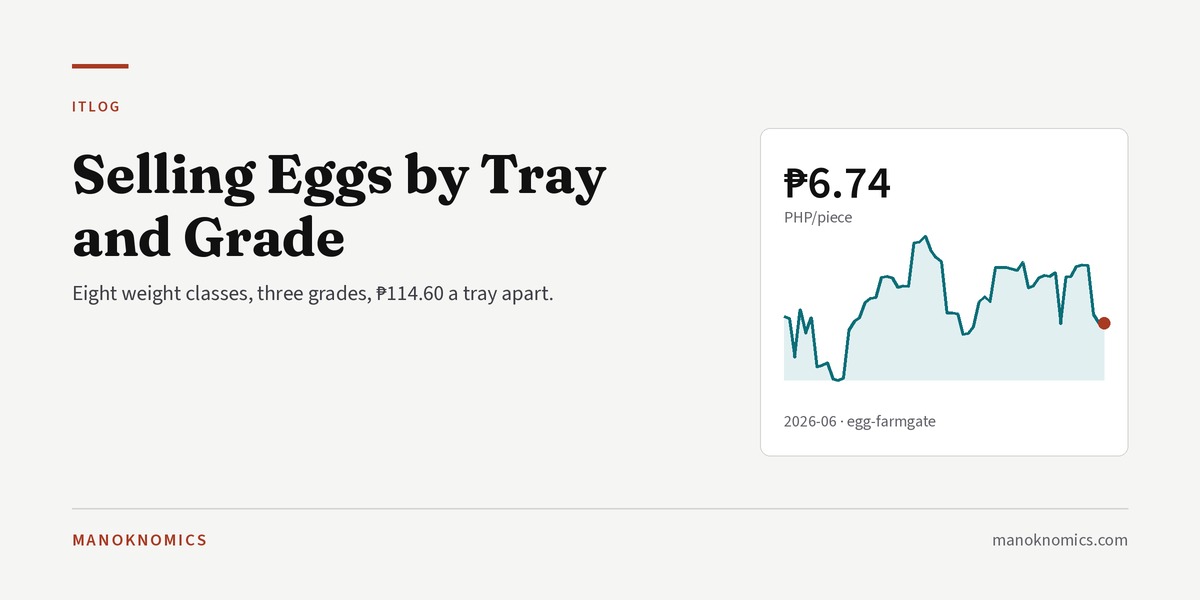
A tray is 30 eggs, and at the ₱6.74 national farmgate of June 2026 that tray is worth ₱202.20 at your gate. What decides whether you get more than that is not the buyer you found. It is the weight class and the quality grade, and both of them are defined in a single Philippine document na malamang hindi mo pa nabuksan.
The short answer
Sort by weight first, then choose a buyer. PNS/BAFS 321:2021 sets eight weight classes and three quality grades for Philippine shell eggs, and says a package should be uniform by both. On the DA’s NCR monitor for 10 to 16 August 2026 the distance from the smallest class to the largest was ₱114.60 a tray. Ang laki, hindi ang bumibili, ang unang nagtatakda ng presyo mo. Five buyer types are realistically open to a bakuran flock and the DA-BAI layer roadmap puts a peso figure on only two of them.
Source PNS/BAFS 321:2021, Shell Eggs (Chicken and Duck), DA-BAFS (read on August 22, 2026)
The five buyers, and the two the state has actually priced
A backyard keeper has five realistic outlets, and they differ less in price per egg than in how much of the work they take off you. The roadmap’s own description of the trade is blunt about who moves the volume: wet markets, groceries and sari-sari stores are “filled up by viajeros or traders or by farm owned delivery vehicles” (DA-BAI Philippine Poultry Layer Industry Roadmap 2022-2040).
| Who buys | What they take off you | What the state has published about them |
|---|---|---|
| Kapitbahay, direct | Nothing. You sort, you carry, you collect | One unfinished sentence, below |
| Sari-sari store | Retailing, in small lots | Nothing specific |
| Palengke vendor | The stall, the day, the haggling | Retailer: ₱0.76 an egg, roadmap p. 50 |
| Viajero or trader | Collection, transport, immediate cash | Trader: ₱0.61 an egg, roadmap p. 49 |
| Processor or institutional | Volume, and your grading problem | Raw material at ₱4.70 an egg, roadmap p. 51 |
The two priced rows come from CALABARZON focus groups on a 2018 basis, so read them as a bearing rather than as this year’s rate. A medium-scale trader moves at least 10,500 eggs and earns as much as ₱6,448 per delivery, which works out at ₱0.61 an egg. What the existing coverage of this document keeps dropping is the frequency in the same sentence: that trader runs “two to three times per week”, so the week is ₱12,896 to ₱19,344. An ordinary retailer sells 3,000 eggs over two to four days for ₱2,277, or ₱0.76 an egg.
Then there is the processor, and this is the row to be careful with. The roadmap’s p. 51 table prices raw material at ₱4.70 per egg, on an assumption of 20 eggs per kilogram of pasteurised whole egg, 30 per kilo of whites and 50 per kilo of yolk. That sits ₱2.04 under the June 2026 farmgate, and most of that distance is eight years of vintage rather than a live discount. Ang punto ay hindi ang eksaktong numero. Ang punto ay ang processor ang pinakamababang bumibili sa listahan, at siya rin ang tanging handang tumanggap ng itlog na tinanggihan ng shelf.
The first row of the table is the interesting one, kasi wala talagang sinasabi ang gobyerno tungkol dito. Page 52 of the roadmap gives the profit shares of retailer, farmer and trader, and then opens a sentence: “Meanwhile in cases wherein the farmer sells directly to the consumer”. It does not finish. The published PDF runs straight into Figure 13. The single sentence in the national layer roadmap about a farmer selling straight to a buyer is a fragment, and that is a fair picture of how much official attention direct selling gets. The data-gaps page keeps the running list of holes like this one.
Kung native ang alaga mo, iba ang buong hanay na iyan. In June 2026 a native itlog read ₱8.61 at the gate against ₱9.62 at retail, so most of what a native egg is worth is being paid to you before the tray leaves the bakuran rather than captured downstream by whoever is in the middle. The egg price article has the year that crossover happened. Choose your buyer knowing which of those two situations you are in.
Grade AA, A and B, and the column that decides where your tray can go
Weight is not the only thing PNS/BAFS 321:2021 sorts on. Clause 5.3 grades chicken fresh shell eggs AA, A and B, and the parameter that actually separates them is the air cell: 3 mm or less in depth for AA, 5 mm or less for A, over 5 mm for B. Albumen, yolk and shell follow the same three steps. The air cell grows as an egg ages, so grade is a function of how long the itlog sat in your bakuran before it moved.
| AA | Air cell 3 mm or lessAlbumen thick and firm; yolk high, round and free from defects; shell clean and unbroken. Suggested use: frying and poaching. |
|---|---|
| A | Air cell 5 mm or lessAlbumen reasonably firm; yolk and shell as AA. Suggested use, in the standard’s own words: "Most often sold in stores". |
| B | Air cell over 5 mmAlbumen thinner and wider; yolk wider and flatter; shell unbroken but may be stained. Suggested use: "For liquid, frozen, and dried egg products". |
Read the last column again, dahil doon nakatago ang buong desisyon. The standard does not say a Grade B egg is bad. It says a Grade B egg belongs in liquid, frozen and dried products. That is the processor row of the table above, the lowest payer of the five. So the grade you deliver does not adjust your price a little. It moves you to a different buyer altogether, and the distance between the palengke vendor’s ₱0.76 an egg and the processor’s ledger is the distance between those two rows.
Two mechanical rules travel with the grades. A package should be uniform by grade and size under section 8, so a tray with three big eggs on top and the rest small is not a graded tray, it is an ungraded one with a display. And under clause 13.1 a package labelled AA needs a minimum 85% grade AA, and the same for A, while a Grade B package admits only Grade B eggs.
There is one honest oddity in how the grade is meant to be measured. Table 9 of the standard sends the tester to “Agricultural Handbook No.75 (Egg Grading Manual), United States Department of Agriculture (USDA), pp 31-32, 34-35 or equivalent methods”. The Philippine standard for Philippine eggs carries no Philippine grading method of its own. In practice a candling lamp and the air-cell depths above are what a buyer will actually use.
A tray is 30 eggs, and the classes are 0.15 kg apart
Clause 3.13 defines a tray as “packaging material which maybe in plastic or pulp form usually containing 30 pcs of eggs”. That is the only Philippine definition of the trading unit, and it is why every per-piece figure on this site multiplies cleanly by 30.
Table 2 then gives a minimum net weight for each class at 30 pieces, and the ladder is regular: Small 1.503 kg, Medium 1.653, Large 1.803, Extra Large 1.953, Jumbo 2.103, Super Jumbo 2.253. Every step is 0.15 kg. Extra Small is 1.350 and Peewee is a maximum of 1.349. So a keeper with a kitchen scale can grade a tray without weighing a single egg, which is the most useful thing in the whole standard and the least known.
Here is what the ladder is worth. The DA priced eggs by class in NCR markets for 10 to 16 August 2026, and multiplying each row by 30 puts them in the unit you actually hand over.
| Class, DA NCR monitor | Per piece | Per 30-piece tray | PNS minimum tray weight |
|---|---|---|---|
| White Pewee | ₱6.15 | ₱184.50 | max 1.349 kg |
| White Extra Small | ₱6.65 | ₱199.50 | 1.350 kg |
| White Small | ₱7.21 | ₱216.30 | 1.503 kg |
| White Medium | ₱7.96 | ₱238.80 | 1.653 kg |
| White Large | ₱8.61 | ₱258.30 | 1.803 kg |
| White Extra Large | ₱9.27 | ₱278.10 | 1.953 kg |
| White Jumbo | ₱9.97 | ₱299.10 | 2.103 kg |
Ang layo ng dulo sa dulo ay ₱114.60 kada tray, sa loob ng iisang linggo, sa iisang rehiyon, sa iisang kulay ng itlog. One class alone, Medium over Small, is ₱22.50 a tray. Those are NCR retail rows and a bakuran keeper will not be paid them, but the shape of the ladder is what carries: sorting is worth more than negotiating.
For scale, that NCR Medium tray sits ₱36.60 above the June 2026 national farmgate tray of ₱202.20, and the national retail price of one medium egg works out at ₱272.10 a tray. Do not read any of those distances as somebody’s margin. Two of them come from different surveys measuring different eggs, and the egg price article sets out why the subtraction comes out negative in 22 of the 102 months where both series carry a value.
One caution before you build a price list on the brown rows. The DA monitor for that week put Brown Extra Large at ₱10.84 and Brown Large at ₱11.30, which is the ladder running backwards. Kaya huwag kang mangako ng brown premium na hakbang-hakbang. The white rows are orderly; the brown ones that week were not.
Losing a weight class in the back of a tricycle
Clause 11.3 states plainly that “during storage and transport, 2-3% loss in weight of the shell eggs may occur due to moisture loss”. Nobody selling eggs treats that as a pricing fact, and it is one.
Take an egg at 56 g, one gram inside the Medium floor of 55 g in Table 1. Apply the 3% upper bound and it arrives at 54.32 grams, which is under the Small ceiling of 54.9 g. It left your bakuran as a Medium at ₱7.96 on the NCR ladder and it can be received as a Small at ₱7.21. Sa isang tray, ₱22.50 ang nawala habang nasa daan ka.
The standard leaves a little room for this and not much. Clause 13.2 lets a package include the immediate smaller class up to 3.4% of the total, which on a 30-piece tray is 1.02 eggs. Clause 13.3.1 allows cracks due to transportation up to 5%, or 1.5 eggs a tray. Clauses 13.3.2 and 13.3.3 allow none at all of two things: “There should be no dirty shell eggs” and “There should be no leaker shell eggs”.
So the practical rule is to grade at the buyer’s end of the trip, not at yours, or to sort a class up when you know the eggs will sit. And check the shelf life you are actually working against: clause 12.1 recommends 10 to 13°C for a 30-day shelf life and gives room temperature 15 days. Walang refrigerated van ang bakuran, kaya 15 araw ang totoong bilang mo.
Two or three eggs in every tray you will not be paid for
The roadmap’s benchmarking table is where the tray economics stop being tidy. Quoting Gonzales et al. (2012), it reports the Philippine layer recovery rate, meaning saleable eggs, at 90-92% for small, medium and large farms alike, and states outright that “the Philippines has attained the lowest percentage of saleable eggs” among the five ASEAN countries compared. Indonesia runs 95 to 99%, Malaysia 96 to 97%, Vietnam above 95%.
On a 30-piece tray, 90% leaves 3 eggs unsaleable and 92% leaves 2.4. Iyon ang itlog na pinakain mo, inalagaan mo, at hindi mo mababayaran. It is not a rounding error against a ₱202.20 tray and it is not in anybody’s spreadsheet either.
Two more costs sit in the same place and both are in the standard. Section 9.2 says a tray made from organic materials, which is the ordinary pulp tray, “should only be used once”. The tray your buyer hands back is not free packaging, it is a used one. And section 7.3 asks that eggs be packed “with their small ends facing down”, which costs nothing and is the cheapest breakage control available to anybody.
The output side of this arithmetic, kung ilan talagang itlog ang lalabas sa inahin mo bawat buwan, is in egg production per hen. The cost side, kung magkano ang kinain nila bago lumabas ang itlog, is in raising layers in a Philippine backyard.
Work it out for your own flock
Magkano ang gastos ko kada itlog, at kumikita ba ako? Open the calculator
Put in the price a buyer has actually offered you rather than a national average, and read what a month of that flock leaves behind.
What the law says about selling itlog, and what nobody publishes
Start with the part that is settled. Fresh eggs are a Basic Necessity under section 3(1) of the Price Act, RA 7581, listed beside rice, fresh poultry meat and fresh vegetables. Section 3(3)(a) names the Department of Agriculture as the implementing agency for fresh poultry products. The Consumer Act points the same way in its Article 6(b), giving the DA jurisdiction over products related to agriculture.
That matters to a seller for one concrete reason. Under section 6 of the Price Act, prices of basic necessities are automatically frozen at prevailing prices whenever the area is proclaimed a disaster area, placed under a state of emergency, or under several other declared conditions, and the freeze runs for the duration of the condition but not more than 60 days. Kapag na-declare na disaster area ang lugar ninyo pagkatapos ng bagyo, hindi mo basta puwedeng itaas ang presyo ng itlog mo. Hindi iyon kagustuhan ng LGU. Nasa batas iyon.
Then the labelling. Section 10 of PNS/BAFS 321:2021 lists what a marked package should carry, and routes it to DOH Administrative Order 2014-0030.
| Product name | The name of the product or the word "eggs"Clause 10.1.1. |
|---|---|
| Weight class and grade | Both, togetherClause 10.1.2. This is where the two halves of this article meet the packaging tape. |
| Who made it | Name and address of producer, packer and distributorClause 10.1.3, and the line an institutional buyer reads first. |
| Origin | "Product of the Philippines"Clause 10.1.4. |
| Dates | Production date, and "best before" or "consume by"Clauses 10.1.5 and 10.1.6. |
| Storage and lot | Storage conditions and lot identificationClauses 10.1.7 and 10.1.8. |
Now the honest part. PNS/BAFS 321:2021 is written in “should” almost throughout. Clauses 4 through 12 say should. The verb only hardens to shall at section 13, on tolerances, and section 14, on heavy metals. The document sits on the DA-BAFS register of approved Philippine National Standards, which states no enforcement mechanism of its own, and nothing in the standard’s own text binds a keeper handing a tray to a kapitbahay. What it does is give a buyer a vocabulary, and a buyer with a vocabulary quotes differently from one without.
What this page could not establish, and will not guess at: whether your barangay or municipality requires a permit to sell eggs. That is set locally, there is no national register of those rules that I could find, and the answer in one town says nothing about the next. Ask your own LGU. I also could not read the scope of DOH AO 2014-0030 itself; the copy on the FDA site is a scanned document with no extractable text, so this page reports only what the PNS clause says about it and claims nothing about the order’s own coverage. Hindi po abogado ang nagsusulat nito.
What usually goes wrong
The mistake: Quoting one price for a mixed tray.
Do this instead: Sort into at least two or three groups by weight before naming a figure.
On the DA NCR monitor for 10 to 16 August 2026 the smallest class and the largest were ₱114.60 apart per tray. Sorting pays better than haggling.
The mistake: Treating a tray price found online as a national figure.
Do this instead: Treat it as one shop on one day, and ask how many pieces are in that tray.
No Philippine agency publishes a tray price. PSA, BAI and the DA monitor all publish per piece. The 30 comes from clause 3.13 of the standard, not from the seller.
The mistake: Grading the tray at your own gate and quoting from that.
Do this instead: Grade against where the eggs will be received, or sort a class up when they will travel or wait.
Clause 11.3 puts storage and transport moisture loss at 2 to 3%. A 56 g Medium arrives at 54.32 g, which is a Small.
The mistake: Budgeting revenue on every egg the flock laid.
Do this instead: Discount the count by 8 to 10% before it becomes money.
The DA-BAI roadmap reports a Philippine recovery rate of 90-92% saleable eggs, the lowest of five ASEAN countries compared. That is 2.4 to 3 eggs per tray.
The mistake: Assuming a low-grade egg simply fetches a lower price from the same buyer.
Do this instead: Expect it to change the buyer, not the price.
Table 7 of PNS/BAFS 321:2021 assigns Grade B to "liquid, frozen, and dried egg products". That is the processor, whose raw material line runs ₱2.04 under the June 2026 farmgate.
The order to do this in
Weigh before you phone. Take thirty eggs, weigh the tray, and find it on the Table 2 ladder: under 1.503 kg you are selling Small or below, at 1.653 you are at Medium, at 1.803 you are at Large. That takes five minutes and it decides everything after it.
Then ask each buyer two questions in this order: which weight class do you want, and which grade. A buyer who cannot answer either is buying by the bucket and will price you by the bucket. A buyer who answers both is reading the same document you are, at doon ka na puwedeng makipagtawaran nang may hawak na numero.
Last, write the production date on every tray, even for a kapitbahay. It costs a marker. It is clause 10.1.5, it is the first thing any institutional buyer asks for, and it converts an unlabelled tray into a graded one at no cost at all. If this is your first flock, starting a backyard chicken flock covers what sits before all of this, and point-of-lay pullets against day-old chicks prices the eighteen weeks you spend getting to the first egg.
Questions people actually ask
How do I sell eggs in the Philippines?
Sort by weight before you quote anything, then pick a buyer. PNS/BAFS 321:2021 defines eight weight classes for chicken shell eggs and three quality grades, and a package should be uniform by grade and size under its section 8. The realistic buyers for a backyard flock are neighbours, a sari-sari store, a palengke vendor, a viajero or trader who collects, and an institutional or processing buyer. The first four pay you close to the farm end of the market and the last one pays least per egg but takes volume. Weigh a sample tray before you talk to any of them.
How much is one tray of eggs in the Philippines? Show the answer
No Philippine agency publishes a tray price, so the honest answer is a calculation rather than a quote. A tray is 30 pieces under clause 3.13 of PNS/BAFS 321:2021. At the June 2026 national household farmgate of ₱6.74 per piece that is ₱202.20 a tray, and at the national retail price of one medium egg, ₱9.07, it is ₱272.10. In NCR markets on 10 to 16 August 2026 the DA priced White Medium at ₱7.96 per piece, which is ₱238.80 a tray. Any tray price you are quoted came from one shop, not from a national series.
Do I need a permit to sell eggs in the Philippines? Show the answer
Nothing in the shell-egg standard itself imposes one, and PNS/BAFS 321:2021 is written in "should" rather than "shall" through almost all of its clauses. What is certain is that fresh eggs are a Basic Necessity under section 3(1) of the Price Act, RA 7581, with the Department of Agriculture named as the implementing agency for fresh poultry products, and that the Consumer Act gives the DA jurisdiction over products related to agriculture. Whether a barangay or municipal permit is required is set locally and no national register of those rules exists that this page could find. Ask your own LGU rather than a national source.
What are the egg sizes in the Philippines? Show the answer
Eight of them, in Table 1 of PNS/BAFS 321:2021: Peewee under 45 g, Extra Small 45 to 49.9, Small 50 to 54.9, Medium 55 to 59.9, Large 60 to 64.9, Extra Large 65 to 69.9, Jumbo 70 to 75, and Super Jumbo above 75. The DA price monitor uses seven, with a 41 g floor the standard does not have and no Super Jumbo row, and its boundaries sit about a gram off. So when a buyer says Medium, ask which Medium. The tray minimums in Table 2 are the cleaner test because a weighing scale settles them.
Who buys eggs from small farms in the Philippines? Show the answer
The DA-BAI layer roadmap describes wet markets, groceries and sari-sari stores as being "filled up by viajeros or traders or by farm owned delivery vehicles". On its own focus-group figures a medium-scale CALABARZON trader moves at least 10,500 eggs two to three times a week and earns about ₱6,448 a delivery, and an ordinary retailer sells 3,000 eggs over two to four days for ₱2,277. Processors are the fifth buyer and the lowest payer per egg. The roadmap has one sentence about a farmer selling directly to a consumer and it is unfinished in the published document.