When to Place a Broiler Batch: What 16 Years of Farmgate Prices Say (2026)
The short answer
June, and June alone. Across the sixteen full calendar years of PSA household broiler farmgate prices, 2010 to 2025, June sat above its own year average in 14 of them: index 102.69, two-sided sign test p = 0.0042. Eleven months come in under the threshold that test sets. On this site’s 35-day grid a June sale means a May placement, and the lean is worth ₱4.05 per kilo liveweight at the June 2026 farmgate. ₱323 across a 50-bird batch, iyon lang. Tiebreak ito sa petsa. Huwag mong gawing plano para sa buong taon.
Source PSA household broiler farmgate, 198 valued monthly rows, this archive (read on August 15, 2026)
The Philippine pages that rank for this question answer it from how long a batch takes and how far apart to start the next one. Ang laki ang tanong dito: umaangat ang June sa talaan, pero tahimik ang talaan kung sulit bang ilipat ang iskedyul mo para doon.
The bar is 13 of 16
On sixteen observations a two-sided sign test needs 13 of 16 before it will call anything at the 5% level: thirteen gives p = 0.0213 and twelve gives p = 0.0768. June’s published index is 102.69 and its count is 14 of 16, p = 0.0042 (broiler farmgate). That count is the evidence. The index on its own is arithmetic, because any series of twelve monthly figures has a highest month and a lowest one whether or not anything is happening in the market.
The other eleven each have an index and a count that stops short of thirteen. February’s index is 100.70, with eight of the sixteen Februaries above their own year average and eight below, which is the shape of a coin. March, May and November each cleared it in 6 of the 16. July and August land at 9, September at 7, April at 5, all of them off the same 198 rows. December is at 10 and gets its own section below, kasi iyon ang buwang inaasahan ng marami na mahal ang manok.
So December at 10 of 16, the month a Filipino keeper expects to be the expensive one, sits inside the range a fair coin produces often enough that ranking it would be selling noise. October at 4 of 16 sits there too, from the other side. The batch-timing tool prints no peso spread for a month at 10 of 16, because pricing an index of 102.7 off a count like that would put money on a coin toss.
The native chicken farmgate series behaves differently, and the tool prints both.
Paano ba ito sinukat, at bakit hindi puwedeng hilaw na average?
The broiler farmgate series, which reads PSA OpenSTAT table 0032M4AFN10 at Type 12 Broiler Chicken and Geolocation 608 PHILIPPINES, holds 200 rows. One is retracted in place, a quarterly trade-press figure withdrawn on 2026-08-13 for coming off the PSA average table instead of the household one. One is a published null: PSA has not released 2026-07. That leaves 198 valued monthly rows, 2010-01 to 2026-06.
Every step below runs against the series download.
- Keep only full calendar years. A year needs twelve valued months to enter. 2010 through 2025 all have twelve. 2026 stops at June with six, so the ₱127.93 PSA recorded for February 2026 (broiler farmgate) stays outside the index, and so does every other reading from the year you are standing in.
- Index each month against its own year.
index = value / that year's mean × 100. A January of ₱140 in a year averaging ₱140 scores 100. - Publish the mean of the sixteen. June’s 102.69 is the average of its sixteen yearly indices, one per full year.
- Count, then test. The count is how many of the sixteen sat strictly above 100. A two-sided sign test on that count gives the p-value.
Step 2 is the one that does the work. The annual mean of this series runs from ₱93.31 in 2013 to ₱149.17 in 2024 (broiler farmgate). Kung hilaw na average ang gagamitin mo sa 16 years ng serye, that climb comes out looking like a season, when it is the market that moved.
The fourteen Junes above their own year average are 2010, 2011, 2012, 2013, 2014, 2015, 2017, 2018, 2020, 2021, 2022, 2023, 2024 and 2025. The two below are 2016 and 2019. Each of the sixteen is one row on the series page divided by the twelve-month mean printed beside it.
| Year | June index | Against its own year mean |
|---|---|---|
| 2023 | 110.15 | Above, the strongest June on record |
| 2013 | 100.30 | Above, by three tenths of a point |
| 2014 | 100.08 | Above, by eight hundredths of a point |
| 2016 | 97.89 | Below |
| 2019 | 97.87 | Below |
Own-year index: each month divided by that calendar year's own twelve-month mean, times 100. Computed on the 192 rows the full years 2010 to 2025 contribute to the broiler-farmgate series. The eleven Junes not shown all sat above 100 as well.
December has the highest index of any broiler month
Less than a hundredth of an index point separates December from June, 102.70 against 102.69 (broiler farmgate), and they are the two highest figures in the twelve. Ten of December’s sixteen years sat above their own year average, in 2011, 2013, 2014, 2017, 2018, 2019, 2020, 2021, 2022 and 2024, which a two-sided sign test reads as p = 0.4545. A page that ranked by index would recommend December off that, and would be selling noise. A keeper already holding a December sale date should keep it, for the buyer’s sake rather than the index’s. Sa talaan, walang basehan para ilipat ang batch papasok sa December o palabas dito.
October has the fewest years above, 4 of 16. January is the lower index at 97.80, against October’s 97.97, and 7 of its 16 years still sat above their own year average, both counts off the archive rows. So which month is weakest depends on which of the two numbers you read, and this page says which one at the claim site. October’s p = 0.0768 is the closest any of the eleven silent months comes to a call, and it still lands on the wrong side of 0.05.
June minus October is 4.72 index points. December minus January is 4.9, the wider of the two, and the series page carries both. Kulang ang dalawang dulo ng bawat isa sa 13 of 16, kaya index points pa rin ang labas ng dalawa at walang piso sa likod nila.
| June | Index 102.69 · 14 of 16 years above · p = 0.0042The one month the sign test calls. Priced by /tools/batch-timing. |
|---|---|
| December | Index 102.70 · 10 of 16 years above · p = 0.4545Highest index of the twelve, on a count of 10 of 16. |
| October | Index 97.97 · 4 of 16 years above · p = 0.0768The fewest years above, and still short of 13 of 16. |
| January | Index 97.80 · 7 of 16 years above · p = 0.8036Lowest index of the twelve, so the weakest month by index and the weakest by count are two months. |
Ang lean ng June, sa piso
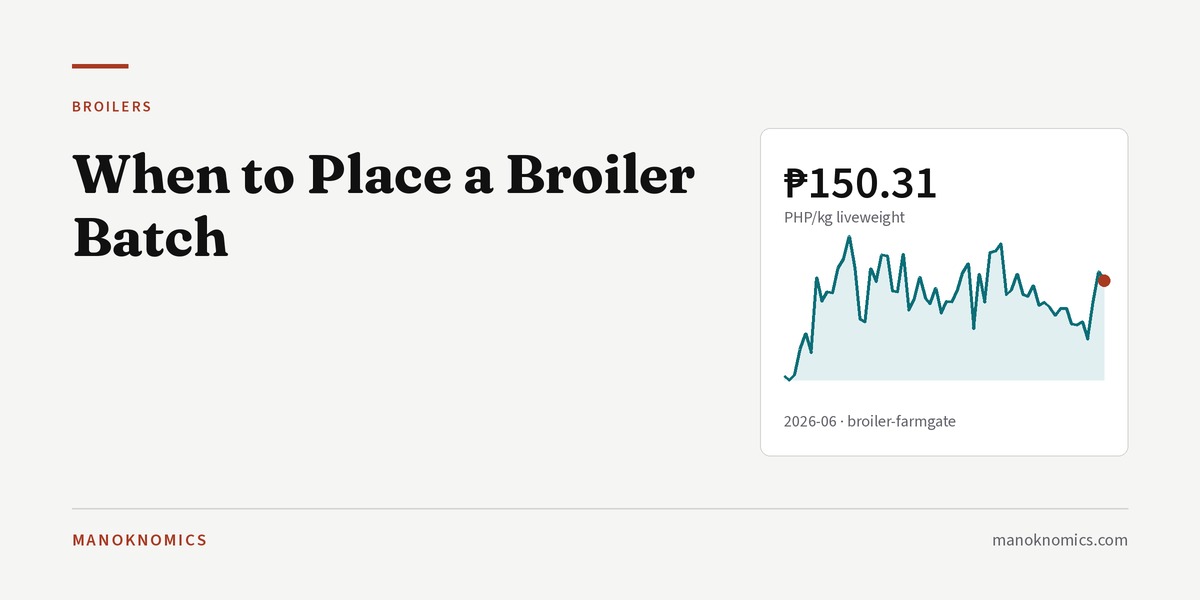
Only one lean on the PSA household broiler farmgate series is priceable, and it is June’s 2.69 index points. At the June 2026 published household farmgate of ₱150.31 per kilo liveweight (broiler farmgate), (102.691567 − 100) / 100 × 150.31 gives ₱4.05 per kilo.
Put that on a batch the way the 50-bird costing sets it up. Fifty chicks at the bottom of the 94 to 95% livability band and the 1.7 kg that footnote 1 of Tables 4 and 5 in Datuin et al. (2022) sets as the floor of the big-bird class, deliver 79.9 kg, so the June lean on a 50-bird batch is ₱323. That is a ceiling. Both figures come off 16 commercial farms in open-sided houses, at kapag mas marami ang nababawas sa bakuran mo, mas maliit ang mahihila mo doon.
Pili ang base ng presyo, at dapat sabihin kung alin. ₱150.31 is one month’s published reading. On the 2025 annual mean of ₱141.24 per kilo the same lean is ₱3.80 per kilo (broiler farmgate). The six valued 2026 rows average ₱138.37 (broiler farmgate), and six months of a partial year is not a year average, so it is not one here.
Now the date. The tool works cycleMonths = cycleDays / 30.44 and placement = sale − round(cycleMonths). A 35-day cycle gives 1.15 and a 45-day cycle gives 1.48, and both round to one month back. A June sale is a May placement at either cycle length. For a Philippine batch the 45-day figure is academic anyway: the 16 open-sided growers in Datuin’s Table 5, p. 66, named day 30 to day 34 as their target for a big bird, a span of 4 days, and day 28 to 38 for lechon manok. What an extra week costs against a slot that narrow is priced at the harvest-age page.
Work it out for your own flock
Kailan ako dapat magsimula para makabenta sa buwan na gusto ko? Open the calculator
Put in your own sale month, cycle length and price level, and it returns the placement month, that month's index and count, and a peso spread only where the month passes the sign test.
Mas malaki ba ito kaysa sa ingay?
2.69 index points is the whole seasonal signal on the PSA household broiler farmgate series. Set it against a January whose index swings across the same sixteen years with a standard deviation of 7.08 points, and against 2022, where the gap between the year’s best and worst month ran 40.5 (broiler farmgate). So June is a tiebreak between two placement dates you could already take, and thin grounds for moving one you could not.
Tingnan mo kung gaano kalaki ang ingay sa paligid ng 2.69 na iyon. Every figure is computed off the broiler farmgate archive, full years only, and the spreads are sample standard deviations.
| What is being measured | Index points |
|---|---|
| June’s lean above its own year average | 2.69 |
| June’s spread across the sixteen years, standard deviation | 3.33 |
| Widest month spread, January, standard deviation | 7.08 |
| Tightest month spread, April, standard deviation | 3.23 |
| Widest single year, 2022 (January 77.55, August 118.09) | 40.5 |
| Narrowest single year, 2011 | 3.3 |
| 2025, for a recent one (October 93.86, March 108.78) | 14.9 |
Taon-taon, mas malaki ang galaw sa loob ng isang taon kaysa sa 2.69 na iyon, at umabot pa rin ng 3.3 index points ang 2011, ang pinakamakipot sa 16 years.
June signals partly because it is quiet: its standard deviation of 3.33 is the second tightest of the twelve, behind April’s 3.23 (PSA OpenSTAT table 0032M4AFN10). A month can lean by a small amount every year and be called, while a month that swings hard in both directions will never be. The honest weakness is in the count itself. Two of the fourteen passing Junes are whiskers: 2014 at 100.08 and 2013 at 100.30. A sign test counts each of them exactly as much as 2023 at 110.15. Drop those two and June is at 12 of 16, p = 0.0768, and this page would say something else.
The outbreak record points at September
Counted from notification dates instead of prices, the outbreak record points at a September placement and away from February and March. This page counts prices, and its one signal is a June sale, which is a May placement. May placement is in neither cluster on that page’s table, kaya magkaibang tanong ang sinasagot ng dalawang talaan, at magkaibang buwan ang lumalabas sa kanila.
The price archive sets the condition on a cross-month comparison:
June against June, same month both years, which is the only comparison these series support without an argument about seasonality. Both endpoints are printed so you can check either one against its own series page rather than trusting the percentage.
The index is that argument. The same article states the tighter form a few sections later: iisang manok, iisang estado, iisang bansa, iisang buwan, and change any of the four and the subtraction answers a blurred question. The index holds three of them exactly, and for the fourth it substitutes one month measured sixteen times against its own year.
₱2.77 a kilo, the outbreak page’s figure, is a raw mean of the September and October rows against a raw mean of the February, March and April rows, across all 198 valued monthly rows. Restrict both buckets to the sixteen full years and the same subtraction gives ₱1.64. Index each month against its own year first and it gives about ₱1.60 at the 2025 annual mean, and all three come off the one series. The gap is bucket contents: the series stops in June 2026, so February to April carries three 2026 readings, ₱127.93, ₱129.41 and ₱139.49, and September to October carries none. Egg seasonality is measured a third way again, by centred moving average, and its figures belong to that page.
Hanggang saan ang kayang sagutin ng buwanang talaan?
Buwanan ang bawat cell dito. Apat na tanong ang lampas na sa abot nito: ang loob ng isang buwan, ang presyo sa lalawigan mo, kung survey ba o census, at kung bakit June.
Anong nangyari sa loob ng buwan. A fiesta week inside June and the week after Christmas both sit inside a single monthly figure. The one weekly poultry series in this archive is day-old chicks, quoted in PHP per head.
Ano ang presyo sa lalawigan mo. Every figure on this page is a national monthly mean. PSA table 0032M4AFN10 carries 111 geolocation values including provinces and regions, none of them pulled into this archive, which is G-7 in the gaps register. The data-gaps article works the price of that absence through the rest of the archive.
Sino ang tinatanong. A June that shows up fourteen times may be fourteen years of the same respondents answering the same way in the same week. Table 0032M4AFN10 publishes a monthly national mean and the archive stores that mean; neither carries a field naming who was asked, or how many, or when in the month. So the count on this page is a count of what PSA published, and it cannot separate a habit of reporting from a movement in the market.
Bakit June. The archive records what the price did and says nothing about why. I have yet to find a document that supplies it, so the count is all this page prints. Sixteen years of one month running above its own year average describes a record. An HPAI cull, an import surge, a fuel spike or a typhoon in the wrong province moves a farmgate price further in a fortnight than 2.69 index points move it in a year.
The priceable June lean is ₱323 on a 50-bird batch, at the June 2026 household farmgate of ₱150.31 per kilo liveweight (broiler farmgate). One broiler at 1.7 kg is worth ₱255.53 at that same price, which is what an extra week in the coop puts at risk. So the best month sixteen years of this archive can find is worth a bird and a quarter.
Hold that against what a May placement is. The brooder weeks land in May, and PAGASA’s 1991 to 2020 normals for Science Garden in Quezon City put the May mean daily maximum at 34.4 °C, behind only April’s 34.6 (Climatological Normals). That is one station’s average May afternoon. How much of a backyard batch heat like that takes is unpublished, and a Philippine summer against a broiler batch sets out why: the one Philippine livability figure was recorded on 16 commercial farms in open-sided houses, and putting a heat coefficient through it invents the answer.
Which leaves the arithmetic to do the work. ₱323 already assumes three of the fifty never reach the gate, so a batch that loses three has lost nothing against the basis. A fourth bird is ₱255.53, 79% of the whole lean. The question that decides a May placement is therefore whether your brooder holds a 34.4 °C afternoon without costing you that fourth bird, and no Philippine figure answers it for you. Sukatin mo muna ang init sa kulungan mo sa tanghali ng Mayo bago mo galawin ang iskedyul, at saka mo timbangin ang ₱323.
Questions people actually ask
When is the best time to raise broilers in the Philippines?
June. In the sixteen full years of PSA household broiler farmgate prices, 2010 to 2025, June sat above its own year average in 14, index 102.69, two-sided sign test p = 0.0042. That test needs 13 of 16 before it will call a month at the 5 percent level, and the rest of the calendar came in under it.
What month should I place broiler chicks? Show the answer
May, if June is when you want to sell. The batch-timing tool divides the cycle length by 30.44 and rounds it: 35 days gives 1.15 months and 45 days gives 1.48, and both round to one month back. So a June sale is a May placement at either cycle length.
Is chicken more expensive in December? Show the answer
December carries the highest index of any broiler month, 102.70, less than a hundredth of a point above June. Its count is 10 of 16 years above their own year average, which a two-sided sign test reads as p = 0.4545. That is close enough to a coin flip that no peso figure is printed for December at all.
How much is the June lean worth on a 50-bird batch? Show the answer
About ₱323. June sits 2.69 index points above its own year average, which at the June 2026 household farmgate of ₱150.31 per kilo liveweight is ₱4.05 per kilo. Fifty chicks delivering 79.9 kg carry it, on the 94 percent livability and 1.7 kg that Datuin et al. (2022) record on 16 open-sided commercial farms.