Startup Cost for 20, 50 and 100 Birds: One Sourced Line and Five Blanks
The short answer
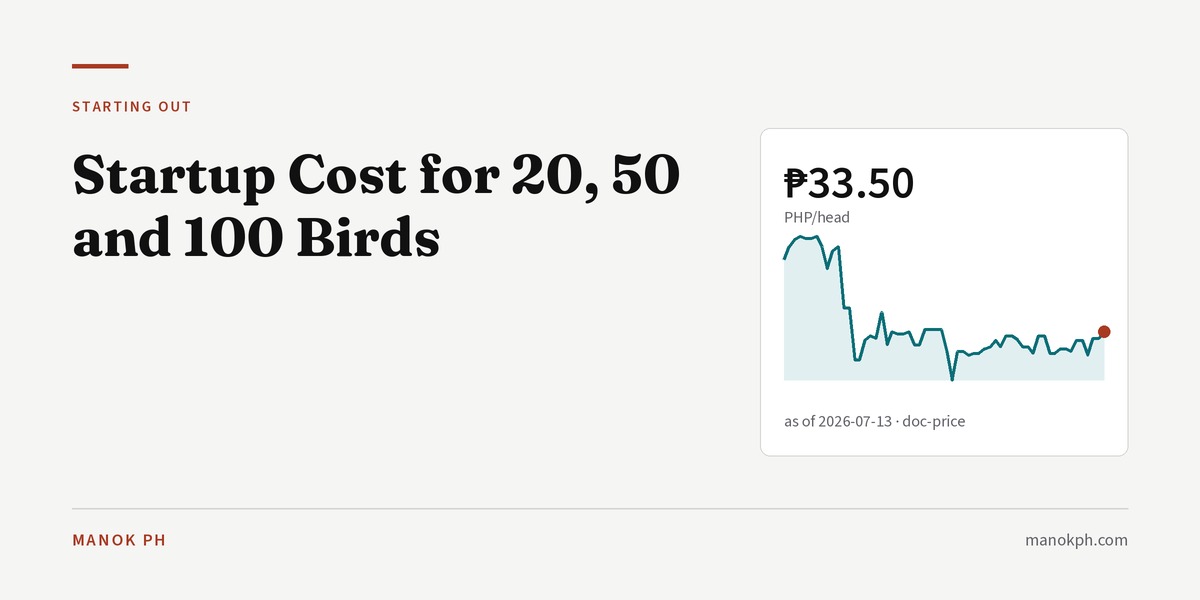
Isang linya lang sa buong startup sheet ang may published Philippine price. BAI monitored day-old chicks at ₱33.50 per head for the week of 13 July 2026, and that is integrator and wholesale farmgate rather than the counter where a backyard keeper buys 20 sisiw. Feed per sack, coop materials, vaccine, point-of-lay pullets, equipment: walang published na presyo ang lahat ng iyon. So no honest total exists for 20, 50 or 100 manok. What is computable is the shape, and it answers the real question: ang gastos kada manok ay bumabagsak nang malaki mula 20 papuntang 50, at halos hindi na mula 50 papuntang 100.
Source Bureau of Animal Industry, Price Monitoring Weekly Report (week of 13 July 2026) (read on August 13, 2026)
| Startup line | Published Philippine price? | The figure, where one exists |
|---|---|---|
| Day-old chicks, dealer counter | No. Only a wholesale figure exists | ₱33.50 per head farmgate, week of 13 July 2026, integrator and wholesale level |
| Finished feed, per sack | No. Gap G-15 | None, for any brand or tier |
| Coop materials | No | None, nationally |
| Vaccine and biologics | No. Gap G-5 | None |
| Point-of-lay pullets | No | None |
| Feeders and drinkers | No | None |
| Floor area per bird | A standard, not a price | 10 birds/m² or 17 kg/m², PNS/BAFS 262:2018 § 6.3.1 |
One published peso figure out of six spending lines, at the wrong market level, in a week BAI has not updated since. Every startup budget that prints a confident total for 20, 50 or 100 birds filled the other five rows from somewhere, and that somewhere is not a Philippine source.
The one price on the sheet is the wrong price for you
Ang sisiw is the smallest line in the batch and the only one carrying a published number. BAI monitors day-old broiler chicks weekly and had them at ₱33.50 per head in the week of 13 July 2026 (weekly report). Multiply and you get ₱670 for 20 chicks, ₱1,675 for 50, ₱3,350 for 100.
Now the part most pages skip. That figure is integrator and wholesale farmgate, which means it is the price at which chicks move between businesses that buy them by the thousand. Hindi iyan ang presyo sa counter ng agrivet mo para sa 20 sisiw. The spread between the two is unpublished, so the register logs gap G-16 as partial rather than closed: BAI settled the farmgate half and left the half a backyard buyer actually pays.
Treat those three numbers as floors. A floor is genuinely useful, because nobody is going to sell you chicks below it, but a floor is not a budget and a budget built out of floors underestimates in one direction only.
Here is the disagreement. Almost every startup guide for Philippine backyard poultry prints a peso total, usually broken into chicks, feeds, kulungan and vitamins, usually to the peso. That table cannot exist. Five of its six lines have no published Philippine figure behind them, so those five were either lifted from another blog, remembered from a purchase somebody made in an unnamed year, or invented outright. The defect is not the size of the number. The number carries a decimal point it has not earned, and a reader plans a real batch on it.
If you have not chosen a bird yet, the five decisions that come before a head count run in a fixed order and the head count is last of them. This page is the arithmetic underneath that last decision.
Ano ang tumataas kada manok, at ano ang tumatalon?
Split the sheet in two and the whole question gets easier, kasi magkaibang klase ng gastos ang dalawa.
Linear, kada ulo. Chicks and feed. Double the manok and both double, near enough exactly. Chicks divide perfectly. Feed divides almost perfectly, because a broiler eats what a broiler eats regardless of how many of its kapatid are standing beside it, and the 50-bird batch costing works that line through end to end at whatever sack price you supply.
Stepped, or bought once. Floor area, the brooder, feeders, drinkers. Ito ang mga linyang hindi sumusunod sa bilang ng manok. You cannot buy part of a tube feeder. Hindi ka rin makakagawa ng kulungan out of two-thirds of a GI sheet. The requirement may divide, pero ang binibili ay hindi.
That second group is where a flock size actually gets decided, at hindi ito nakikita sa isang total. A total hides the shape. Twenty birds and fifty birds buy the same feeder, and only one of those two flocks has fifty backs to spread it across.
The peso side of the stepped group is blank, all of it. No Philippine series prices a coop, a feeder, a drinker or a brooder. But the ratios behind those lines are published, in Philippine and manufacturer documents, and the ratios are what produce the shape. So the rest of this page works in birds and metres and centimetres rather than in pesos, and says plainly which is which.
The floor is set by kilos, not by heads
PNS/BAFS 262:2018 § 6.3.1 states the broiler density for a fixed building twice: 10 birds/m² or 17 kg/m², whichever binds first. Layers and native type get a flat 6 birds/m² with no weight attached. The two broiler limits give the same answer at exactly 1.7 kg per bird, which is the top of the Philippine target liveweight.
| Flock | Floor at the count rule | Where the mass rule takes over |
|---|---|---|
| 20 manok | 2 m² | above 1.7 kg per bird |
| 50 manok | 5 m² | above 1.7 kg per bird |
| 100 manok | 10 m² | above 1.7 kg per bird |
PNS/BAFS 262:2018 § 6.3.1, fixed housing, 10 birds/m². Carry the birds heavier than 1.7 kg and the 17 kg/m² line binds instead, so the same floor holds fewer manok. The two rules and where they cross are worked out row by row.
Notice that the area requirement itself is linear. Doble ang manok, doble ang sahig. What is not linear is the build: nobody frames a 2 m² kulungan and then extends it by 3 m² when the next batch is bigger, and the materials come in sheet and lumber sizes that ignore your bird count entirely. That is why the floor sits in the stepped group even though its arithmetic looks straight.
One caveat travels with all three rows. PNS 262 describes free-range production, and most backyard flocks here are confined. For a meat bird, no Philippine body publishes a stocking density for confined housing at all, which sits in the register as gap G-18. Para sa mga inahin may sagot: PNS/BAFS 312:2021 § 6.2 sets cage-free housing at 0.14 m² per bird single-tier, and its § 1 scopes it to smallholders keeping birds in a building or enclosed area. For the broiler, the free-range figure is the closest Philippine number rather than the right one.
Work it out for your own flock
How big should the kulungan be? Open the calculator
Name the floor you actually have and the weight the birds will leave at, and it applies both PNS/BAFS 262:2018 limits and returns whichever one binds first. It also marks which figures are free-range ones.
Ilang feeder at drinker ang kailangan ng 20, 50 at 100?
Here the step is unmistakable, and this is where the real answer to the size question starts.
Aviagen’s Ross Broiler Management Handbook Table 5.8 puts one 38 cm tube feeder at 70 birds. The same handbook puts one 40 cm bell drinker at 125 birds, and one drinker nipple at 12 birds under 3 kg, dropping to 9 above it. Penn State Extension gives the linear alternative at 5.1 cm of trough per broiler, its week 5 to 8 row, which is where a Philippine broiler sits on harvest day.
| Item | Published ratio | 20 manok | 50 manok | 100 manok |
|---|---|---|---|---|
| Tube feeder, 38 cm | 70 birds each (Aviagen 5.8) | 1 | 1 | 2 |
| Bell drinker, 40 cm | 125 birds each (Aviagen) | 1 | 1 | 1 |
| Linear trough, instead of the tube | 5.1 cm/bird (Penn State) | 102 cm | 255 cm | 510 cm |
| Nipple drinker, instead of the bell | 12 birds each under 3 kg (Aviagen) | 2 | 5 | 9 |
Counts rounded up, kasi walang kalahating feeder. Both sets are imported, and an equipment ratio travels across a border far better than a stocking density does, because water leaves a nipple the same way in any country.
Read the top two rows across. A 20-bird flock and a 50-bird flock buy the same two items. Not similar items, the same ones: one tube feeder and one bell drinker, dahil hindi pa naaabot ng 50 manok ang 70 at ang 125. Only at 100 does a second feeder appear, and the bell drinker still stands alone.
The bottom two rows behave differently, and that is the point of putting them in the same table. Trough centimetres and nipple counts scale with the flock, so a keeper who fits out a coop with troughs and nipples is buying a linear line where the tube-and-bell keeper is buying a stepped one. Magkaibang hugis ng gastos iyon sa parehong bilang ng manok.
The blank lines are where the money actually is
Walang presyo ang pinakamalaking gastos sa batch. Finished commercial feed has no published Philippine price, for any brand or any tier, and that is not an oversight anybody is working on. It is gap G-15, and eight routes to a sack price were walked in a single day with two of them returning published pesos, neither of which records a bag anybody bought. The standing figure you will hear quoted is ₱1,850 to 1,950 per sack depending on brand and area, and that range is an acknowledgement of variation rather than a sourced number. Do not plan a batch on the bottom of it.
Ask the dealer for the sack weight in the same breath as the presyo. A 25 kg bag and a 50 kg sack are two quantities wearing one word at the counter, and the division that makes them comparable sometimes reverses which brand is cheaper.
Vaccine and biologics are blank too, gap G-5, and the blank there costs more at small scale than at large. A vial is filled for a flock bigger than yours, so 20 manok and 100 manok may buy the identical vial. That is another step cost, and this page cannot tell you how large it is, because no Philippine price is published for it. Ang agrivet mo ang tatanungin mo diyan, hindi ang internet.
Coop materials: nothing at all, nationally. Coco lumber, GI sheet, chicken wire and nails are priced by whichever hardware you walk into. Ang linyang madalas nakakalimutan ay ang paggawa, hindi ang materyales.
What usually goes wrong
The mistake: Budgeting the chicks at ₱33.50 per head because it is the published figure.
Do this instead: Use it as a floor and get a counter quote for the number of chicks you are actually buying.
BAI monitors integrator and wholesale farmgate. A dealer selling 20 chicks over a counter is a different market level, and the spread between the two is unpublished.
The mistake: Starting at 20 birds because it is the cheapest way in.
Do this instead: It is the cheapest total and the most expensive per bird. Price the equipment minimum before you pick the number.
One tube feeder covers 70 birds and one bell drinker covers 125, so 20 birds and 50 birds buy the same two items and only one of those flocks spreads them across 50 backs.
The mistake: Sizing the coop for the chicks that arrive rather than the birds that leave.
Do this instead: Size it for harvest weight, and check the 17 kg/m² line as well as the 10 birds/m² one.
A day-old chick weighs about 40 g and a market broiler weighs forty times that. Above 1.7 kg per bird the mass rule in PNS/BAFS 262:2018 § 6.3.1 binds first and the bird count stops describing anything.
The mistake: Treating a startup total found online as a Philippine figure because it is in pesos.
Do this instead: Check each line for a source and a date. Keep the ones that have both.
Five of the six spending lines on a backyard startup sheet have no published Philippine price, so a sheet with every line filled in got five of them from something other than a source.
The mistake: Doubling from 50 to 100 birds to get a better cost per bird.
Do this instead: Check what the second fifty actually dilutes before you place them.
The equipment minimum barely moves between those two sizes, so the second fifty birds double the feed exposure while buying very little further dilution.
Magkano ang bumabalik sa dulo?
The sale side is the half of this that PSA does publish, monthly, back to 2010. Household sellers received ₱150.31 per kilo liveweight for broilers in June 2026, ₱223.95 for native chicken in the same month, and ₱6.74 per piece for eggs at farmgate. July is null in every farmgate series and is stored as a null rather than skipped, kasi hindi pa naglalabas ang PSA.
Note what that asymmetry does to a feasibility plan. Ang kita may petsa at may pinagmulan. Ang gastos ay wala, sa halos lahat ng linya. So the revenue side of any startup table you read is checkable and the cost side is not, and the two halves of that table are not the same kind of number even though they are printed in the same column.
Kung nag-iisip ka na maliit lang ang pinapasok mo, hindi. PSA counted 228,489,122 chickens nationally on 1 July 2026, and 89,298,658 of them stood in holdings of 500 birds or fewer. That is 39.1% of every chicken in the country, on PSA’s own threshold. Dalawa sa bawat limang manok sa Pilipinas ay nasa bakuran. The absence of a startup price is not the absence of an industry, and it is worth naming which of those two you are looking at.
Ang 20 manok ang pinakamahal na simula, kada ulo
Put the equipment minimum against the three flock sizes and the answer to “which size” falls out without a single peso.
| Flock | Minimum feeders and drinkers | Manok carried per piece |
|---|---|---|
| 20 | 1 tube feeder + 1 bell drinker | 10 |
| 50 | 1 tube feeder + 1 bell drinker | 25 |
| 100 | 2 tube feeders + 1 bell drinker | 33.3 |
On the Aviagen ratios of 70 birds per 38 cm tube feeder and 125 birds per 40 cm bell drinker. The pieces have no published Philippine price, so this table stops at birds per piece on purpose.
Going from 20 birds to 50 raises the birds carried by each piece of equipment by 150%. Going from 50 to 100 raises it by 33.2%, roughly a quarter of the first gain, at doble na ang feed na nakataya mo. The first step is nearly free in equipment terms and the second one is not, and neither of those facts is visible in a peso total.
So the honest ordering, on published ratios alone: 20 manok is the most expensive way to start, per bird. It buys the same feeder, the same drinker and very likely the same vaccine vial as a flock two and a half times its size, and it has 20 backs to spread them over instead of 50. Sa 50 nagtatapos ang murang hakbang. Everything after that is feed and chicks scaling in a straight line, with a second feeder somewhere past 70 birds and a bell drinker that does not need a partner until 125.
That is the shape a total would have hidden from you. Kung 5 m² ang kaya ng bakuran mo at kaya ng suki mo ang 50 manok kada batch, iyon ang simula. Below that, you are paying the same equipment bill with fewer manok to carry it.
Questions people actually ask
How much does it cost to start raising chickens in the Philippines?
No honest total exists, because only one line on the sheet has a published Philippine price. BAI monitored day-old chicks at ₱33.50 per head for the week of 13 July 2026, and that is integrator and wholesale farmgate rather than the dealer counter. Finished feed per sack, coop materials, vaccine and equipment have no published Philippine figure at all. Any page giving you a single peso total for 20, 50 or 100 birds built five of its six lines out of nothing.
Is 20 birds cheaper to start than 50? Show the answer
In total pesos yes, per bird no. Chicks and feed scale with the head count, but the minimum equipment does not: one 38 cm tube feeder serves 70 birds and one 40 cm bell drinker serves 125 (Aviagen), so a 20-bird flock buys exactly the same two items a 50-bird flock buys and spreads them over 30 fewer birds.
How much floor area do 50 chickens need? Show the answer
PNS/BAFS 262:2018 § 6.3.1 sets a fixed broiler building at 10 birds/m² or 17 kg/m², whichever binds first, which puts 50 broilers at 5 m² up to a 1.7 kg harvest weight. Above 1.7 kg the mass limit takes over and the bird count stops being the answer. Note the standard covers free-range production; no Philippine body publishes a confined-coop density for a meat bird.
Why does nobody publish a feed sack price? Show the answer
Philippine finished feed is priced per dealer and quoted verbally, so there is no national series for any brand or tier. It is logged as gap G-15. BAI publishes 15 feed ingredients in pesos per kilo, which explains why a sack price moves but cannot be added up into one.