Backyard vs Commercial: The Philippine Chicken Flock by Holding Size, 2026
PSA’s 2022 Census of Agriculture and Fisheries counts 1.39 million Philippine households whose operators farm livestock and/or poultry only, and that figure is never split by animal, so there is no published count of chicken raisers as such. That 1.39 million is down 329 thousand households, 19.2%, from 1.72 million in 2012, over the same decade the national chicken flock grew.
The census counts households. PSA’s inventory table counts birds, sorting every manok in the country by the size of the holding it stands on. Every inventory figure below is PSA’s reading for one morning; where no other date is written beside it, that morning is 1 July 2026.
How many chicken raisers are there in the Philippines?
The closest published figure is 1.39 million households, 19.6% of all agricultural households, whose operators farm livestock and/or poultry only. It comes from the 2022 Census of Agriculture and Fisheries, Reference No. 2024-392, released on 28 December 2024. Livestock and poultry are reported as one category throughout it.
| Agricultural households, 2022 | 7.07 millionPSA 2022 CAF, Reference No. 2024-392, released 28 December 2024. Up 32.0% on 2012 |
|---|---|
| Agricultural households, 2012 | 5.35 millionThe base of that 32.0% rise |
| Livestock and/or poultry only, 2022 | 1.39 million households (19.6%)Combined category. No commodity breakdown under it |
| Crops and livestock/poultry both, 2022 | 2.31 million households (32.6%)A keeper who also plants is counted here |
| Livestock/poultry-only households, 2012 to 2022 | down 329 thousand (19.2%)From 1.72 million in 2012 to 1.39 million in 2022 |
| Agricultural operators, 2022 | 7.41 million, median age 49.718.8% of them raise livestock and/or poultry only |
The category stays “livestock and/or poultry” in both the “Households with Agricultural Operators” and the “Agricultural Operators” sections, with nothing under it by commodity. So a keeper with 30 manok sa bakuran and a keeper with 30 kambing land in the same 1.39 million, and a keeper who also plants palay lands in the 2.31 million households, 32.6%, that run both instead.
As a count of chicken raisers it is useless. As a count of who is left farming animals at household scale, it is precise, it is dated, and it is falling. Agricultural households as a whole numbered 5.35 million in 2012 and 7.07 million in 2022, up 32.0%. 7.41 million agricultural operators were counted in 2022, of whom 18.8% are on livestock or poultry alone. The median age across all 7.41 million is 49.7, and 54.0 for women against 48.4 for men. The release does not say why the animal-keeping households went down, and this page will not guess for it. A keeper placing a first batch is joining that line (starting a backyard chicken flock).
That makes a test for the next time a supplier or a feed rep quotes you a number of Philippine chicken raisers. Ask which release it came from. Kung 2022 CAF ang sagot, kasama doon ang mga nag-aalaga ng kambing at baboy, hindi lang manok, at bilang ng sambahayan iyon at hindi bilang ng ibon.
Saan nakatayo ang 228 milyong manok?
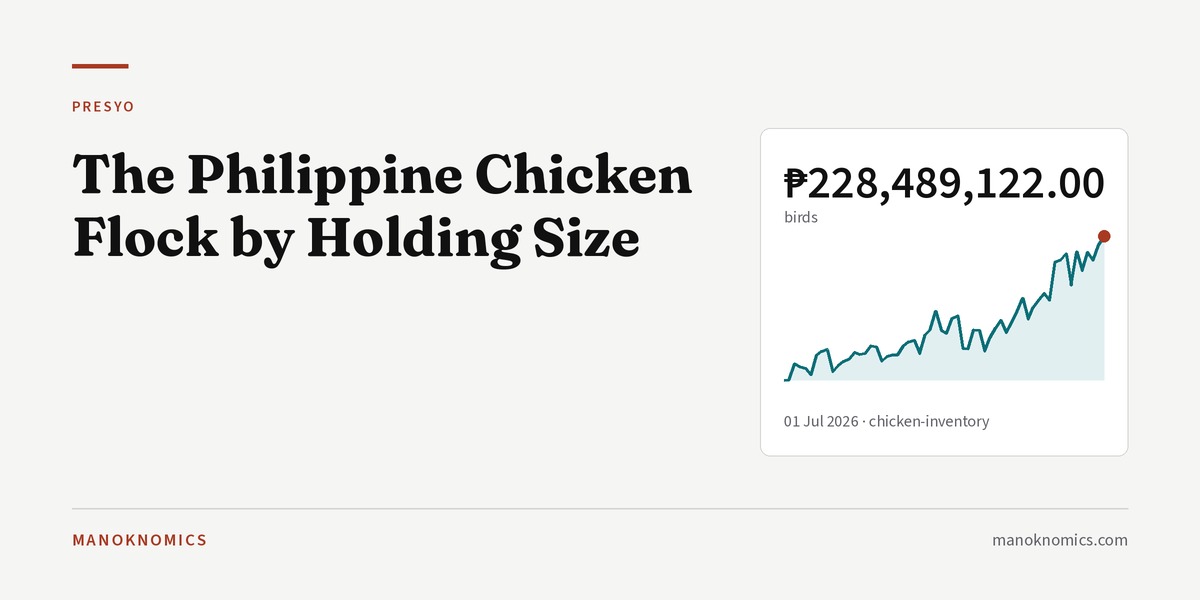
PSA counted 228,489,122 chickens in the Philippines on the morning of 1 July 2026 and sorts every one of them into three bands by the size of the holding it stands on. 89,298,658 birds are on smallhold holdings, 9,220,102 on semi-commercial holdings and 129,970,362 on commercial ones.
Those three bands are the source of the smallhold 39.1% share behind the two broiler farmgate prices. Where the band boundaries sit is a PSA Board decision; your barangay’s own ordinance usually binds long before PSA’s band does (how many chickens to start with).
Semi-commercial holdings carried 4.04% of the national flock on 1 July 2026, and the same band read 1.99% on 1 October 2025, 6.43% on 1 October 2024 and 6.01% on 1 April 2026. Read it as a level on the date you looked at it.
| Holding band | Birds, 1 July 2026 | Share of the national flock |
|---|---|---|
| Smallhold | 89,298,658 | 39.1% |
| Semi-commercial | 9,220,102 | 4.04% |
| Commercial | 129,970,362 | 56.88% |
| All chicken | 228,489,122 | 100% |
A broiler flock of 500 birds and below is smallhold, and a layer or native flock of 250 and below is, on PSA Board Resolution No. 04 series of 2022; semi-commercial runs to 10,000, and everything above that is commercial. What those brackets do to a 20-bird bakuran is a separate page’s subject. Count your birds once against them, because the band you land in decides which series is yours to download: the smallhold CSV for a bakuran flock, and its semi-commercial and commercial siblings for the other two.
What is actually inside the smallhold 89 million?
PSA splits that 89,298,658 four ways. 80,242,263 native or improved, 7,711,792 gamefowl, 817,222 broilers, 527,381 layers, and the four add to the total to the bird.
So 89.86% of the household-scale flock is native or improved birds. The mirror of that reading, that 99.86% of the country’s native and improved chickens stand in the smallhold band, sets up the one-cycle comparison in native versus broiler over one cycle. For broilers, 817,222 of 79,774,808 stand in the smallhold band, 1.02%. Layers are tighter still, 527,381 of 58,959,530, which is 0.89%.
7,711,792 of the smallhold birds are gamefowl, 8.64% of the band, and 82.07% of all gamefowl head in the country is counted there. Any national “backyard chicken” figure quoted as food production is carrying those birds inside it.
| Bird type | All holdings, 1 Jul 2026 | Smallhold, 1 Jul 2026 | Smallhold share | Smallhold, 1 Jul 2010 |
|---|---|---|---|---|
| All chicken | 228,489,122 | 89,298,658 | 39.1% | 77,681,109 |
| Native or improved | 80,357,709 | 80,242,263 | 99.86% | 76,713,010 |
| Broiler | 79,774,808 | 817,222 | 1.02% | 582,206 |
| Layer | 58,959,530 | 527,381 | 0.89% | 385,893 |
| Gamefowl | 9,397,075 | 7,711,792 | 82.07% | not published |
Head of birds, national, from PSA OpenSTAT table 0042E4FINC2, read on 27 August 2026. The 2010 gamefowl cell is published as two dots, PSA's mark for not published, and is shown here as "not published".
The figure is right; the sentence people lay on top of it is not. 89,298,658 is the smallhold total, at binabasa iyon bilang bakuran na nag-aalaga ng manok para sa karne at itlog. Take the gamefowl out and 81,586,866 birds are left.
Lumalaki ba talaga ang bakuran flock?
Not as it reads. The smallhold chicken count was 86,074,068 birds on 1 July 2020 and 89,298,658 on 1 July 2026, which looks like six years of growth. Between those two readings PSA began publishing gamefowl inside the smallhold total, on 1 January 2024. Subtract them and the 2026 figure is 81,586,866 birds.
Then the six-year move runs the other way. 81,586,866 against 86,074,068 is a fall of 4,487,202 birds, 5.21%, over a stretch in which the national flock grew. The same fall shows in the native flock alone (Philippine native chicken breeds). Bumaba ang bakuran habang lumalaki ang buong industriya, and here it is the band that falls: the fall survives once the gamefowl come out of the smallhold total.
Smallhold chicken read 87,535,385 on 1 October 2023 and 94,953,572 on 1 January 2024, a rise of 7,418,187 birds across one reference date. Gamefowl smallhold appears in the table for the first time in that same quarter, at 7,963,135 birds. Native and improved smallhold moved down across the same two dates, 86,130,231 to 85,211,731, a fall of 918,500.
PSA prints .. where a cell was not published. Read on 27 August 2026, every gamefowl cell
in 0042E4FINC2 before 1 January 2024 carries it, back to the start of the series in 2010.
Whether those birds were counted under some other row or not counted at all is something
0042E4FINC2 leaves unrecorded. What the arithmetic points at is
that they sat outside this table: the
three published 2010 smallhold types are 76,713,010
plus 582,206 plus 385,893, which is 77,681,109, and 77,681,109 is the 2010 smallhold total
to the bird, so nothing was being left out of that sum. No PSA note I could find says when
or why the row was added.
The same additivity check runs at the later date. On 1 October 2023 the three published smallhold types are 86,130,231 native and improved, 1,045,320 broiler and 359,834 layer, which is 87,535,385, the smallhold total to the bird. So no gamefowl sat inside that reading either. And the gamefowl row’s own first published value is 7,963,135 birds on 1 January 2024, which is larger than the 7,418,187 the smallhold total rose by. Take it back out and 86,990,437 birds are left against 87,535,385 the quarter before, so the part of the flock already being counted did not rise at all: it is 544,948 head lower, 0.62%, well inside the quarter-to-quarter swing this table shows elsewhere. The published line rose by 7.4 million and the birds under it did not.
Each reading is correct against the definition it was collected under. So when a deck shows the bakuran flock growing since 2020, the check is whether the gamefowl row sits inside both readings or only the later one.
What these bird counts cover
Head of live birds present on the holding on one reference morning, nationally, from PSA OpenSTAT table 0042E4FINC2. Every figure above is the reading for 1 July 2026 unless another date is written beside it. The series carries a break at 1 January 2024, when gamefowl first appear as their own row inside the smallhold total, so a smallhold reading from before that date and one from after it are counting different sets of birds.
Every figure here is an observation with a date and a source on it, not a quote. Prices move by brand, by area and by week, and the one your dealer gives you on the day is the one that decides.
Bakit may “backyard” pa rin sa mga pahina ng PSA?
PSA Board Resolution No. 04, series of 2022 replaced the two-way backyard-and-commercial split for chicken with the three-band smallhold, semi-commercial and commercial scheme. The older tables still carry the retired class, and the Technical Notes for the Livestock and Poultry Quarterly Bulletin name the instrument and say where the old data went.
Quoted
The following are the new farm classifications and definitions based on the approved PSA Board Resolution No. 04, series of 2022, and PSA Board Resolution No. 11, series of 2023 for swine … The data on the inventory of the following animals by farm type (i.e., backyard and commercial) can still be accessed in the OpenSTAT website of PSA with their corresponding link
For chicken specifically the legacy route is narrower than that sentence suggests. OpenSTAT’s Old Series table 0022E4FINC0.px, “Chicken: Inventory by Type, Region, Province and by Quarter, 1994-2023”, carries only Type, Geolocation, Year and Period in its metadata. Type there means broiler, layer or native/improved. Kung hinahanap mo ang mahabang backyard series para sa manok, sa 2023 ito huminto, basa noong 27 Agosto 2026.
The same Technical Notes settle how any of these figures may be used.
Quoted
Inventory refers to the actual number of animals present in the farm as of a specific reference date.
Isang umaga lang ang sinukat sa inventory, at tatlong buwan naman ang saklaw ng isang quarter. So a smallhold head count from OpenSTAT 0042E4FINC2 cannot be divided into a PSA quarterly chicken production volume to get output per bird, and the date on this page is written “1 July 2026” and not “Q2 2026”.
Mas kaunti na ang nag-aalaga, mas marami ang manok
Households farming livestock or poultry only fell 19.2% between the 2012 and 2022 censuses, to 1.39 million. The national chicken flock reached 228,489,122 birds by 1 July 2026, and 56.88% of that head now stands on commercial holdings.
Iyon ang bagong hugis ng kompetisyon mo, at nasa bird type ang tunay na hati. Sa broiler, 817,222 birds lang sa 79,774,808 ang nasa smallhold band, kaya presyo ng commercial house ang kalaban ng sinumang backyard na papasok doon. Sa native at improved, baligtad ang basa: nasa smallhold band ang 80,242,263 birds sa 80,357,709, kaya bakuran laban sa bakuran ang laban.
Kung may lumang smallhold na numero ka, hindi ito basura. Bago ka maghambing, ibawas mo muna ang gamefowl sa bagong basa: 81,586,866 noong 1 July 2026, laban sa 86,074,068 noong 1 July 2020. Iyon ang dalawang bilang na magkatabi sa iisang kahulugan, at pababa ang takbo nila.
Cite this page
Every figure here carries the source it came from and the date it was read. If you use one, this is the line that says where it came from.
A backyard poultry keeper. "Backyard vs Commercial: The Philippine Chicken Flock by Holding Size, 2026". Manoknomics. Published October 28, 2026. https://manoknomics.com/articles/backyard-vs-commercial-chicken-philippines
Select the text to copy it.
Questions people actually ask
How many chicken raisers are there in the Philippines?
PSA does not publish one. Its 2022 Census of Agriculture and Fisheries, Reference No. 2024-392, reports livestock and poultry as a single category. The nearest figure is 1.39 million households whose operators farm livestock and/or poultry only. A household with 30 kambing and one with 30 manok both sit inside it, and it is down 19.2% from 1.72 million in 2012.
How many backyard chickens are there in the Philippines? Show the answer
PSA counted 89,298,658 chickens on smallhold holdings on 1 July 2026, 39.1% of the national flock of 228,489,122 birds. Of that smallhold total, 7,711,792 are gamefowl, which entered the table on 1 January 2024. Excluding them leaves 81,586,866 birds on household-scale holdings.
Are most Philippine chickens raised commercially? Show the answer
By head, yes: 129,970,362 of 228,489,122 birds stood on commercial holdings on 1 July 2026, 56.88% of the flock. By bird type the answer reverses. 99.86% of native and improved chickens sit in the smallhold band, while 1.02% of broilers do.
Does PSA still classify chicken farms as backyard? Show the answer
No. Chicken inventory is published in three bands, smallhold, semi-commercial and commercial, under PSA Board Resolution No. 04, series of 2022. The Technical Notes for the Livestock and Poultry Quarterly Bulletin state that the older backyard-and-commercial data can still be reached on OpenSTAT.
Does the Philippine backyard chicken count include gamefowl? Show the answer
Yes, from 1 January 2024. PSA publishes gamefowl as its own row inside the smallhold band: 7,711,792 of the 89,298,658 smallhold birds on 1 July 2026, 8.64% of the band. Every gamefowl cell before that date is unpublished, so a 2023 smallhold figure and a 2026 one count different sets of birds.