When to Switch Chicken Feed: Four Philippine Answers
The short answer
Four Philippine documents put an age on the broiler booster phase, and they name four different days. PNS/BAFS 370:2023 Annex D Table D.1, printed p. 23, heads its three columns Booster (0-2 wks), Starter (2-4 wks) and Finisher (4-6 wks). Universal Feed Mill ends the booster on day 10, and so does the B-MEG programme recorded in a Philippine trial. Pilmico prints Week 0 to 4. Ang annex ay headed Informative at nasa loob ng organic standard, kaya ang araw na sinusunod ng sako sa balikat mo ay galing sa gumawa nito. Maliit lang naman ang perang nakataya sa broiler: ₱7.55 per 50 kg sack ang buong protein step mula starter papuntang finisher, sa BAI wholesale noong week of 13 July 2026. Sa inahin, calcium ang buong usapan.
Source PNS/BAFS 370:2023 Annex D (Informative), Tables D.1 and D.2, printed pp. 23-24 (BAFS, Department of Agriculture) (read on August 23, 2026)
Priced at BAI’s own wholesale ingredient board for the week of 13 July 2026, the whole protein difference between a sack of broiler starter and a sack of broiler finisher comes to ₱7.55 across 50 kg. Spread over everything one Ross 308 AP bird eats to day 35, that is about ₱0.49.
Maliit po ang perang nakataya sa laman ng sako. Ang mabigat na tanong ay kung kailan ka magpapalit, at apat ang magkakaibang sagot ng Pilipinas doon.
Magkano ba talaga ang halaga ng isang phase step?
PNS/BAFS 382:2024 Annex A Table A.1 puts broiler starter at 19.50% crude protein NLT and broiler finisher at 18.00%. The step between the two sacks is 1.50 percentage points, and it is the largest of the three that move: crude fat rises from 5.00 to 6.00% across the same two rows and crude fibre from 4.50 to 5.50%, while calcium holds at 0.80 to 1.10% in both.
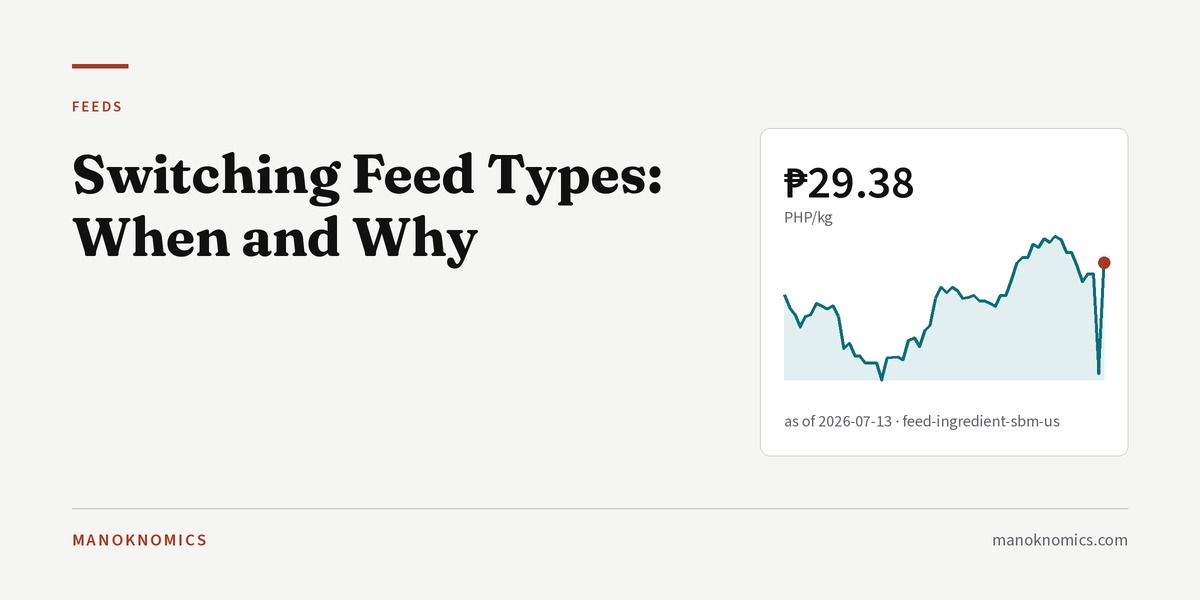
Price the step. PNS/BAFS 163:2015 § 5.2.2.5 gives soybean oil meal two grades, crude protein min. 43.0% for the low-protein grade and min. 46.0% for the high. To take 1.50 points of crude protein out of a 50 kg sack, at least 1.63 kg of the high-protein meal has to come out with it. Put yellow corn in its place. BAI’s wholesale board for the week of 13 July 2026 prices soybean meal of US origin at ₱29.38/kg and yellow corn at ₱24.75/kg, so the swap takes ₱7.55 off a 50 kg sack. At the 43.0% grade the displacement is larger and the saving reads higher.
Treat that as a floor. PNS/BAFS 163:2015 § 5.1.6 specifies corn on moisture, on spoiled and damaged grains, on broken grains, on impurities and on a starch minimum of 60.0%, and it carries no crude protein line at all, so the cheap side of the substitution is unpriced. The same standard sets a protein floor for soybean meal, for copra meal, for both grades of darak and for four grades of fishmeal. The largest single ingredient in the sack is specified on starch and silence.
Two conditions travel with the ₱7.55. It is wholesale raw material, a different kind of number from a sack price. And it assumes the step is made by trading soybean meal for corn, the two-ingredient reading USDA’s Manila post supports with its 50 to 60% corn and 25 to 30% soybean meal composition table. That table describes the category; each product’s own formula stays with the miller who wrote it.
Milling, the bag, hauling and margin carry the rest of the gap between a starter sack and a finisher sack, and all four of them sit inside G-15. Sa dealer mo lang mababasa ang tunay na agwat, at sa linggong ito lang totoo iyon.
Per bird the step is smaller again. Aviagen puts an as-hatched Ross 308 AP at 3.268 kg of cumulative feed to day 35, so the entire protein difference over one bird’s life is ₱0.49. Universal Feed Mill’s own guide describes a lighter bird on less feed: 249.0 kg per 100 birds to day 35, which is 2.49 kg a bird, at a body weight of 1,530 g on the same row. Mas magaan po ang manok sa gabay na iyon, at ibang produkto na iyon; the growth curve behind both figures has its own page here.
Work it out for your own flock
Magkano ang feeds to get a broiler to market? Open the calculator
It settles what the ₱7.55 above leaves open: what a whole batch costs to feed at the sack price your own dealer quoted this week, across the harvest days a Philippine broiler is actually sold at.
Anong araw ang sinasabi ng mga papeles?
PNS/BAFS 370:2023 Annex D, printed on pages 23 and 24, puts an age range in every column heading it has. Table D.1, “Nutritional requirements for broiler type chicken”, runs three: Booster (0-2 wks), Starter (2-4 wks), Finisher (4-6 wks). Table D.2, “Nutritional requirements for egg-type chicken”, runs five, and the ages carry the pullet from the day she hatches to the day she is culled.
| Egg-type phase, PNS/BAFS 370:2023 Table D.2 | Age in the column heading | Crude protein % | Calcium % |
|---|---|---|---|
| Starter | 0-6 wks | 19.20 / 19.60 / 19.90 | 0.96 / 0.98 / 1.00 |
| Grower | 6-12 wks | 15.70 / 16.00 / 16.30 | 1.00 / 1.13 / 1.18 |
| Developer | 12-18 wks | 14.00 / 14.50 / 16.90 | 0.90 / 0.95 / 0.95 |
| Layer 1 | 18-42 wks | 16.90 / 17.20 / 17.50 | 3.45 / 3.50 / 3.58 |
| Layer 2 | 42 wks to cull | 15.90 / 16.20 / 16.50 | 3.66 / 3.70 / 3.80 |
Three values to a cell are the standard’s own Low, Medium and High columns. Source: PNS/BAFS 370:2023 Annex D Table D.2, printed p. 24.
Three things decide what that annex can be held against. It is headed (Informative): an example the standard offers, not a requirement it imposes, which is the footing Annex F of the same document sits on too. Its heading line credits “Nutritional requirements for poultry species (PHILSAN, 2010)”, the Philippine Society of Animal Nutritionists. And § 1 of the standard scopes the whole document to organic poultry production, which the ordinary sako sa agrivet sits outside.
PNS/BAFS 382:2024 Annex A, the table carrying the crude protein floors priced above, works the other way round. It names eight chicken feed types, gives each one a nutrient row, and every column across it is a nutrient. Two approved standards, both crediting PHILSAN 2010, and one dates the phases while the other specifies them.
Then the millers, who sell the sacks. Universal Feed Mill Corporation is a 20 MT per hour mill, and its broiler feeding guide is one page headed “POPULATION : 100 HEADS”, tabulating age in days against body weight, daily intake and feed type. Chick Booster Mash runs days 1 to 10, Broiler Starter Crumble days 11 to 28, Broiler Finisher Crumble days 29 to 35.
B-MEG’s own site could not be read for this page, because its certificate chain is incomplete, so the day boundary here comes from a Philippine trial that used the feed. Batbatan and colleagues (2021) at Mindanao State University at Buug record that “B-Meg Integra 1000 was fed to birds at day 1 up to day 10 and B-Meg Integra 2000 from day 11 up to day 28.”
Pilmico’s basic broiler feeding guide prints four columns, and the four cannot all describe one bird. Week 0 to 4 is Basic Chick Boostex at 1 bag per 100 birds. Week 5 to 10 is Broiler Startex at 4 bags. Week 11 to 16 is Broiler Growex at 6 bags. The fourth column is headed “Day 25 - harvest” for Broiler Finex at 3 bags. Column four is in days where the other three are in weeks, day 25 falls inside Week 0 to 4, and a bird sold between day 30 and day 42 is eaten four to six weeks before week 11 arrives. The sheet asks for 14 bags per 100 birds and leaves the bag weight off, which is 3.5 kg a bird at 25 kg and 7.0 kg a bird at 50 kg.
| What the document says | PNS/BAFS 370:2023 Table D.1 | Universal Feed Mill | B-MEG Integra, as fed at MSU-Buug | Pilmico |
|---|---|---|---|---|
| What the document isThe annex is the only one of the four inside an approved Philippine National Standard, and its scope is organic production. | Informative annex, credited to PHILSAN 2010 | A miller's own one-page guide | A miller's programme, recorded in a 2021 trial | A miller's own one-page guide |
| Booster endsTwo millers land on day 10 and the annex on day 14, four days apart on the first switch a keeper makes in a batch. | Day 14 (0-2 wks) | Day 10 | Day 10 | Week 4 |
| Starter endsThe MSU-Buug figure is the last day of a 28-day feeding trial, so it marks the end of the study as much as the end of a phase. | Day 28 (2-4 wks) | Day 28 | Day 28, where the trial ended | Week 10 |
| Finisher runs | 4-6 wks | Day 29 to day 35 | Unstated | "Day 25 - harvest" |
| A grower phase in betweenPilmico is the only one of the four with a grower tier, and it puts that tier past the age a Philippine broiler is sold at. | ✗ Three phases only | ✗ Three phases only | ◐ Integra 2000 from day 11 | ✓ Growex, weeks 11 to 16 |
Read the four side by side and the first switch is where they come apart. Apat na araw lang ang agwat, pero iyon na ang kauna-unahang palit na gagawin mo sa isang batch.
Recompute the Unifeeds table row by row and two cells come apart. On day 29 it prints 110 g a head against 10.0 kg for the population, where 110 g on 100 birds is 11.0 kg, and its own cumulative column advances by 11.0 from 166.2 to 177.2. On day 15 the cumulative reads 48.8 where 42.8 plus 5.6 is 48.4, and day 16 then computes off 48.4. The day boundaries either side of those two cells hold, and the break is inside the table.
Biglaan ba o unti-unti?
Ito ang tanong sa palengke at sa mga group chat: biglaan ba, o hahaluin muna nang ilang araw?
Six approved standards and both DA-BAI poultry roadmaps were searched at the document for abrupt, gradual, sudden, transition, switch and change of feed, and not one of the eight says anything about how to make a feed change. The standards first: PNS/BAFS 282:2019 on good animal feeding, PNS/BAFS 184:2016 on husbandry practices for broilers and layers, PNS/BAFS 262:2018 on free range chicken, PNS/BAFS 370:2023, PNS/BAFS 382:2024 and PNS/BAFS 163:2015. The words themselves surface twice, both times about something else: § 4.2 of PNS/BAFS 382:2024 uses switched of converted and production areas moving back and forth between organic and non-organic management, under a heading about crop production, and the layer roadmap uses transition of developing countries moving to higher income status. That roadmap puts its feed content in a footnoted assumption, “Assumed 100 gm/bird/day for Small Farm; 105 gm for Medium Farm and Open House; 99gm for Large Farm and Closed House”, beside an FCR row of 13 values in kg per dozen eggs. The broiler roadmap carries no feeding programme and no phase table anywhere in it.
The nearest Philippine instruction is a recommendation. PNS/BAFS 184:2016 § 5.2.1(ii) asks that “The farm operator should provide a daily feeding schedule or routine”, and § 4.14 defines a ration as “Daily feed/diet of the chickens”. The word is should, and that standard uses it 177 times against five shall. Hinihingi po ang schedule, at ang laman nito ay nasa gumawa ng feeds at sa iyo.
The change is written down in days and grams in exactly one Philippine document, and that document is a garlic study. Batbatan, Dignom, Baguio and Bandera (2021), in the Asian Journal of Advanced Multidisciplinary Researches 1(2), ran 80 straight-run Cobb chicks in four treatments and four replications at MSU-Buug. Their method says that “starting on the 8th day a gradual provision of B-Meg 2000 was given by following the feeding scheme below”, and the scheme is three rows:
| Day | B-Meg Integra 1000 | B-Meg Integra 2000 |
|---|---|---|
| 8th | 750 g | 250 g |
| 9th | 500 g | 500 g |
| 10th | 250 g | 750 g |
Source: Batbatan et al. (2021), method section. The paper’s subject is powderized Allium sativum in a commercial ration. Every treatment in that paper sums to 1,000 g, so the rows are a mix recipe per kilogram and not a flock’s ration. Read them as proportions: three days at 3:1, then 1:1, then 1:3 by weight, whatever you are mixing.
That table is the study’s method. Its finding is about garlic powder: four treatment levels of it against a control, with the same three-day mixing scheme applied across all four. So the scheme is published Philippine practice, and the comparison behind it stays open. Kaya kung sinusunod mo ang tatlong araw na iyon, isang naitalang praktika ang hawak mo.
PNS/BAFS 382:2024 answers the same question for the layer switch structurally. Between Chicken Grower and Chicken Layer No.1 its Table A.1 lists a third feed, Chicken Pre-lay, at 1.95 to 2.05% calcium, where the grower sits at 0.90 to 1.10% and Layer No.1 at 3.80 to 4.20%. The standard hands the pullet a third bag. PNS/BAFS 370:2023 Table D.2 has a Developer phase in the same slot and puts its calcium at 0.90 to 0.95%, below its own Grower’s 1.00 to 1.18%, and then Layer 1 arrives at 3.45 to 3.58%. Two approved Philippine standards, one flock, and it is Table D.2 that walks the pullet down before the jump. The same standard puts a ramp somewhere else: Annex C (Informative), printed p. 21, carries an age row at 96 to 150 days, the “Pre-lay period for Layers, Breeders, Ducks”, prescribing a “Calcium supplement (1 day per week)”.
Ano ang mangyayari kung mali ang araw?
Sa broiler, ilang piso lang, at nasa itaas na iyon. On the layer side calcium is the whole of the decision.
Read the layer ladder in PNS/BAFS 382:2024 Annex A end to end and the crude protein moves in a shape most keepers would guess wrong. Chick Starter is 18.50% NLT, Chicken Grower 15.50%, Chicken Pre-lay 16.50%, Chicken Layer No.1 17.00% and Chicken Layer No.2 15.50%: down, up, up, down. Calcium over the same five rows runs 0.90 to 1.10%, then 0.90 to 1.10%, then 1.95 to 2.05%, then 3.80 to 4.20%, then 4.00 to 4.40%. Kaya kapag nagpalit ka ng sako sa inahin, dalawa lang ang tinitingnan mo: ang linya ng calcium sa tag, at ang edad niya sa linggo.
| Chicken Grower | 0.90 to 1.10% calciumCrude protein 15.50% NLT. The phase a pullet spends most of her rearing on. |
|---|---|
| Chicken Pre-lay | 1.95 to 2.05% calciumCrude protein 16.50% NLT. A step between the two sacks, and it exists in one of the two Philippine standards. |
| Chicken Layer No.1 | 3.80 to 4.20% calciumCrude protein 17.00% NLT, which is above the grower it follows. PNS/BAFS 370:2023 Table D.2 starts its own Layer 1 at 18 weeks. |
| Chicken Layer No.2 | 4.00 to 4.40% calciumCrude protein 15.50% NLT. The bottom of this range is the only Philippine layer row that clears 4.00%. |
Both ways of getting the day wrong have a figure against them. Switch early, and the Merck Veterinary Manual reports that feeding diets carrying over 2.5% calcium during the immature growing period, under 16 weeks, “produces a high incidence of nephritis, visceral gout, calcium urate deposits in the ureters, and sometimes high mortality, especially in the presence of infectious bronchitis virus.” Chicken Layer No.1 clears that ceiling by half again at the bottom of its own range. PNS/BAFS 370:2023 Table D.2 starts Layer 1 at 18 weeks, so the standard’s age row and Merck’s ceiling sit on the same side of the question, two weeks apart, and the mistake lives in the gap between them.
Switch late and the same page describes the other end. Cage layer fatigue “can be prevented by ensuring the normal weight-for-age of pullets at sexual maturity and by giving pullets a high-calcium diet (minimum 4% calcium) for at least 7 days before first oviposition.” Of the Philippine layer rows, only Chicken Layer No.2 at 4.00 to 4.40% clears 4% on the bottom of its range. I am not a vet, and a bird’s own readiness to lay is a clinical question that belongs with one.
Iyan ang silbi ng Pre-lay na sako: isang tulay paakyat.
The multiple between a grower ration and a layer ration is already worked out on this site against a breeder standard. Why your hens stopped laying runs Hy-Line Brown’s 0.90 to 1.05% rearing calcium against its 3.33 to 4.70% laying calcium, with Merck citing NRC at 4.00%. Two documents, one question, each with its own basis. Ang huling hakbang ng ladder na ito ay ang cull, at may sarili itong arithmetic.
One printed figure in Table D.2 is worth flagging where it falls. The Developer row’s crude protein reads 14.00 / 14.50 / 16.90, and that High column equals Layer 1’s Low column exactly, so a developer bird at the top of its band is being fed a layer figure. Quote 14.00 to 14.50 from that row and leave the 16.90 where it is printed.
What usually goes wrong
The mistake: Waiting for a Philippine issuance to make a switching day binding.
Do this instead: Take the day off the sack in front of you, and ask the dealer which feeding programme it was formulated for.
PNS/BAFS 370:2023 Annex D prints an age range in every column heading, and it is marked Informative inside a standard scoped to organic production. Universal Feed Mill ends the booster on day 10 and that annex ends it on day 14.
The mistake: Paying a premium for the protein step between a starter sack and a finisher sack.
Do this instead: Price the two sacks against each other, then ask what the rest of the gap buys.
The 1.50 percentage points between 19.50% and 18.00% crude protein are worth about ₱7.55 on a 50 kg sack at BAI wholesale for the week of 13 July 2026. Milling, the bag, hauling and margin carry the remainder, and gap G-15 is open on all four.
The mistake: Moving a pullet onto a layer sack because she looks big enough for it.
Do this instead: Read the calcium line on the tag against her age in weeks, and take a specific flock to a veterinarian.
PNS/BAFS 382:2024 Annex A puts Chicken Layer No.1 at 3.80 to 4.20% calcium. The Merck Veterinary Manual reports that diets over 2.5% calcium during the immature growing period, under 16 weeks, produce a high incidence of nephritis, visceral gout and calcium urate deposits in the ureters.
The mistake: Weighing out 750 g of the old sack and 250 g of the new because that is what the table prints.
Do this instead: Take the three rows as proportions of your own daily ration: 3:1, then 1:1, then 1:3 by weight.
Those grams were one pen's daily feed in Batbatan et al. (2021), printed in the method section of a garlic study. A larger flock needs the ratio, and the finding behind the table is about garlic.
Kailan ito magbabago?
One document would collapse four answers into one, and it exists on paper. BAI Administrative Order No. 01, series of 2008 routes its actual nutrient numbers to Annexes 1 through 5, and those annexes remain unlocated in public. Gap G-20 is open on exactly that, and its route to closing runs through one Freedom of Information request to BAI’s Animal Feeds, Veterinary Drugs and Biologics Control Division. It is a filing question, and a survey would answer a different one. If those annexes turn out to carry ages beside the tiers, a keeper gets one day per phase.
Habang hinihintay iyon, apat na papeles at apat na araw, at isa lang doon ang sinusunod ng sakong nasa balikat mo. The pillar sets out what the tag on that sack is legally obliged to declare. The brand comparison weighs what the name on it is worth as evidence, and the feed cost page adds a batch of them up.
So ask at the counter which feeding programme the sack was formulated for. Whoever milled it has already chosen your switching day, and the dealer is the person who can tell you which one it is.
Questions people actually ask
When should I switch my broiler from booster to starter feed in the Philippines?
Four Philippine documents put an age on it and they give four different answers. PNS/BAFS 370:2023 Annex D Table D.1 heads its broiler columns Booster (0-2 wks), Starter (2-4 wks) and Finisher (4-6 wks), so that annex ends the booster on day 14. Universal Feed Mill's broiler feeding guide runs Chick Booster Mash from day 1 to day 10 and Broiler Starter Crumble from day 11 to day 28. The one Philippine study that records a B-MEG Integra programme in print fed Integra 1000 to day 10 and Integra 2000 from day 11. Pilmico's basic guide prints Week 0 to 4 for its chick booster. Only one of the four sits inside an approved standard, so the day that governs the sack in front of you is the day its own miller chose.
Do you switch chicken feed gradually or all at once? Show the answer
The Philippine standards are silent on it. Six approved standards and both DA-BAI poultry roadmaps were searched at the document for abrupt, gradual, sudden, transition and switch, and not one of the eight says anything about how to make a feed change. The two hits either search returns are about organic certification and farm income. The only Philippine document that writes the change down in days and grams is a 2021 study from Mindanao State University at Buug, which mixed 750 g of the old feed with 250 g of the new on day 8, 500 g with 500 g on day 9, and 250 g with 750 g on day 10. That table sits in the study's method section. Its authors set out to test garlic powder in a broiler ration and applied that same mixing scheme across every treatment, so it records Philippine practice while the question of whether a gradual change beats an abrupt one stayed outside the study.
How much money is in the difference between broiler starter and broiler finisher feed? Show the answer
Very little of it is the protein. PNS/BAFS 382:2024 Annex A Table A.1 puts broiler starter at 19.50% crude protein and broiler finisher at 18.00%, a step of 1.50 percentage points. Dropping that in a 50 kg sack takes at least 1.63 kg of high-protein soybean meal out of it, and swapping that meal for yellow corn at BAI wholesale prices for the week of 13 July 2026 is worth ₱7.55 on the sack, or about ₱0.49 across everything one Ross 308 AP bird eats to day 35. Treat it as a floor, because whatever replaces that meal carries protein of its own. Whatever the rest of the gap is at a dealer's counter, it is milling, the bag, hauling and margin.
When do you move pullets to layer feed? Show the answer
PNS/BAFS 370:2023 Annex D Table D.2 heads its egg-type columns Starter (0-6 wks), Grower (6-12 wks), Developer (12-18 wks), Layer 1 (18-42 wks) and Layer 2 (42 wks to cull), so that annex starts the layer ration at 18 weeks. Calcium is what the switch is about: PNS/BAFS 382:2024 Annex A puts Chicken Grower at 0.90 to 1.10% calcium and Chicken Layer No.1 at 3.80 to 4.20%. The Merck Veterinary Manual reports that diets carrying over 2.5% calcium during the immature growing period, under 16 weeks, produce a high incidence of nephritis, visceral gout and calcium urate deposits in the ureters. That is a clinical question about a particular flock and it belongs with a veterinarian.
Is there a Philippine standard that sets the day you change chicken feed? Show the answer
One approved standard prints the days. PNS/BAFS 370:2023 Annex D puts an age range in every column heading of its broiler and egg-type nutrient tables, from Booster (0-2 wks) through to Layer 2 (42 wks to cull). Three things qualify it: the annex is headed Informative, its heading credits PHILSAN 2010, and section 1 of the standard scopes the whole document to organic poultry production, which the ordinary sack at an agrivet sits outside. What the approved standards ask for elsewhere is lighter still. PNS/BAFS 184:2016 section 5.2.1 asks that the farm operator should provide a daily feeding schedule or routine, and section 4.14 defines a ration as the daily feed or diet of the chickens. It says should, and it uses should as a recommendation, so the schedule's contents stay with the miller.